
Lieferung heute & morgen

Qualitätsgarantie

Willkommens-Angebote freischalten: KOSTENLOSE Lieferung | Bis zu 80 % RABATT | Kostenlose 30-Tage-JoyPlus-Testphase
App herunterladen
A food processor with chopper can chop vegetables, process herbs, crush nuts or knead dough. Depending on the design, the range extends from a compact mini chopper to a multifunctional food processor with slicing and grating discs. The key question is not how many functions are listed on the packaging, but whether the power, work bowl, accessories and cleaning requirements suit your household.
A high wattage rating alone says little about how practical a machine is for everyday use. You should also consider the permitted ingredients, maximum operating time and blade design. A small electric chopper with 500 watts may be suitable for onions, herbs and vegetables, while a larger appliance with several attachments is more likely to be designed for dough, slicing or larger quantities.
It is therefore important to check the specific details for the continuous operating time, breaks between processing cycles and recommended foods. Some models may only be operated for a few seconds at a time and then require a cooling-down period.
Manufacturers often distinguish between the container’s total volume and the quantity that can actually be processed. For example, the Kenwood MultiPro Go has a bowl volume of 1.3 litres, but the stated working capacity for both dry and liquid ingredients is 0.75 litres. The Philips Daily Collection HR7320/00 likewise specifies a container volume of 2.1 litres and a working capacity of 1.5 litres.
If you regularly cook for a family, compare the working capacity rather than just the number of litres printed on the product.
A meat mincer, vegetable cutter, dough tool and several discs can expand the range of functions. However, they also need storage space and must be cleaned after use. If you only chop onions occasionally, a large multifunctional food processor may be unnecessary. On the other hand, if you often grate vegetables, prepare dough or process ingredients in different sizes, several attachments can be worthwhile.
Before buying, check whether the tools you want are actually included. “Compatible with additional accessories” does not automatically mean that those accessories are included in the box.
For typical chopping tasks, 500 to 700 watts is often sufficient for compact appliances, provided the model is approved for the type of food you want to process. Larger food processors with kneading and slicing functions may offer higher power ratings. The Kenwood MultiPro OneTouch FDM73850SS is described as having a 1,000-watt motor, while the Severin KM 3892 has a power rating of 1,200 watts.
The manufacturer’s safety instructions remain decisive. Blades and grating discs are sharp and should only be fitted, removed or cleaned with the appliance unplugged. Hard ingredients such as bones, coffee beans or ice are not permitted in every model. Some appliances expressly specify restrictions for these ingredients.
Glass containers are resistant to odours and stains and allow you to monitor the chopping process. The Grundig CH 5320 Multi-Cutter, for example, has a 0.5-litre glass container. Plastic containers, by contrast, may be lighter and often more compact. A container of under one litre is sufficient for small portions; families and frequent users should calculate the working quantity more carefully.
Also bear in mind that containers and lids are not necessarily heat-resistant or suitable for microwave use. Hot ingredients should only be processed if the instructions explicitly permit this.
A dishwasher-safe food processor can reduce the effort required for cleaning. This usually only applies to removable parts such as the bowl, lid, blades or discs. The motor unit must not be immersed in water. Sharp blades must be removed carefully, even when the parts are dishwasher-safe.
For small kitchens, cable storage, appliance height and the option to store accessories in the container or in a bag are also important. A compact appliance kept ready to use in a drawer will often be used differently in everyday life from a heavy food processor that remains permanently on the worktop.
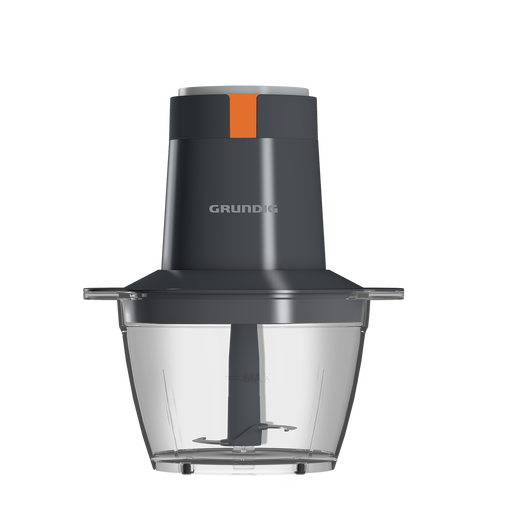
Why this product suits this profile: This compact onion chopper is designed for smaller portions and is suitable for fruit, vegetables and nuts. Two speed settings support coarse or finer chopping.
The specifications clearly state a 0.5-litre container volume, 500 watts and two speed settings. The glass bowl is also described as dishwasher-safe; check whether the lid is dishwasher-compatible before cleaning it.
Glass container, removable stainless-steel double blade, safety lock and non-slip base.
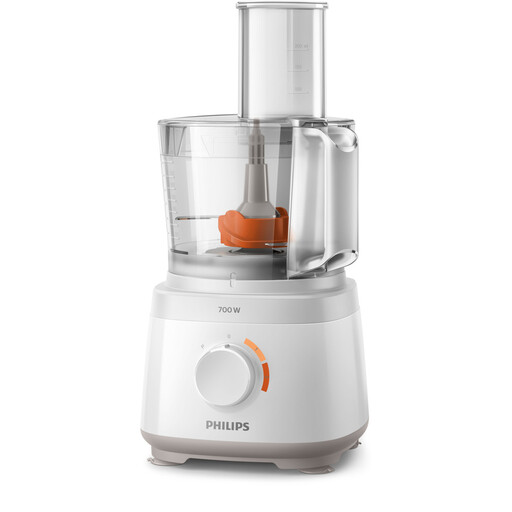
Why this product suits this profile: This model combines a 2.1-litre bowl with slicing, grating, kneading and chopping functions. It is aimed at households that regularly process a range of different ingredients.
The product specifications distinguish between a 2.1-litre container volume and a 1.5-litre working capacity. The available functions and included accessories are listed clearly.
700-watt motor, two speed settings plus pulse function, stainless-steel blade, slicing and grating discs, and dishwasher-safe removable parts.
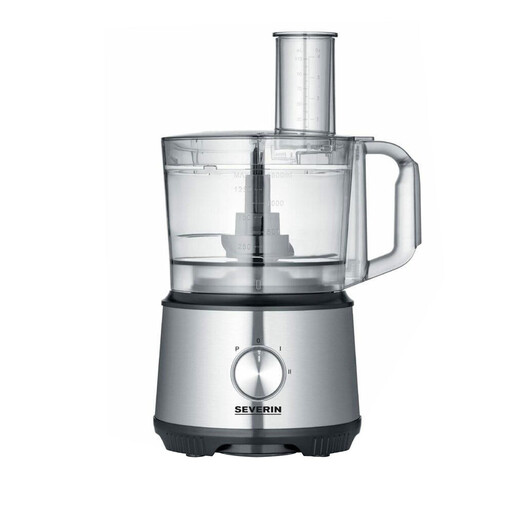
Why this product suits this profile: This appliance is designed for users who want to do more than chop, including kneading, grinding, grating, slicing, emulsifying and mixing.
The accessories are listed individually: grinding attachment, three disc inserts, dough tool, blade and emulsifying disc. This makes it easier to assess the actual range of functions before buying.
1.5-litre bowl, 1,200 watts and multiple functions for dough, herbs, spices, slicing and sauces.

Why this product suits this profile: This compact appliance combines chopping, slicing, grating, puréeing and kneading. The Express-Serve function processes ingredients directly onto a plate or into a pan.
The usable capacity is stated as 0.75 litres for both dry and liquid ingredients. Cable storage and drawer storage are also provided for.
650-watt motor, 1.3-litre bowl, pulse function, reversible 4 mm slicing and grating disc, and dishwasher-safe accessories.
We have put together a complete, regularly updated list of products that fully meet these strict selection criteria and the safety regulations applicable in the EU.
For onions, herbs and soft vegetables, compact appliances with around 300 to 500 watts may be sufficient. For dough, larger quantities or several accessory functions, consider the motor power, working capacity and operating time together. Wattage alone is not a reliable selection criterion.
This depends on the model and its instructions. Some food processors are described as suitable for raw meat or nuts, while others are intended only for soft to moderately hard ingredients. Bones, coffee beans, very hard spices and frozen foods must not be processed in many appliances.
Its lifespan depends on the workload, correct operating time, cleaning and storage. Overloading, unsuitable ingredients and failure to allow cooling breaks can place strain on the motor and blades. Always unplug the appliance before cleaning and handle blades only by the designated safe grip area.