Salsa for a group
If you want to make your planned recipe quantity with as few filling and emptying cycles as possible, check the working capacity in the instructions, not just the bowl capacity.


If you want to slice or grate vegetables as well as make salsa, a food processor is the better choice. If you mainly want to chop, a mini chopper may be enough. The key factor is the amount of wet ingredients the specific model is rated to process, not just the bowl capacity. A pulse or momentary function helps you work in stages, but it doesn’t guarantee a particular texture.
If you want to make your planned recipe quantity with as few filling and emptying cycles as possible, check the working capacity in the instructions, not just the bowl capacity.
If you want to stop chopping before the ingredients become too fine, look for a pulse or momentary function and check the operating instructions for the specific appliance.
If you want to slice or grate vegetables as well as make salsa, check what comes with the specific model and its dimensions before making space for the appliance and accessories.
A good fit if: You’re preparing several portions and also want to use the appliance for slicing or grating.
Bear in mind: A large stated bowl capacity doesn’t guarantee a particular working capacity for salsa. Extra accessories also take up space and need cleaning.
A good fit if: You regularly want to slice or grate as well as chop, and you’re looking for a compact appliance. Bosch lists a 2.3-l bowl for the MCM3531M; Kenwood lists a 1.3-l bowl for the FDP23.140RD.
Bear in mind: Check which accessories are actually included with the specific model variant. Bowl capacity doesn’t tell you how much wet salsa it can process.
A good fit if: You mainly want to chop vegetables and herbs, and don’t need slicing or grating discs. According to the manufacturer, the Rommelsbacher MZ 500 has a 1.5-l glass bowl.
Bear in mind: Rommelsbacher recommends pulses of 2–3 seconds or a maximum of 20 seconds of continuous operation for the MZ 500. These instructions don’t automatically apply to other appliances.
| Criteria | What to check before buying | Who it matters most to |
|---|---|---|
| Working capacity | Compare your recipe quantity with the fill markings and instructions for processing wet ingredients on the specific model. | If I’m making salsa for a group, I want to plan as few batches as possible. That’s why around 36% of consumers prioritise a suitable quantity per batch. |
| Texture | Check for a pulse or momentary function, the blade and the model-specific operating instructions. | If I want my salsa to stay chunky, I need to control the chopping process a step at a time. Around 29% of consumers pay particular attention to the texture they want. |
| Cleaning | Check the instructions for each removable part to see whether it’s dishwasher-safe. | If the bowl, lid and blade need cleaning after several batches, I want the process to be straightforward. Around 21% of consumers prioritise cleaning up after preparation. |
| Extra functions and storage space | Compare what’s included and the dimensions of the exact model variant with the tasks you regularly need it for. | If I want to slice or grate vegetables as well as make salsa, the accessories need to fit in my storage space. Around 14% of consumers prioritise extra functions when space is limited. |
A bowl’s stated capacity doesn’t prove that the same amount of wet salsa can be processed in one go. The actual working capacity can affect how many batches you need.
Compare your recipe quantity with the instructions for filling the specific model with wet ingredients.
If your recipe quantity exceeds the permitted fill level, you’ll need to allow for extra batches, with more filling and cleaning in between.
A review of choppers won’t necessarily tell you how chunky a particular appliance will make your salsa or how much of your recipe will fit inside.
Consider the functions you want, the working capacity and the operating instructions for your recipe when making your decision.
Slicing and grating discs, as well as cleaning guidance, apply to specific variants. You can’t assume they’ll be the same just because the model names are similar.
Check the full model number and the contents of the offer against the manufacturer’s information.
According to KitchenAid, the 5KFP1319EAC food processor comes with a 3.1-l bowl, a chopping blade and slicing and grating accessories.
Bosch lists a 2.3-l bowl, a momentary setting and various tools for the MultiTalent 3 MCM3531M.
The MZ 500 is a mini chopper with a 1.5-l glass bowl, which the manufacturer says is designed primarily for chopping.
According to Kenwood, the compact MultiPro Go FDP23.140RD combines a 1.3-l bowl with a chopping blade and included slicing and grating discs.
The following product options include mini choppers for chopping and food processors for making salsa and preparing other vegetables.
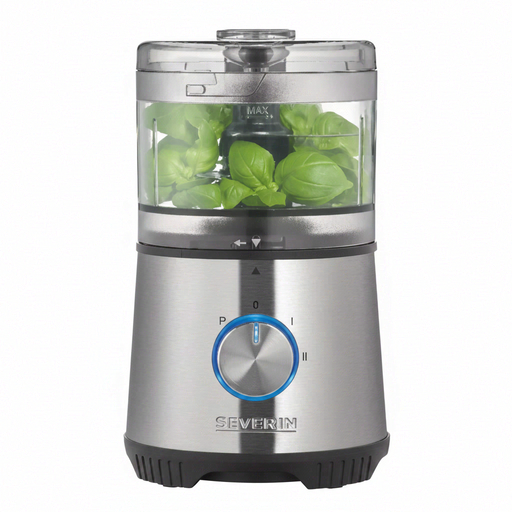 No image available
The product description lists a pulse function and a four-blade knife for chopping in stages.
Two speed settings; 400 W. Removable parts are described as dishwasher-safe.
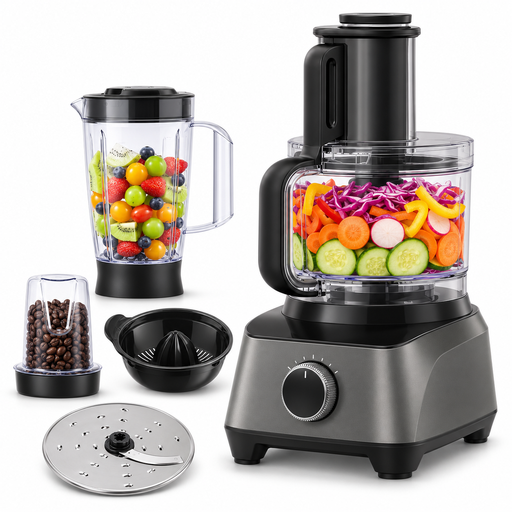 No image available
For salsa and other vegetable preparation, the listed features include a chopping blade, pulse function, and slicing and grating functions.
2.5-l bowl and 1.5-l container; three speeds; 1300 W. Dishwasher-safe components are listed.
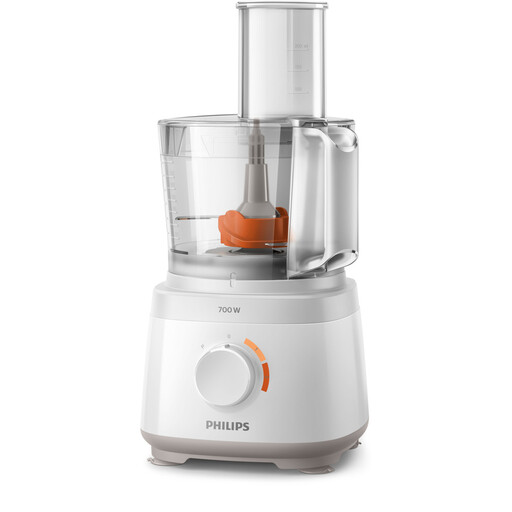 No image available
For chunky chopping and other vegetable preparation, the listed features include a chopping blade, a pulse function, and slicing and grating discs.
2.1-l bowl capacity and a stated working capacity of 1.5 l; 700 W. Removable parts are described as dishwasher-safe.
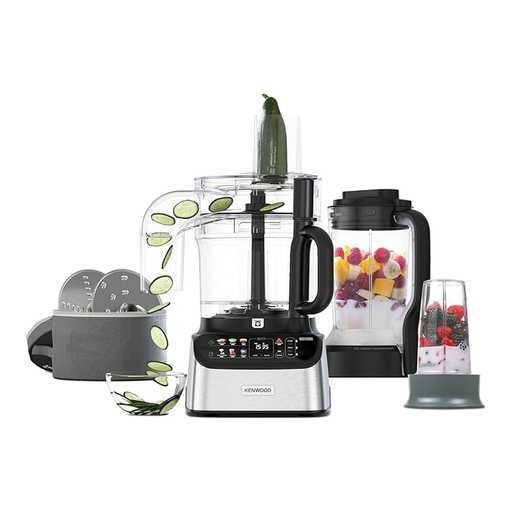 No image available
The product description lists chopping, slicing and grating functions for making salsa and preparing other vegetables.
3-l bowl; a chopping blade and slicing and grating discs are listed as accessories.
 No image available
For chopping vegetables, the description lists pulse control and three bowls that fit inside one another.
Bowl sizes of 2.5 l, 2.2 l and 1.8 l; 350 W; two speed settings. Operation is limited to up to 30 seconds per cycle.
No. For the KitchenAid 5KFP1319EAC, 3.1 l refers to the bowl capacity, not a confirmed working capacity for salsa. Follow the filling guidance for the specific model.
Rommelsbacher recommends pulses of 2–3 seconds or a maximum of 20 seconds of continuous operation for the MZ 500. Follow the instructions for the appliance you buy; this guidance doesn’t automatically apply to other models.
Keep salsa made with chopped vegetables in the fridge until you’re ready to eat it, in a sealed or fully covered container. The German Federal Institute for Risk Assessment recommends this approach for chopped vegetable salads; it doesn’t establish a general shelf life for every salsa recipe.
Parts intended to come into contact with food are covered by Regulation (EC) No 1935/2004 on food contact materials. CE marking is required only when applicable harmonised EU rules require it; it isn’t independent proof of chopping performance. Check the information and labelling for the specific offer.
No. Your statutory rights are claims against the seller if goods are faulty; a guarantee is an additional voluntary promise with its own terms. The consumer advice centre recommends keeping the two distinct.