
Lieferung heute & morgen

Qualitätsgarantie

Willkommens-Angebote freischalten: KOSTENLOSE Lieferung | Bis zu 80 % RABATT | Kostenlose 30-Tage-JoyPlus-Testphase
App herunterladen
The aroma of freshly baked bread, paper-thin slices of ham, or perfectly portioned cheese—a good food slicer brings professional precision and freshness into your home kitchen. But the path to finding the right appliance is often paved with disappointment. Many models that look promising online turn out to be a poor investment in daily use.
As your Joybuy Product Recommendation Officer, I'm here to filter out the crucial information from the marketing noise. Pay attention to these three common pitfalls to make an informed decision.
To avoid buyer's remorse, let verifiable facts—not advertising promises—guide your decision. The following three parameters are crucial for the performance and longevity of a bread slicer.
The most important characteristic of a reliable food slicer is its stability. A metal food slicer offers clear advantages here. A robust metal housing and a metal base plate ensure the appliance stands firmly on the worktop, even under load, without vibrating or flexing. This is the fundamental requirement for consistent and precise slices. Plastic models can warp over time, which impairs slicing accuracy and shortens the lifespan. A solid construction is therefore not a luxury, but a necessity for anyone who values lasting quality.
A powerful electric food slicer is essential for gliding effortlessly through a wide variety of foods. However, the wattage figure alone is only part of the equation. A well-engineered motor with a solid gear system provides constant torque, allowing the blade to maintain its speed even when met with resistance. A model with at least 150 watts of power is a good benchmark. This ensures that everything from soft white bread to rustic sourdough with a hard crust is cut cleanly without tearing.
The blade is the primary factor determining what a deli slicer is suitable for. There are two basic types:
Ensure the blades are made of stainless steel and are ideally easy to remove. This significantly simplifies cleaning and switching between blade types.
Finding an appliance that meets all the aforementioned quality criteria can be a challenge. We present a model that, thanks to its construction and features, is ideal for quality-conscious households that value durability and versatility.
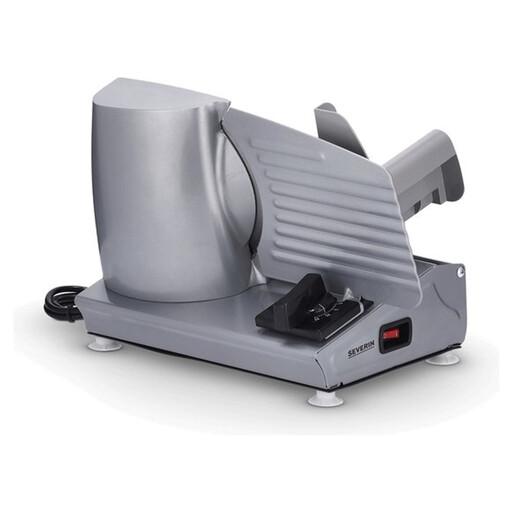
Why This Fits Their Persona: This model is aimed at users looking for a durable and versatile solution. The robust metal construction and 'Made in Germany' quality seal promise a long service life, while the two included blades (serrated and smooth ham blade) offer maximum flexibility for bread, meats, and cheese.
The stable metal design prevents instability. The 180-watt motor provides ample power reserves for demanding foods. The tilting carriage allows for easy blade removal and straightforward cleaning, thus avoiding hygiene issues.
Two high-quality stainless steel blades (serrated and smooth ham blade) included. Infinitely variable slice thickness adjustment from 0 to 15 mm for complete control.
We have compiled a complete, real-time list of products that fully satisfy these strict selection criteria and UK safety regulations.
Safety comes first: Always unplug the appliance before starting to clean. If possible, remove the blade according to the user manual. Clean the blade, carriage, and food holder with warm water and a mild detergent. The housing of the appliance should only be wiped with a damp cloth. Dry all parts thoroughly before reassembling the unit.
As a rule of thumb: The serrated blade is ideal for anything with a hard crust and a soft interior, like bread or a baguette. The smooth blade (ham blade) is the right choice for precise, paper-thin slices of sausage, ham, or cheese, as it creates a clean cut without fraying.
For long-term use, investing in a metal appliance is generally worthwhile. The superior stability not only leads to better and more consistent slicing results but also increases operational safety. A metal deli slicer is more resistant to wear and tear and maintains its precision for many years, whereas plastic models reach their limits much faster.