
Lieferung heute & morgen

Qualitätsgarantie

Willkommens-Angebote freischalten: KOSTENLOSE Lieferung | Bis zu 80 % RABATT | Kostenlose 30-Tage-JoyPlus-Testphase
App herunterladen
A good food slicer promises precision and efficiency in the kitchen. Whether it's paper-thin ham, uniform bread slices, or perfectly cut vegetables – the right appliance can make meal prep significantly easier. But the market is saturated with models whose marketing promises often fall short in practice. Before you make a decision, it's crucial to know the common pitfalls that can lead to frustration and a bad purchase.
As your Joybuy Product Recommendation Officer, I'll help you separate the wheat from the chaff. We'll focus on the facts and show you what really matters when making your choice.
Many slicers look convincing at first glance, but their weaknesses only become apparent in daily use. Pay close attention to these three critical points to avoid a poor investment:
To find the right food slicer for your needs, don't be guided by marketing slogans, but by objective technical features. Here are the three most important criteria you should check.
Wattage alone is often a misleading indicator. The type of motor is far more crucial.
An electric food slicer with a high-quality DC motor is therefore often the more reliable choice for regular use.
The blade determines what you can slice and how well. The two main types are:
A robust build is essential for safety and durability.
Different slicers are suited for different purposes. We've matched a few models to typical user profiles.
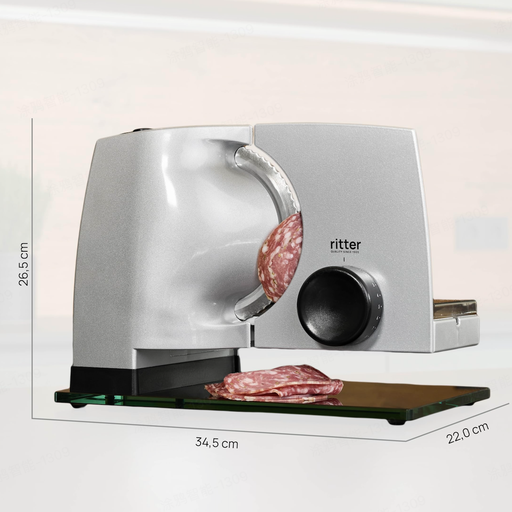
Why This Fits Their Persona: Ideal for daily family use. Whether it's fresh bread for breakfast or cold cuts for dinner, this machine is designed for reliability and ease of use.
The cantilevered metal construction provides stability and allows for straightforward cleaning, as the removable carriage and glass base plate are easily accessible. This bypasses the typical hygiene and stability traps.
Eco-motor for energy-saving operation. Made in Germany, an indicator of build quality. Removable carriage with an 18 cm slicing length.
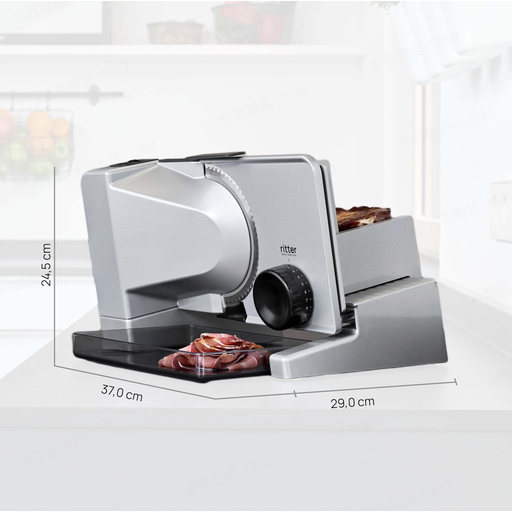
Why This Fits Their Persona: For those who value professional results and frequently entertain guests with perfectly arranged charcuterie and cheese boards. This machine is built for precision and heavy-duty use.
The full-metal construction and powerful DC motor prevent instability and power loss. The electronic speed control gives you full command, rather than relying on a misleading wattage figure.
Includes both a serrated blade and a smooth ham/deli blade. Large carriage travel (24 cm) and thickness adjustment up to 23 mm. Tilted position for optimal slicing results.
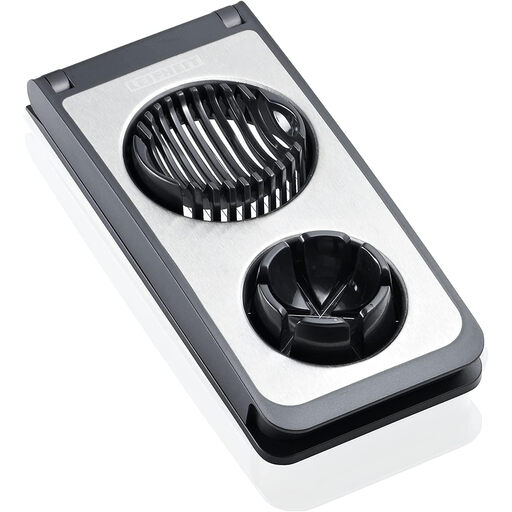
Why This Fits Their Persona: Not everyone needs a large deli slicer. For precise, decorative cuts of eggs, mozzarella, or boiled potatoes, a specialised manual slicer is often the more practical solution.
As a manual kitchen tool, it bypasses the problems of motor power and complex electronics. Its design is optimised for a single function, making it simple to handle and clean.
Three cutting functions (round slices, oval slices, wedges) in one device. Sturdy stainless steel wires for clean cuts. Compact and easy to store.
We've compiled a complete, up-to-date list of products that fully meet these strict selection criteria and German safety regulations.
Safety first: Always unplug the slicer before you start cleaning. Ideally, the carriage, food holder, and blade cover plate should be removable. Clean these parts with warm water and mild dish soap. You can wipe down the housing and the area around the blade with a damp cloth. Make sure no moisture gets into the motor.
That depends on your primary use case. The serrated blade is the all-rounder, excellent as a bread slicer and for fruits and vegetables. However, if you regularly want to slice paper-thin ham, carpaccio, or soft cheese, a smooth blade will deliver much cleaner results as a deli slicer or cheese slicer. Some models include both blades.
Wattage alone isn't a meaningful metric. An electric food slicer with an efficient 65-watt DC motor can be more powerful and durable than a machine with a 150-watt AC motor. Instead of focusing on wattage, concentrate on the motor type (Direct Current/DC is often preferable) and the build quality of the construction.