
Lieferung heute & morgen

Qualitätsgarantie

Willkommens-Angebote freischalten: KOSTENLOSE Lieferung | Bis zu 80 % RABATT | Kostenlose 30-Tage-JoyPlus-Testphase
App herunterladen
A food slicer can cut bread, vegetables, fruit, cheese, cold meats and charcuterie into even portions. However, not every appliance is right for every household. Vague product descriptions, overlooked safety features or a mistaken idea of how you’ll use it can often lead to the wrong purchase.
Before buying, consider whether you need an electric food slicer, a manual slicer or perhaps a mandoline. Terms such as “multifunction kitchen slicer” or “stainless steel cutting machine” don’t tell you much on their own about ease of use, slice thickness or cleaning.
A vegetable slicer or mandoline is often suitable for cucumbers, carrots, potatoes and other firm vegetables. But a manual slicer like this isn’t necessarily designed for bread, cured sausages or larger pieces of cheese. Conversely, an electric slicer with a large carriage takes up more space and needs more care if you only use it occasionally.
The key is to think about which food group you’ll be slicing most often.
Bread calls for different settings from ham or cheese. Look for a clearly stated slice thickness and check whether it can be adjusted continuously or only in fixed increments. Some appliances offer a range of up to around 20 or 23 mm, while compact vegetable slicers don’t offer comparable adjustment.
A removable carriage, a collection tray and an easily accessible blade make cleaning easier. Finger protection, a stable base and a momentary or continuous switch are just as important. Manual appliances should have a blade cover and non-slip surfaces. A meat or cheese slicer without a suitable holder can make it unnecessarily difficult to use.
A stainless steel blade is resistant to moisture and can be kept hygienic with proper cleaning. Serrated blades often grip bread and firm crusts more effectively. Smooth blades can be suitable for cold meats, ham or cheese. If the appliance comes with multiple blades, check that they’re genuinely interchangeable and suitable for what you intend to slice.
For a manual vegetable slicer, rust-resistant blades and a sturdy frame are important. Stainless steel and ABS plastic can be a practical combination, offering low weight and easy storage. However, material specifications are no substitute for checking the build quality, stability and cleaning instructions.
The length of the carriage travel determines the size of food you can slice. A longer cutting path is useful for large loaves or longer pieces of sausage. A compact mandoline usually takes up less storage space.
Also check:
An electric food slicer saves effort when you’re preparing larger quantities, but it needs a permanent place on your worktop and a power supply. A momentary switch runs the appliance only while you press it; a continuous switch can be useful for longer slicing sessions. Both functions should be clearly described and easy to operate safely.
A manual slicer doesn’t use electricity, but it does require even pressure. An electric model may be better for preparing larger quantities for meal prep, while a small cheese slicer or vegetable slicer may be all you need for occasional portions.
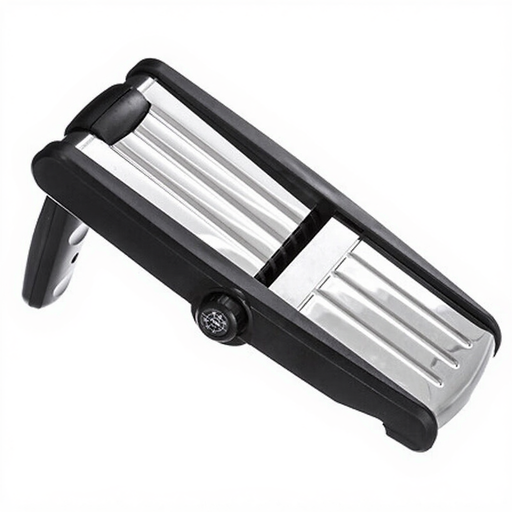
Why this product suits this profile: This compact manual vegetable slicer is ideal for households that want to prepare vegetables, fruit and side dishes without using an electric appliance.
Three interchangeable stainless steel blades make its functions clear: slicing, julienne cutting and grating. This reduces the risk of buying an appliance with a specialist function you don’t need.
Compact dimensions of 24,5 × 13 × 12,7 cm, a weight of 0,365 kg, and stainless steel and ABS components.
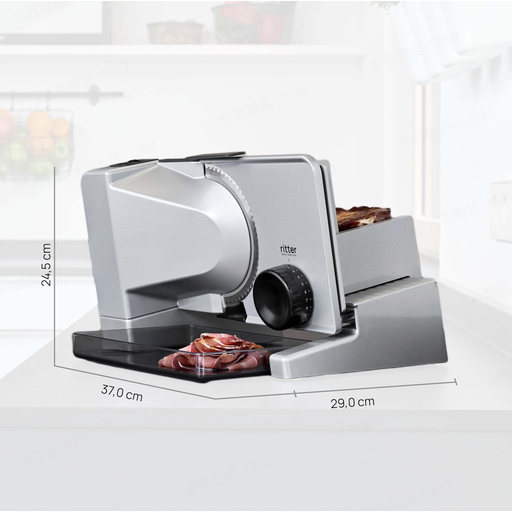
Why this product suits this profile: For regularly slicing bread, cold meats, cheese and other foods, this electric model offers a wider range of features.
The slice thickness is specified as adjustable up to 23 mm. A serrated blade and a smooth blade cater for different types of food.
All-metal construction, an angled design, electronic speed adjustment, a 24 cm cutting path and a removable carriage.
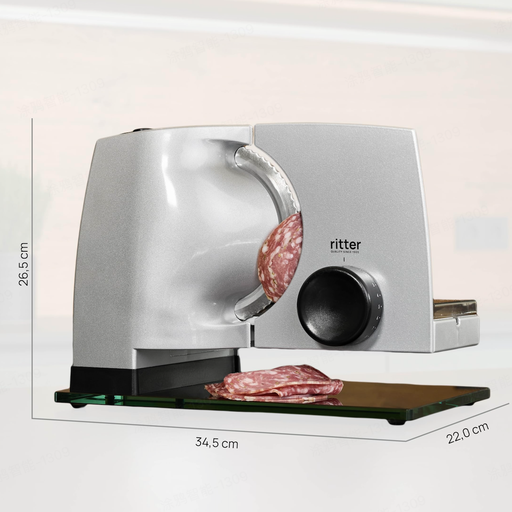
Why this product suits this profile: This model is aimed at people who regularly slice bread, fruit and vegetables and value a design that’s easy to access.
The removable food support makes cleaning easier. The momentary and continuous switches suit different ways of working.
Slice thickness of up to around 20 mm, an 18 cm cutting path, ECO motor and impact-resistant glass base plate.
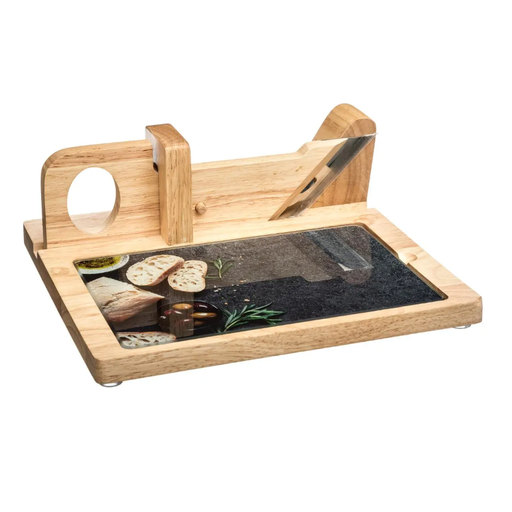
Why this product suits this profile: The combination of a slicer and wooden board is ideal for serving smaller portions of cured meat, cheese and cold meats.
Its intended use for charcuterie is clearly defined. Follow the guidance not to slice bones or frozen food.
Integrated wooden board, stainless steel blade, and a surface that can be used for both slicing and serving.
We’ve put together a complete, regularly updated list of products that meet these strict selection criteria and fully comply with the safety regulations in force in the EU.
It depends on the quantity and the types of food. If you regularly bake bread, prepare meals in advance or portion cold meats and cheese, an electric slicer can save you time. For occasional use, a manual slicer or small cheese slicer is often enough.
There’s no single answer. It depends on the quality of the materials, how heavily it’s used, how it’s cleaned and how well the blade is maintained. Clean removable parts according to the manufacturer’s instructions. Don’t let food residue dry on, especially around the blade, carriage and collection area.
An electric food slicer uses electricity while it’s running, and you may also need to pay for replacement blades or repairs. Actual energy use depends on the motor’s power and how long the appliance runs. A manual vegetable slicer doesn’t use electricity, but needs careful handling and may take more effort when you’re preparing larger quantities.