If you need to put your food slicer away after use, start by looking for a foldable model with a specified serrated blade. Check both the storage space it needs and the worktop space required when unfolded. For large loaves, the support surface and carriage travel also matter. A non-folding machine may be suitable if you can leave it out and want a wider range of slice thicknesses. A manufacturer’s specifications for the design and blade do not, on their own, prove that every crusty loaf will slice equally well.
Who should consider these options?
Bread buyers short on cupboard space
If you put the machine away after slicing, check its folded dimensions and the worktop space it needs separately. Ritter states that the icaro 5 is 10 cm wide when folded; Graef gives the MYtiny’s folded height as 8 cm.
Buyers who need to slice crusty bread
Compare the blade on the specific version you’re considering, and distinguish manufacturer specifications from independent test results. The F.A.Z. Kaufkompass reports on the Graef G52’s performance with crusty bread; that finding doesn’t automatically apply to the MYtiny or other models.
Buyers of large loaves
For a large loaf, the support surface and carriage travel can make all the difference. Ritter gives the icaro 5’s carriage travel as around 20 cm, so the smallest folded dimensions alone won’t tell you how easy a loaf will be to guide while slicing.
What should you look for when buying?
| Buying priority |
What to check |
Who is it important to? |
| Storage and space on the worktop |
Compare the folded dimensions in the right orientation, as well as the unfolded dimensions and the clear space needed for the carriage. |
If I put the slicer away after every use, I need it to fit in my cupboard and have enough room to use it. Storage space is the top buying priority for around 36% of consumers. |
| Blade for crusty bread |
Check whether the exact version comes with a serrated blade; don’t treat manufacturer specifications as equivalent to an independent slicing test. |
If I mainly want to slice bread with a firm crust, I look at the specific blade and test results for that exact model. Around 29% of consumers put slicing crusty bread first. |
| Guiding large loaves |
Check that the support surface and carriage travel on the specific model are suitable for the size of your loaf. |
For large loaves, I want enough room to place and guide the bread, even if that means the machine is less compact. Guiding large loaves is the main priority for around 21% of consumers. |
| Cleaning and spare parts |
Check the cleaning instructions, which parts can be removed and which replacement blades are compatible with the model. |
If cleaning and choosing spare parts later are especially important to me, I want to know which parts can be removed and which blade fits my machine. Around 14% of consumers prioritise these points. |
Avoid common misconceptions
-
Comparing only the smallest folded dimension
Manufacturers may give folded width, folded height and footprint in different orientations. Fitting the machine in your cupboard isn’t enough if it can’t stand securely on the worktop or the carriage doesn’t have room to move freely.
Measure your storage space and the space needed for slicing separately. Only compare dimensions when the orientation and machine position are the same.
-
Assuming wattage alone determines how well it slices crusty bread
An independent test of the Graef G52 attributes its performance with hard-crusted bread to its sturdy construction and well-sharpened blades, not just its power consumption. You can’t assume the same results from other models.
Check the blade type and findings for the specific model instead of relying on a single power rating to judge slicing quality.
-
Assuming every spare blade from the same brand will fit
Ritter replacement blades vary in size, shape and gear colour, among other things.
Check the exact model and blade details before ordering a replacement.
A replacement blade that doesn’t fit may mean you have to place another order.
Key brands at a glance
Ritter
For this selection, both a foldable metal machine and a non-folding model are worth considering.
- Ritter says the icaro 5 is 10 cm wide when folded and has around 20 cm of carriage travel; it can slice up to around 14 mm thick.
- According to the manufacturer, the non-folding E 16 has a serrated blade and adjustable slice thickness of up to around 20 mm.
- These specifications apply to the models listed. No folded dimensions are given for the E 16.
Graef
The MYtiny is a low-profile folding option, while the Graef G52 is a separate freestanding model.
- Graef gives the MYtiny’s folded height as 8 cm, its footprint as 23.4 × 34.0 cm and its serrated blade diameter as 170 mm.
- The F.A.Z. Kaufkompass reports good results for the G52 with hard-crusted bread.
- The test results for the G52 don’t confirm the MYtiny’s slicing quality.
Severin
The AS 3912 adds a model with a foldable base plate to the selection.
- Severin says the AS 3912 has a cable tidy, a removable blade and adjustable slice thickness from 0–15 mm.
- The manufacturer’s slicing specifications aren’t independent proof of how well it handles crusty bread. Also check that the stated dimensions suit your storage space.
Clatronic
The AS 2958 is another model with a foldable housing.
- According to Clatronic, the machine has a removable carriage and a food holder with finger guard; slice thickness is continuously adjustable.
- The product specifications don’t give exact folded dimensions. Nor is the blade’s suitability for crusty bread independently verified.
Food slicers at Joybuy
The electric food slicers below are intended for bread or offer adjustable slice thickness; their design and stated features vary by model. Product specifications describe each version and don’t provide independent proof of how well it slices hard-crusted bread.
 No image available
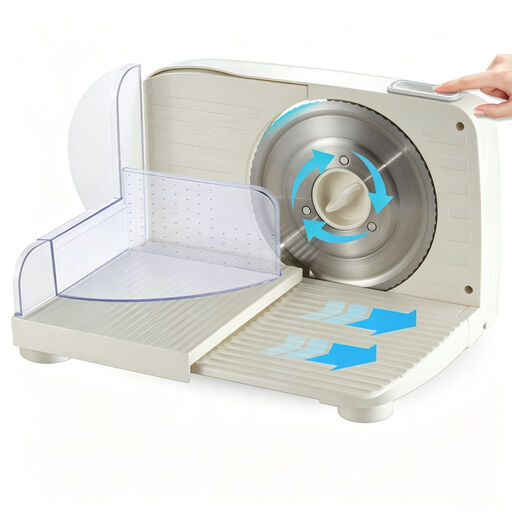
Electric food slicer, foldable, 0–15 mm
The stated foldable design may suit buyers who want to put the machine away after use.
Product specifications: stainless steel blade; slice thickness 0–15 mm.
View at Joybuy
 No image available
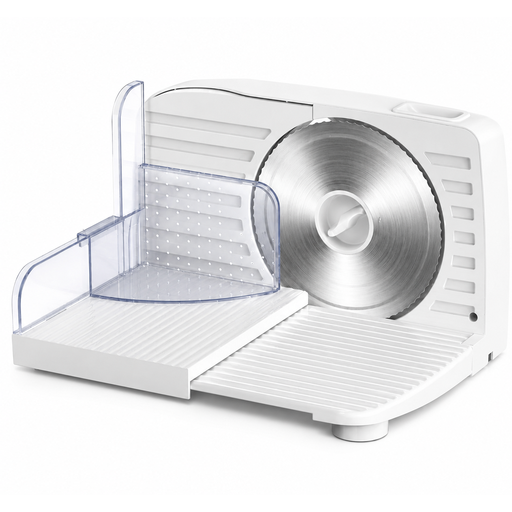
Electric food slicer, 250 W, two blades
The stated use as a bread slicer and adjustable slice thickness are worth comparing with the bread you buy and the thickness you prefer.
Product specifications: 250 W; two blades; slice thickness 0–15 mm.
View at Joybuy
 No image available
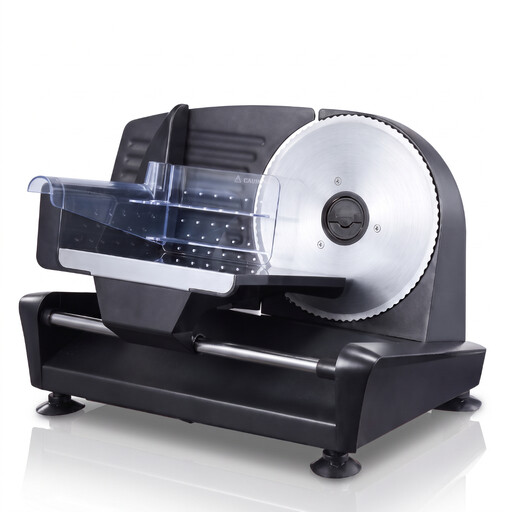
Electric bread slicer, 250 W, 0–15 mm
This model is described as a bread slicer. If you plan to put it away, also check its actual dimensions and how much space it needs in use.
Product specifications: 250 W; two blades; slice thickness 0–15 mm.
View at Joybuy
 No image available
YASHE SL-5801D23B3, foldable food slicer
The stated foldable design may appeal if you want to put the slicer away. Check how much room you’ll need to use it, too.
Product specifications: 180 W; 17 cm-diameter stainless steel blade; slice thickness 0–15 mm.
View at Joybuy
 No image available
FOHERE food slicer, 200 W, two 19 cm blades
Its stated use as a bread slicer makes it relevant if you want to slice bread. If cupboard space is limited, check how much storage room it needs before choosing.
Product specifications: two stainless steel blades, each 19 cm in diameter; slice thickness 0–15 mm.
View at Joybuy
Frequently asked questions
Are the folded dimensions enough to tell me whether it will fit in my cupboard?
No. Measure the available cupboard space in the right orientation, as well as the worktop space needed for the unfolded machine and carriage. Ritter says the icaro 5 is 10 cm wide when folded and measures 24 × 20 × 34 cm when unfolded.
How should I clean and store my food slicer?
Follow the instructions for your specific model and unplug it before cleaning if the manufacturer says to do so. Ritter explicitly requires the E 16 to be unplugged; Severin lists a removable blade for the AS 3912. Follow the model-specific instructions before removing any parts.
Is the manufacturer’s guarantee the same as your statutory rights?
No. The German Consumer Advice Centre distinguishes statutory consumer rights against the seller in the event of a fault from a voluntary guarantee, whose terms are set by the guarantor. A guarantee is therefore not the same as your statutory rights.
What does CE marking mean when buying in Germany?
Where legislation requires CE marking, a product must not be placed on the market without it under § 7 ProdSG. The Federal Institute for Occupational Safety and Health explains what the marking means for electrical products; it isn’t proof of independently tested slicing performance.
Can an old electric food slicer go in the general waste bin?
No. The German Environment Agency advises that waste electrical equipment must be collected separately from unsorted municipal waste. Find out about suitable recycling centres or take-back points.


