For a loaf with a hard crust, check that the blade is designed for bread, that the guide can accommodate the width of your loaf and that the slicer offers the thickness you want. If several people will be using it, also consider the food holder, safety features and cleaning instructions. A folding model must stand firmly while in use. Before buying, check the usage instructions for the specific model: the instructions for the ritter E 16 explicitly rule out commercial use.
Who is a food slicer for crusty bread suitable for?
For slicing crusty loaves
You want to cut even slices of bread for your course every time, and choose a blade, slice thickness and carriage to suit your loaf. ritter describes its serrated blade as suitable for hard bread crusts; GRAEF gives details of the bread width and slice thickness for the G50.
Course leaders with different people using the slicer
You want bread to be guided with the carriage and food holder, and to be able to unplug the appliance before cleaning it. GRAEF lists a food holder and thumb guard for the G50; ritter says to unplug the E 16 before cleaning or taking it apart.
Course kitchens with limited storage
You only set up the slicer for the session, so you compare its folded dimensions with the space it needs when in use. ritter gives a folded width of 10 cm for the icaro 7; SEVERIN describes the AS 3912 as foldable.
What should you look for when buying?
First, check that the blade and guide are right for your loaf. Then consider how the slicer will be used during the course, the appliance’s usage instructions, and how you’ll clean and store it.
| What matters |
What to check before buying |
Who should pay particular attention |
| Crusty bread and slice thickness |
Check that the supplied blade is designed for bread crusts, that your loaf fits on the carriage and that the thickness setting covers the slice size you want. ritter describes its serrated blade as suitable for hard crusts; GRAEF says the G50 can accommodate bread up to 22 cm wide with the carriage fitted. |
If I want to cut a hard-crusted loaf into even slices, the blade, guide and thickness setting are my priorities. Around 36% of consumers say slicing crusts is their most important buying consideration. |
| Use by several people |
Compare the food holder, finger guard, switch and guidance on keeping the slicer stable. Check when the appliance needs to be unplugged before cleaning or taking it apart; ritter requires this for the E 16. |
If several people with different levels of experience will be slicing, I want to be able to feed bread and smaller pieces through in a controlled way. Around 29% of consumers put safe use during a course first. |
| Setting up and storage |
Compare the dimensions when set up with the folded dimensions, and allow space to guide the loaf. ritter gives a folded width of 10 cm for the icaro 7; on its own, this measurement says nothing about how stable the slicer is when in use. |
If the slicer needs to be put away after the course, I look at both its folded dimensions and whether there’s enough room to use it. Around 21% of consumers say storage space is their main consideration. |
| Cleaning after the course |
Check the instructions to see which parts can be removed and how contact surfaces should be cleaned; unplug the appliance before taking it apart. The BfR points out that objects which appear clean are not necessarily microbiologically clean. |
If crumbs and residue need to be removed after the course, I want to be able to reach the relevant contact surfaces easily. For around 14% of consumers, cleaning is their most important buying consideration. |
Avoiding buying and usage mistakes
-
Focusing on motor power instead of the blade and bread guide
The wattage alone won’t tell you whether the loaf can be guided on the carriage or whether the supplied blade is designed for hard crusts.
First compare the blade type, loaf dimensions and adjustable slice thickness for the specific model. ritter describes its serrated blade as suitable for hard bread crusts.
-
Assuming a domestic appliance can be used for a commercial course
The instructions for the ritter E 16 explicitly rule out commercial use. This applies to this model and does not support a general statement about other appliances.
If the course is run commercially, check the instructions and usage requirements for the exact model you’re considering before buying.
-
Assuming similar model names or accessory bundles are identical
GRAEF specifically lists the extra smooth blade for the G52 TWIN; it isn’t automatically included with every G52 variant. DOMO lists one model as the MS171/N, which shouldn’t automatically be assumed to be the same as every product called the MS171.
Compare the full model code, what’s included and blade compatibility for the specific product. If you need an extra blade, check that it’s compatible with your chosen variant and available to buy.
An extra blade you need may not be included and, if compatible and available, would have to be bought separately.
Notable brands and their models
GRAEF
GRAEF describes the G50 as having a serrated blade and adjustable slice thickness. The G52 TWIN is also aimed at users who need a smooth blade.
- For the G50, GRAEF gives a maximum bread width of 22 cm with the carriage fitted.
- According to GRAEF, the extra smooth blade is included with the G52 TWIN, not automatically with every G52 variant.
ritter
The manufacturer describes the foldable icaro 7 as suitable for bread; the E 16 is a non-folding metal model with a serrated blade.
- ritter gives a maximum slice thickness of around 14 mm for the icaro 7.
- The instructions for the E 16 restrict it to domestic use and specify a short operating time of around 5 minutes. These details don’t apply generally to other ritter models.
SEVERIN
SEVERIN describes the AS 3912 as a foldable compact food slicer and the AS 3915 as a metal model with a carriage and food holder.
- SEVERIN gives an adjustable slice thickness of up to 15 mm for both models.
- Both product pages state that no repair service is available. This is separate from the warranty and statutory consumer rights.
DOMO
DOMO describes the MS171/N as a food slicer for items including bread, with a lightly serrated stainless steel blade.
- The stated slice thickness goes up to 15 mm.
- Check the full model code, MS171/N; it shouldn’t automatically be assumed to be the same as a product described as the MS171.
Emerio
For the foldable MS-125000, Emerio lists removable blades, a finger guard on the feed attachment and an adjustable slice thickness of 0–17 mm.
- These details apply to model code MS-125000.
- CHIP reports a safety issue with a different model code, MS 125001. This finding cannot automatically be applied to the MS-125000.
Joybuy products for bread and crusty loaves
The Joybuy products below are electric food slicers described as suitable for bread, including foldable models. Check the instructions for the specific appliance, and confirm that commercial use is permitted if you’re running a commercial course.
 No image available
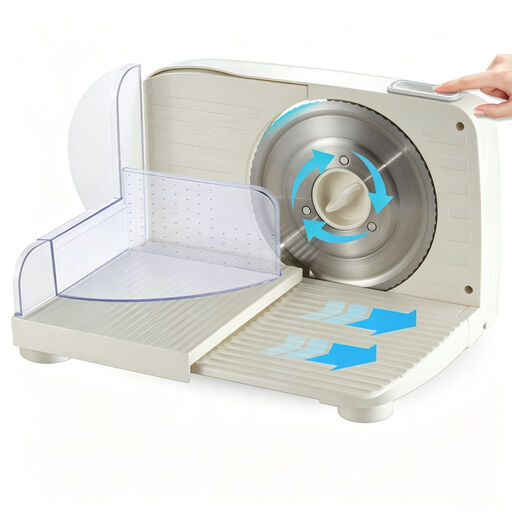
Foldable electric food slicer, 0–15 mm
The listing says it’s suitable for bread and has a foldable design.
The description says the slice thickness is adjustable from 0 to 15 mm. It also lists a stainless steel blade, holder and safety guard.
View at Joybuy
 No image available
250 W electric food slicer, 2 blades
For bread, the listing describes a serrated blade and a foldable appliance.
It lists 250 W, two blades and a continuously adjustable slice thickness of 0 to 15 mm. The description states that the appliance is for domestic use only, so it isn’t approved for commercial use on a course.
View at Joybuy
 No image available
YASHE SL-5801D23B3, 180 W
The listing says it’s suitable for bread and describes the appliance as foldable.
It lists a 17 cm stainless steel blade, a serrated blade, adjustable slice thickness from 0 to 15 mm and removable parts.
View at Joybuy
 No image available
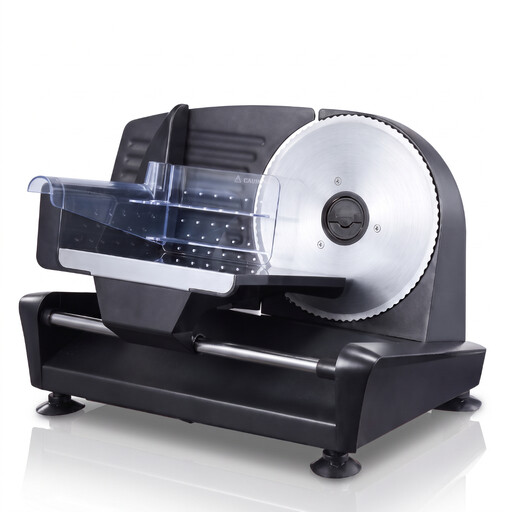
FOHERE food slicer, 200 W, 2 × 19 cm
For bread, the description lists a serrated blade and a food holder.
The listing includes two 19 cm stainless steel blades, adjustable slice thickness from 0 to 15 mm, a safety switch and a removable carriage.
View at Joybuy
 No image available
ritter serano⁷ Professional
For bread, the description lists a serrated blade and a slice thickness of up to 23 mm.
It lists two blades, a removable carriage with a 24 cm cutting travel and electronic speed control. If you’re running a commercial course, check the usage requirements for this specific model.
View at Joybuy
Frequently asked questions
Do I need a particular blade for crusty bread?
Check that the supplied blade is suitable for bread. ritter specifically describes its serrated blade as suitable for hard bread crusts; also check that your loaf can be guided safely with the carriage fitted.
Can course participants clean the food slicer?
You must unplug the appliance before taking it apart or cleaning it, and follow the instructions for the specific model. ritter requires this for the E 16; even when stationary, the blade is sharp and can cause injury.
Can I use a domestic model on a commercial cookery course?
Not simply because it’s suitable for bread. ritter explicitly rules out commercial use of the E 16. If the course is run commercially, check the instructions for the exact model you’ve chosen to see whether this use is permitted; you can’t draw a general conclusion about other models from this.
What’s the difference between statutory rights and a guarantee in Germany?
Statutory consumer rights and a guarantee aren’t the same thing: the Verbraucherzentrale describes a guarantee as a voluntary additional promise with its own terms. Check the repair service and guarantee terms separately; the absence of a repair service does not affect your statutory rights in the event of a defect.
Is a CE mark an independent safety test?
No. According to information from the European Union, the manufacturer uses the CE mark to declare that the product meets the relevant EU requirements; there isn’t a central EU body that generally grants approval or issues a certificate for this. The labelling requirements depend on the applicable regulations.


