If you regularly slice bread with a hard crust, first look for a suitable serrated blade and check that the loaf, carriage and desired slice thickness are compatible with the model. After a late shift, safe operation and cleaning in line with the instructions matter too. A folding model can save storage space, but you’ll still need a stable surface when slicing. Wattage alone doesn’t tell you how well a machine will slice crusty bread.
Which food slicer is right for you?
For regular crusty-bread slicing
If you want to slice a loaf after your shift, first check that the blade is suitable for hard crusts and that the guide can accommodate your loaf. Graef says its serrated blades are suitable for bread with a hard crust, while F.A.Z. Kaufkompass reports that the G52 it tested could slice crusty bread.
For those who prioritise safety and easy cleaning
If you’ll be using and cleaning the machine after a long day at work, check how the switch, food holder and carriage work, and read the instructions for the specific model. Ritter lists a removable carriage among the E 16’s features, while Severin specifies a finger guard and food holder for the AS 3915.
For bread lovers short on storage space
If you need to put your food slicer away after use, compare its dimensions when set up separately from its storage dimensions. Severin describes the base plate of the AS 3912 as foldable.
What should you look for when buying?
Start by checking the blade and bread guide, then consider safe operation and cleaning. If space is limited, compare the dimensions both when the machine is set up and when it’s stored away.
| What matters |
What to check before buying |
Who this matters most to |
| Hard crusts and slice thickness |
Serrated blade and stated suitability for bread; loaf guide and adjustable slice thickness. |
When I slice a hard-crusted loaf after my shift, I want the blade and guide to suit my bread. Around 33% of consumers put cutting through the crust first. |
| Safe operation |
Check the food holder, finger guard and switch on the specific model; make sure the machine is stable on the worktop. |
When I get home tired, I want to guide the bread safely and operate the switch easily. Around 27% of consumers prioritise safe operation. |
| Cleaning after slicing |
Check which parts are removable and follow the cleaning instructions; unplug the machine before cleaning and wait for the blade to stop. |
When I’m only slicing a few pieces, I want cleaning afterwards to be straightforward and in line with the instructions. Around 20% of consumers pay particular attention to cleaning up afterwards. |
| Worktop and storage space |
Compare the dimensions when set up and when stored separately; plan for a stable place to use the machine. |
When I need to put the machine away between uses, I care about its folded dimensions as well as having a safe place to slice. Around 20% of consumers put storage space first. |
Avoid common misconceptions
-
Assuming the G52 and G52 TWIN come with the same accessories
Graef lists an additional smooth blade for the G52 TWIN. It isn’t automatically included with every G52 version.
If you need an extra smooth blade, you may have to buy one separately unless it’s included with your version.
Check the exact model name and the listed contents.
-
Confusing folded dimensions with the space needed for slicing
According to the manufacturer, the foldable base plate of the Severin AS 3912 makes it easier to store. You’ll still need room for the machine when it’s set up, as well as space to guide the bread safely.
Measure the available worktop space as well as your storage space, and plan for a stable place to use the machine.
-
Assuming CE or GS marking proves a machine is especially good at slicing bread
The Federal Institute for Occupational Safety and Health (BAuA) distinguishes CE conformity marking from the voluntary GS mark. Neither marking on its own shows how well a specific machine slices crusty bread.
Check the markings separately from the machine’s suitability for the bread you want to slice.
Key brands to consider
Graef
The G52 is worth considering if you’re looking for a specific review of a machine slicing hard crusts. F.A.Z. Kaufkompass reports that the G52 it tested could slice crusty bread.
- Graef says its serrated blades are suitable for bread with a hard crust.
- The additional smooth blade is listed for the G52 TWIN and shouldn’t be assumed to come with the standard G52.
Ritter
The E 16 is a freestanding metal model with a serrated blade and removable carriage. The E 18 is a separate option if you want to guide the food with your left hand.
- Ritter states that the E 16 has an adjustable slice thickness of up to around 20 mm.
- The E 18’s left-to-right feed and operating specifications don’t automatically apply to the E 16.
Severin
The AS 3912 is a foldable option for limited storage space, while the freestanding AS 3915 has specified safety features.
- Severin lists a finger guard and food holder for the AS 3915; the AS 3912 has a foldable base plate.
- Plan for folded storage dimensions and worktop space separately. Severin’s claim that the AS 3912 operates quietly is a manufacturer’s statement, not an independent noise measurement.
DOMO
According to the manufacturer, the MS171/N is designed for a range of slicing tasks, including bread, and has a slightly serrated 17 cm blade.
- The manufacturer states that the slice thickness is adjustable up to 15 mm.
- The product description doesn’t provide evidence of comparative testing on hard crusts. The MS171 and MS171/N model names shouldn’t be treated as interchangeable without evidence that they refer to the same model.
Food slicers at Joybuy
The range includes electric food slicers for bread, including foldable models and options with specified features for ease of use or cleaning.
 Image unavailable
Electric foldable food slicer (0–15 mm)
A foldable option for slicing bread if you want to put the machine away afterwards.
The slice thickness can be adjusted from 0–15 mm. The listed features also include a stainless steel blade, food holder and safety guard. According to the description, the machine isn’t suitable for slicing frozen food or bones.
Joybuy
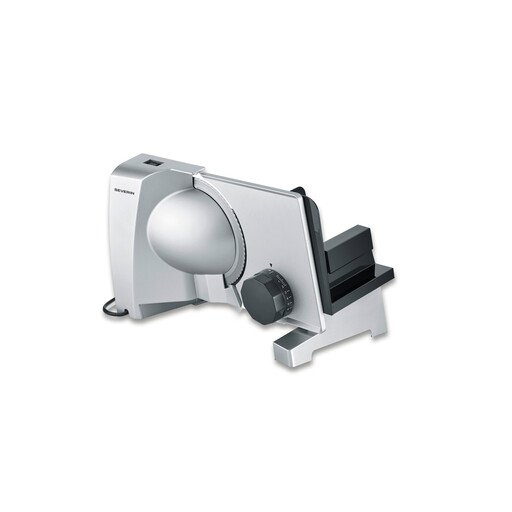 Image unavailable
Severin AS 3917 food slicer
This model is worth considering for slicing bread to different thicknesses, provided its stated slice thickness suits your needs.
The slice thickness can be adjusted from 0 to 23 mm. The blade and support table are removable, according to the description, which also lists 130 W and a metal housing.
Joybuy
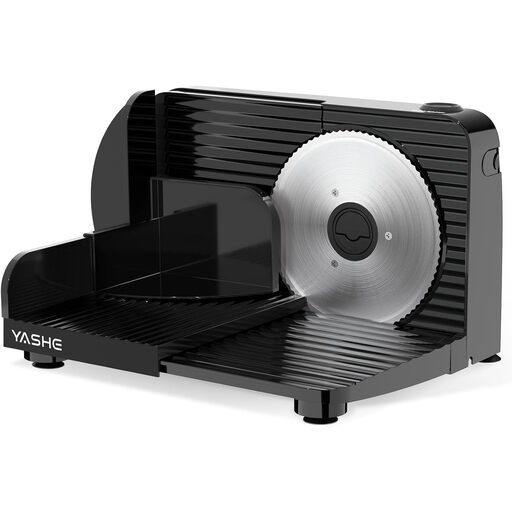 Image unavailable
YASHE SL-5801D23B3, foldable
The product description lists bread as a suitable use; the foldable design is handy if you want to put the machine away after use.
Listed features include a 17 cm serrated blade, slice thickness adjustment from 0–15 mm and 180 W. The description also mentions a safety switch, food holder and removable parts.
Joybuy
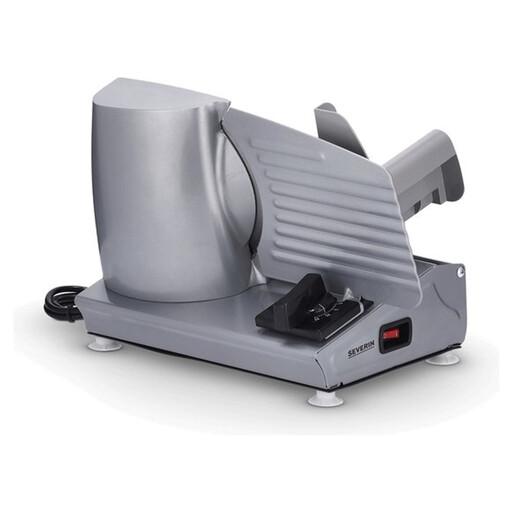 Image unavailable
Severin AS 3915 food slicer (180 W)
This model is an option for slicing bread to your preferred thickness; the description also lists features for safe handling and cleaning.
Listed features include a serrated blade and slice thickness adjustment from 0–15 mm. According to the product details, it also has a finger guard, food holder and stainless steel blade.
Joybuy
Frequently asked questions
Is high wattage enough to make a food slicer suitable for hard-crusted bread?
No. Wattage alone doesn’t show how well a food slicer will handle crusty bread. Check the specific blade, bread guide and slice thickness. F.A.Z. Kaufkompass reports that the Graef G52 it tested could cut through a hard crust.
What should I do before cleaning a food slicer?
Unplug the machine before cleaning and wait for the blade to stop. Severin’s instructions for the AS 3912 specify these steps; if you have a different model, follow its own instructions.
Who should I contact if the machine I bought is faulty?
If you buy from a retailer in Germany, your statutory consumer rights are generally claims against the seller. Verbraucherzentrale states that these rights apply for two years from delivery; a voluntary guarantee is separate.
Which safety marking is relevant for a new mains-powered appliance in Germany?
For electrical products covered by the low-voltage rules, the BAuA explains that CE marking is required before they are made available. The rules cover rated voltages of 50 to 1000 V AC or 75 to 1500 V DC. CE isn’t an independent safety certification mark; the voluntary GS mark is based on independent testing. Check the markings on the specific product listing.


