Regular bread slicers
If you’re portioning a crusty loaf for several packed lunches, look for a suitable blade and a slice thickness that works for the bread you’re slicing.


For crusty bread, your food slicer should have a serrated blade; ritter explicitly says its smooth ham and cold-cut blade is unsuitable for bread. If you slice regularly, you should also consider whether the carriage travel and slice thickness are suitable. A foldable model may be worth considering if storage space is limited. Before buying, check how the specific model works and what its cleaning instructions say.
If you’re portioning a crusty loaf for several packed lunches, look for a suitable blade and a slice thickness that works for the bread you’re slicing.
If you have little worktop space to spare, a foldable design can make it easier to put the slicer away. Still, check how much room it needs when in use.
If you use your slicer regularly, take a close look at the carriage, controls and instructions for cleaning a sharp or removable blade.
First, check that the blade and carriage are suitable for your loaf. Then compare the slice thickness you need and the space available with the specifications of the model you’re considering.
| What matters | What to check before buying | Who should pay particular attention? |
|---|---|---|
| Crusty bread and slice thickness | Check for a serrated blade, an adjustable slice thickness and enough carriage travel for your loaf. | If you slice crusty bread for packed lunches, the blade and carriage should suit your loaf. Around 36% of consumers prioritise these features. |
| Safe operation and cleaning | Check the carriage guard, food holder, switch and cleaning instructions for the specific model; unplug the slicer before taking it apart. | If you slice often and clean the appliance afterwards, safe handling and clear cleaning instructions are important. Around 29% of consumers prioritise these everyday considerations. |
| Worktop space and storage | Allow for the appliance’s operating and storage dimensions, as well as room for the carriage to move and the slices to fall. | If your kitchen has limited worktop space, the appliance needs to be easy to store. Around 21% of consumers have this storage requirement. |
| Different slicing tasks | Check which blades are supplied with the specific model and which replacement or additional blades are compatible. | If you slice foods other than bread, make sure the blade is suited to each task. Around 14% of consumers use their slicer for a range of different foods. |
ritter says its smooth ham and cold-cut blade is unsuitable for baked goods, especially bread. The type of blade is therefore an important factor when choosing a slicer for crusty bread.
Check whether the specific model comes with a serrated blade and whether a suitable additional blade is available if you also want to slice cold cuts thinly.
The SKS100 and Classic C20 are both freestanding models, with differences including their design and footprint.
The E 16 is a freestanding model designed for right-handed use, while the E 18 is designed for feeding food with the left hand.
The AS 3912 is a foldable option for easier storage; the AS 3915 is a freestanding model with additional specified safety and holding features.
DOMO lists the MS171/N and DO521S among its food slicer models.
The Joybuy products below are electric food slicers for bread and other foods. Check whether the blade type and design of each model suit crusty bread and the storage space you have available.
 No image available
The foldable design is worth considering if you want to put the appliance away after use; check that the blade is suitable for crusty bread.
The slice thickness is adjustable from 0 to 15 mm. The product description lists two blades, including a serrated one, as well as finger protection, a safety switch and removable parts.
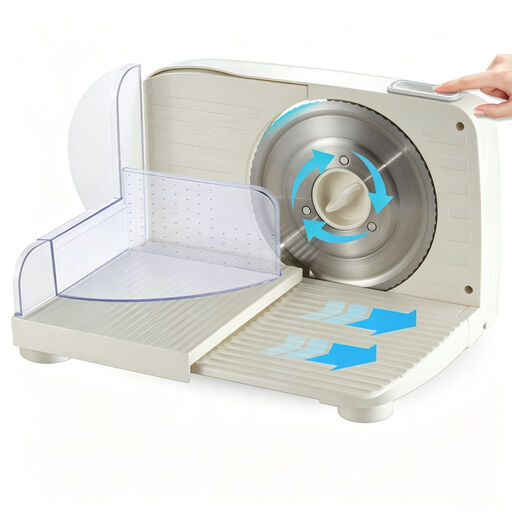 No image available
The description lists a serrated blade for bread; before buying, check whether the foldable design suits your storage space.
Specifications include 250 W, two blades, a slice thickness of 0 to 15 mm and removable parts. A food holder and safety guard are also listed.
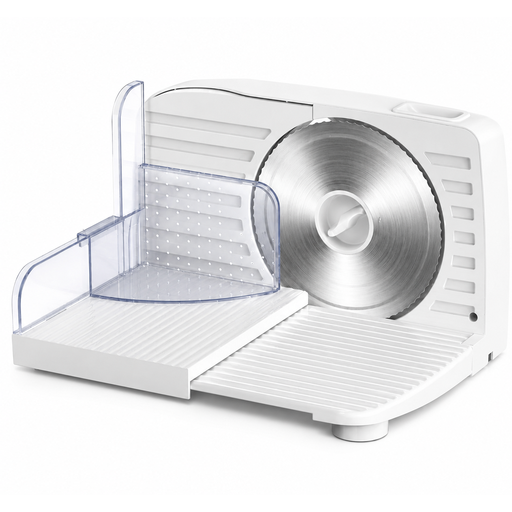 No image available
The description lists a serrated blade and a foldable design; check that both suit your needs for slicing crusty bread and storing the appliance.
The slice thickness is adjustable from 0 to 15 mm. Other listed features include two blades, removable parts, a safety switch, finger protection and non-slip feet.
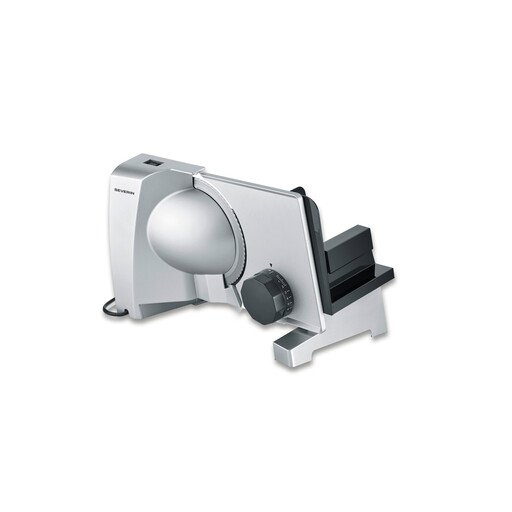 No image available
If you want to adjust the thickness of your slices, compare the stated range with your needs and check that the blade is suitable for bread.
The product title lists 130 W and a continuously adjustable slice thickness of 0 to 23 mm. The description also lists a metal housing, a removable blade and a tray.
 No image available
The description lists a serrated blade for bread and a foldable design; check that the appliance’s dimensions will work in your kitchen.
Features listed include a 17 cm stainless steel blade, an adjustable slice thickness of 0 to 15 mm and 180 W. The description also mentions a safety switch, food pusher and cord storage.
Not as a general rule: ritter explicitly says its smooth ham and cold-cut blade is unsuitable for baked goods, especially bread. Check which blade comes with the specific appliance; the manufacturer’s specifications list a serrated blade for bread.
Unplug the appliance before taking it apart or cleaning it, and follow the instructions for your specific model. ritter says to disconnect its appliances from the mains in its safety instructions; Graef describes the SKS100 as having a removable blade.
In Germany, the retailer is responsible for statutory consumer rights, which are separate from any voluntary manufacturer’s guarantee. The consumer advice centre states that new goods generally have a two-year statutory warranty. Check the guarantee terms, as well as the availability of spare parts and repair options, separately.
No. Electrical equipment covered by the EU Low Voltage rules — that is, 50 to 1,000 V AC or 75 to 1,500 V DC — must meet the relevant CE requirements; CE is not an independent safety test mark. The German Federal Institute for Occupational Safety and Health describes GS as a voluntary test mark. So, a missing GS mark alone does not mean that an appliance cannot be sold.