For fine slices of ham
If you want to slice cooked ham as thinly and evenly as possible, check the blade type, what’s included and how the food is guided through the slicer. GRAEF recommends a smooth blade for wafer-thin ham.


For particularly fine slices of ham, check whether a smooth blade is included or specifically compatible with the model. GRAEF recommends smooth blades for wafer-thin ham. For larger, softer pieces, an angled support can be useful: ritter describes one for cooked ham. If you’ll be putting the slicer away after use in your holiday cottage, compare its storage footprint with the space needed to set it up safely and access its parts for cleaning.
If you want to slice cooked ham as thinly and evenly as possible, check the blade type, what’s included and how the food is guided through the slicer. GRAEF recommends a smooth blade for wafer-thin ham.
If you only use your food slicer occasionally, a folding design can make it easier to put away. SEVERIN describes the foldable base plate on the AS 3912 as space-saving; you’ll still need to set it up safely on the worktop.
If you want to slice bread or other cold meats as well as ham, compare the blade options and check which parts can be removed for cleaning. GRAEF says the G52 TWIN comes with an additional smooth blade, while SEVERIN lists a finger guard and food holder for the AS 3915.
| Priority | What to check before buying | Who is it important to? |
|---|---|---|
| Fine slices of ham | Check whether the specific model includes a smooth blade or is explicitly compatible with one, and whether you can adjust the slice thickness. GRAEF recommends smooth blades for wafer-thin ham. | If I want to slice cooked ham as finely as possible, I pay particular attention to the blade type and what’s included. Around 33% of shoppers make the finished slice their top priority. |
| Storage in a holiday cottage | Compare the space you have for storage and use with the size of the slicer, and check that it can be set up safely before using it. SEVERIN describes the AS 3912 as having a foldable base plate. | When space is limited in my holiday cottage, I want to be able to put the slicer away after use without overlooking safe set-up. Around 27% of shoppers prioritise ease of storage. |
| Safe use and cleaning | Check the food holder, finger guard and removable parts on the specific model. Unplug the appliance before dismantling or cleaning it, and follow the instruction manual. | If safe handling and thorough cleaning matter to me, I look for safety features and easy-to-reach parts. Around 20% of shoppers have this as their main priority. |
| Slicing ham and bread | Compare the blade type and what’s actually included with each version. A universal serrated blade does not automatically mean that a smooth ham blade is included. | If I want to slice both bread and ham in my holiday cottage, I compare the blade options and the effort involved in changing and caring for them. Around 20% of shoppers put this versatility first. |
A slicer can cut ham and still come with a serrated blade as standard. GRAEF recommends a smooth blade for especially fine slices of ham.
Before buying, compare the blade type, what’s included and whether the blade is explicitly listed as compatible with the specific model.
Ham sliced in advance could spoil before you get a chance to eat it.
For shoppers comparing an angled design, a smooth ham blade or a space-saving model.
For shoppers comparing what’s included and the blade options for a specific version.
The AS 3912 and AS 3915 models cater for different space and usage requirements.
The MA 451 CB is a countertop slicer with a universal serrated blade, suited to shoppers who want to slice bread too.
The AS 2958 is a foldable alternative with adjustable slice thickness and a food holder.
This selection includes electric food slicers with a range of features, including foldable designs, adjustable slice thickness and different blade options. What matters most depends on whether you mainly want to slice fine ham, bread or need a slicer that’s easy to store in your holiday cottage.
 No image available
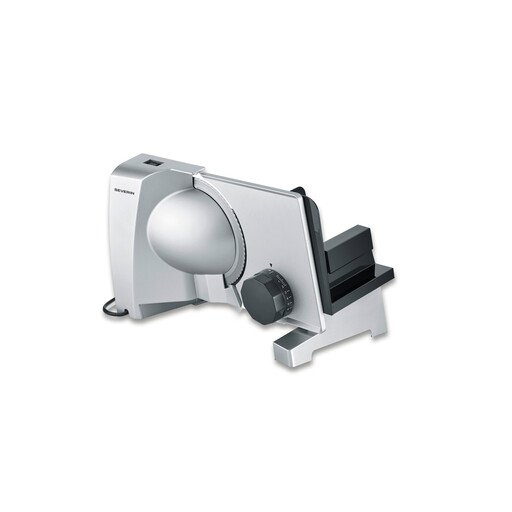
The foldable design could suit you if you want to put your food slicer away after use.
The product description lists an adjustable slice thickness of 0 to 15 mm and a stainless steel blade.
 No image available
The product description lists this model for bread and cold meats, making it an option if you want to slice other foods as well as ham.
Features include a continuously adjustable slice thickness of 0 to 23 mm, 130 W of power and a metal housing.
 No image available
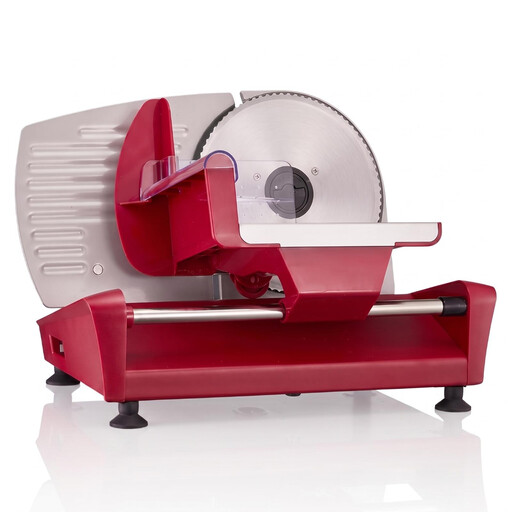
The product description lists a smooth blade for ham and two serrated blades for other slicing tasks.
It also lists an adjustable slice thickness of 0 to 15 mm and a safety lock.
 No image available
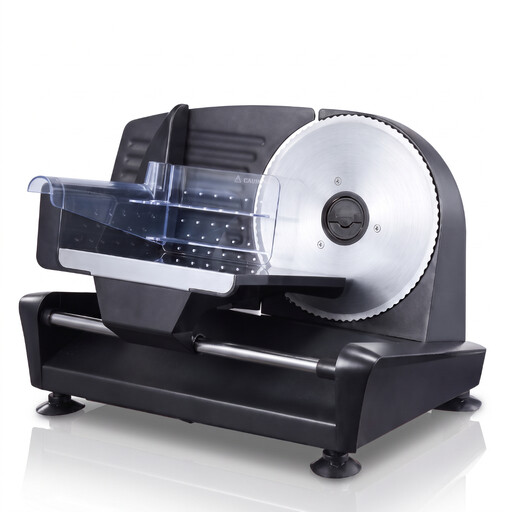
The product description lists bread, meat, ham and cheese among the foods it can slice.
It lists two stainless steel blades, each 19 cm in diameter, and an adjustable slice thickness of 0 to 15 mm.
 No image available
The angled design could appeal if you’re looking for a countertop slicer in this style.
The product description lists an all-metal construction, a DC motor and electronic speed adjustment.
Check whether a smooth ham blade is included or explicitly compatible with the slicer. GRAEF recommends a smooth blade for wafer-thin ham and says the G52 TWIN comes with an additional smooth blade. Check what’s included with the specific version.
Unplug the slicer before dismantling or cleaning it, and follow the instructions for your specific model. Clean the accessible parts that have come into contact with the food; a removable carriage can make them easier to reach. Always follow the model’s instruction manual.
Keep perishable cold meats chilled and follow the storage instructions on the packaging. The Verbraucherzentrale recommends storing sausages at 4 to 7 °C and using an insulated cool bag that maintains a stable temperature when travelling in summer. Its advice on how long cooked sausage can be kept doesn’t apply automatically to every type of ham.
For electrical appliances that require marking, the manufacturer uses the CE marking to declare that the product complies with the relevant EU requirements. It isn’t an independent quality mark for slicing performance. Also check the product details, manufacturer information and German-language instruction manual.
No. As the German Federal Ministry for the Environment explains, waste electrical equipment must be collected separately and handed over to an authorised collection operator. For details of where to take it, check with your local authority’s collection point or a designated take-back point; this doesn’t mean that every retailer is obliged to take it back.