Cheese lovers
If you want to slice hard cheese, check whether the specific blade is described as suitable for it. GRAEF explicitly lists harder cheese for the SKS110.


If hard cheese is your main priority, first check whether the manufacturer explicitly states that the blade on the specific model is suitable for harder cheese. GRAEF does this for the SKS110. Next, consider the space it takes up, storage and cleaning. A folding design makes it easier to put away, but doesn’t reduce the space you need to use the slicer.
If you want to slice hard cheese, check whether the specific blade is described as suitable for it. GRAEF explicitly lists harder cheese for the SKS110.
If you need to clear your worktop after slicing, it’s worth comparing the dimensions when in use and when folded away separately. For the icaro 7, ritter gives different widths for each position.
If you prepare different foods one after another, check which cutting parts can be removed and how the instructions say to clean them. For the AS 3917, SEVERIN lists a removable blade and carriage.
First check whether the blade is suitable for hard cheese, then consider how much space it takes up and how you’ll clean it at your only prep space.
| Priority | What to check before buying | Who it matters most to |
|---|---|---|
| Suitability for hard cheese | Check the exact model, the blade supplied and whether it is explicitly described as suitable for harder cheese. | If I mainly slice hard cheese, I want to know whether the blade is designed for it. Around 31% of consumers put suitability for hard cheese first. |
| Space needed | Compare the dimensions in use and when folded away separately; allow for the carriage’s travel and somewhere to put the slices. | If there’s only one prep space available, the appliance needs room to use and somewhere to be stored afterwards. Around 25% of consumers prioritise having clear worktop space. |
| Cleaning between tasks | Check which parts can be removed and what cleaning method the instructions recommend. | If I switch between ingredients or prep tasks, I want to be able to reach the cutting parts and contact surfaces easily. Around 25% of consumers prioritise cleaning between tasks. |
| Guiding smaller pieces | Check the food holder, finger guard and switch system for the exact model variant. | When slicing smaller pieces of cheese, I want to be able to guide them safely and understand how to operate the appliance. Around 19% of consumers prioritise control and ease of use. |
A general mention of cheese doesn’t automatically mean that the blade is suitable for harder cheese. GRAEF explicitly lists this use for the SKS110; descriptions of the other models considered here are less specific.
Before buying, check the suitability information for the exact model and the blade supplied, rather than relying on the product category alone.
A folding appliance can take up considerably more room when slicing than when stored away. For the ritter icaro 7, the manufacturer gives a width of 24,0 cm in use and 10,0 cm when folded.
Allow space for the appliance, the carriage’s travel and somewhere to put the slices at the prep space you’ll actually use.
GRAEF lists an additional smooth blade for the G52 TWIN; it is not listed as part of the SKS110’s supplied accessories. Blades and fittings can vary between models.
Check the full model name, what’s included and whether the blade fitting is compatible before planning to use accessories.
Removable parts make components easier to reach, but they don’t replace cleaning. The German Federal Institute for Risk Assessment notes that germs from raw foods can be transferred to other foods via utensils or work surfaces.
Build cleaning according to the model’s instructions, and changes between foods, into your routine.
The SKS110 is worth considering if hard cheese is your main priority: GRAEF explicitly lists harder cheese among the foods it can slice.
The icaro 7 folds away to save storage space; ritter lists cheese among the foods it can slice.
The AS 3912 is a folding option, while the AS 3917 focuses on removable cutting parts and a stated slice thickness range.
The following Joybuy options are electric food slicers, with features such as adjustable slice thickness, fold-away storage or easier cleaning. Suitability for hard cheese varies by model, so check the information for the specific blade.
 No image available
The product title lists cheese among the foods it can slice, but doesn’t explicitly confirm suitability for hard cheese.
Folding design; slice thickness 0–15 mm; stainless steel blade.
 No image available
The product description also lists hard cheese among the foods it can slice. Check that it’s suitable for your type of cheese and the specific blade.
180 W; slice thickness 0–15 mm; 17-cm stainless steel blade; folding design.
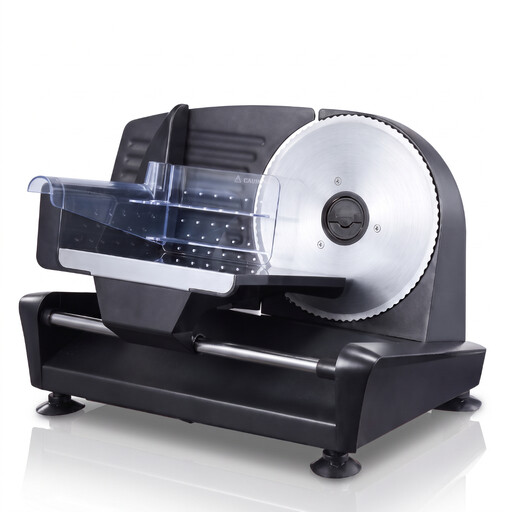 No image available
The product title mentions cheese, but not hard cheese specifically. If cleaning between tasks is important, check the details about the removable parts.
Two 19-cm stainless steel blades; slice thickness 0–15 mm.
 No image available
If you want to clean between tasks, check the product description for details of the removable blades and carriage, along with the cleaning instructions for this model.
The product description lists cheese among the foods it can slice and gives an adjustable slice thickness of 0–15 mm.
 No image available
The product title mentions a removable carriage for easier cleaning, but doesn’t explicitly describe the appliance as suitable for hard cheese.
Serrated blade; removable carriage; shatterproof glass base.
A smooth edge alone doesn’t guarantee it. GRAEF and ritter describe smooth blades mainly for thin or softer cold cuts; what matters is the suitability information for the specific blade and model. GRAEF also lists harder cheese as suitable for its serrated blade.
Allow room for the appliance and the moving carriage, and clean contact surfaces and removable parts according to the model’s instructions. The German Federal Institute for Risk Assessment notes that germs from raw foods can be transferred to other foods via utensils or work surfaces; a removable blade doesn’t prevent this by itself.
According to the European Union’s explanation, the CE marking is the manufacturer’s declaration that the product meets the relevant EU requirements; it isn’t a certificate issued by a central EU body. On its own, it doesn’t confirm that an individual listing complies.