What should you look for when buying?
First, check what the manufacturer says about the blade and the foods it can slice. Then consider safety and cleaning, as well as how much space you’ll need to use and store the slicer.
| Priority |
What to look for when buying |
Who it matters most to |
| Even slices of cheese |
Check what the manufacturer says about hard cheese, the blade type and the adjustable slice thickness. |
If I want to slice hard cheese evenly for guests, the suitability of the specific blade matters to me. Around 33% of consumers put the cut quality of hard cheese first. |
| Safe operation and cleaning |
Check the food holder, finger guard and cleaning instructions for the specific model. |
If I’m preparing several foods, I want to be able to remove and clean the parts that have come into contact with food safely. Around 27% of consumers prioritise safe operation and cleaning. |
| Worktop space and storage |
Check the dimensions when set up and stored, as well as the space needed for the carriage to move and for a collection tray. |
If my kitchen has limited worktop and storage space, the slicer needs room to operate and must be easy to put away afterwards. Around 20% of consumers put space requirements first. |
| Other foods |
Check which foods the slicer can handle, what’s included and whether an optional blade is compatible. |
If I’m preparing bread or cold meats as well as cheese, I need a blade that’s suitable for the foods I plan to slice. Around 20% of consumers prioritise being able to use the slicer for several foods. |
Food slicers for preparing cheese
This selection features electric food slicers for preparing a cheeseboard, including models described as suitable for cheese or hard cheese. For each slicer, check whether the manufacturer’s guidance covers the specific hard cheese you want to slice.
 No image available
Electric food slicer, foldable, 0–15 mm
An option if you’re looking for a foldable slicer with adjustable slice thickness; the product title lists cheese as one of the foods it can slice.
According to the product description, the slice thickness can be adjusted from 0 to 15 mm. It also mentions a stainless steel blade and a safety and food holder.
Joybuy
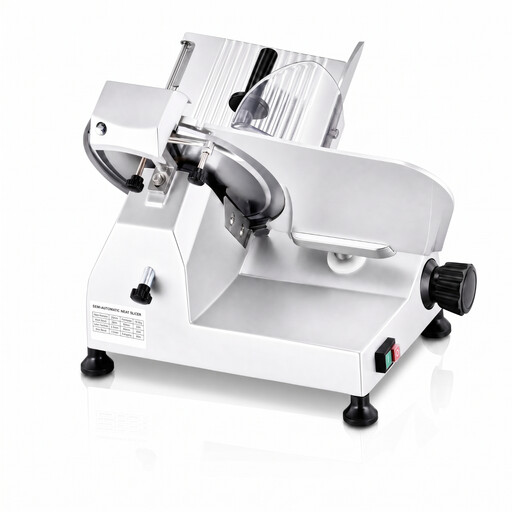 No image available
FOHERE 240 W electric food slicer, 0–12 mm
The product description specifically mentions hard cheese, making this model worth considering if it’s the main food you plan to slice.
It lists a 25.4-cm carbon steel blade and an adjustable slice thickness of 0 to 12 mm. According to the description, the blade and other parts that come into contact with food can be removed.
Joybuy
 No image available
YASHE SL-5801D23B3, 180 W, foldable, 0–15 mm
The description mentions hard cheese and a serrated blade; the foldable design may also be useful for storage.
According to the product description, the slicer has a 17-cm stainless steel blade and an adjustable slice thickness of 0 to 15 mm. It also lists a safety switch, food pusher, removable parts and built-in cord storage.
Joybuy
 No image available
ritter sono¹ electric food slicer
An option if you’re looking for an electric food slicer with a removable carriage. Before buying, check the guidance for the specific model to make sure it’s suitable for the hard cheese you want to slice.
The description lists a serrated blade, an adjustable slice thickness of up to around 20 mm and a removable carriage. It also mentions momentary and continuous operation switches.
Joybuy
Frequently asked questions about food slicers for hard cheese
How can I tell whether a blade is suitable for hard cheese?
Check what the manufacturer says about the specific model and the food it can slice. GRAEF says the serrated blade on the SKS110 can handle harder cheese; ritter describes its serrated blade in general as suitable for hard and soft foods, while its smooth slicing blade is designed for soft foods.
What should I do before cleaning the slicer?
Follow the instructions for your model and unplug it before cleaning if the instructions say to do so. ritter requires this for the E 18 before taking it apart or cleaning it. Handle a removed blade with care and clean any parts that have touched food before switching to a different food.
Are a guarantee and your statutory rights the same thing?
No. Verbraucherzentrale distinguishes between your statutory rights against the seller if a product is faulty and a voluntary guarantee, which is subject to its own terms and conditions. Also check the repair and spare-parts information for the specific model.
What does the CE marking mean when buying in Germany?
Products covered by harmonised EU rules that require CE marking must carry the prescribed marking. The European Union and Bundesnetzagentur explain that it represents the manufacturer’s declaration that the product meets the applicable requirements, but it isn’t an independent quality mark for slicing performance. Check the safety information and instructions too.
How long can I leave cheese slices out on a platter?
Follow the storage instructions on the packaging for the cheese you’re serving. Perishable foods should be kept sufficiently chilled until they’re prepared or eaten; the Bundesinstitut für Risikobewertung highlights the risks of inadequate refrigeration.


