Cheese portioners
You want to cut firmer cheese into even slices, so first check whether the manufacturer specifies that the blade is suitable. Graef explicitly says that the standard serrated blade on the SKS500 is also suitable for harder cheese.


A food slicer is suitable for hard cheese when the manufacturer explicitly states that the specific blade and model are designed for it. If you’re preparing multiple portions, the slice thickness and carriage should also suit the cheese block; the collection options, cleaning and operating time all affect how smoothly you can work. A continuous-operation switch doesn’t automatically mean the appliance can run indefinitely.
You want to cut firmer cheese into even slices, so first check whether the manufacturer specifies that the blade is suitable. Graef explicitly says that the standard serrated blade on the SKS500 is also suitable for harder cheese.
If you’re slicing several portions in a row, the carriage, collection options and operating limits all matter. For the E 16, ritter specifies a collection tray and a short-time operating period of 5 minutes.
You want to clear your worktop after slicing, so compare the folded dimensions with the space needed when the appliance is in use. Steba gives the folded dimensions of the AS 100 as 20 × 9.5 × 33 cm.
First, check whether the specific blade and model are described as suitable for hard cheese. Then consider the slicing action, cleaning and the space available.
| Buying consideration | What to check | Who will value this most? |
|---|---|---|
| Suitability for cheese and slice thickness | Manufacturer’s information for the specific model and supplied blade; adjustable slice thickness and the thickness you want. | If I want to slice hard cheese evenly, the suitability of the specific blade is essential. Around 36% of consumers put suitability for cheese first. |
| Workflow when preparing multiple portions | Carriage suited to the size of the block, a way to collect the slices, and guidance on operating time and breaks. | When preparing multiple portions, I want to guide the cheese safely and collect the slices without being caught out by an operating limit. Around 29% of consumers prioritise batch preparation workflow. |
| Safety and cleaning | Food holder and carriage, removable parts, and instructions on disconnecting the appliance from the mains and cleaning it. | When I need to clean the appliance after portioning, safe handling and accessible contact surfaces matter to me. Around 21% of consumers prioritise safety and cleaning. |
| Worktop and storage space | Check the folded and assembled dimensions separately; allow room for the carriage and operation. | With limited worktop space, I want to be able to put the appliance away after slicing while still having enough room to use it. Around 14% of consumers put storage space first. |
A general reference to cheese doesn’t automatically mean that the specific blade and model are described as suitable for firmer cheese.
Check the manufacturer’s information for the supplied blade and exact model variant. Manufacturer information is no substitute for an independent comparison of slicing results.
For the ritter E 16, the manufacturer specifies both a continuous-operation switch and a short-time operating period of 5 minutes.
Plan work periods and breaks in line with the instructions for the specific appliance.
A foldable food slicer also needs space for the carriage and operation when you’re slicing.
Measure your storage space and usable worktop space separately, and allow room for the carriage to move.
The SKS500 is worth considering if you’re looking for an explicit manufacturer statement on harder cheese and a way to collect multiple portions.
The E 16 has a fixed design, a collection tray and a documented operating limit.
The AS 3917 is an option if adjustable slice thickness and removable parts are important to you.
The AS 100 is an option to compare if you want to fold the food slicer away after use.
The MS171 is an editorial comparison option as a basic food slicer.
The Joybuy products below are electric food slicers. For hard cheese, check the information on the specific blade and consider slice thickness, handling and access for cleaning.
 No image available
The product information lists cheese as a food it can slice; this doesn’t confirm that it’s suitable for hard cheese.
Slice thickness: 0–15 mm. Also listed are a stainless steel blade, a food holder and a safety guard.
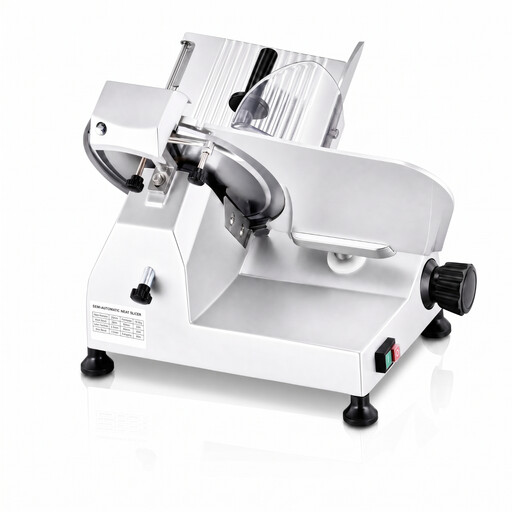 No image available
The product description explicitly lists hard cheese; this is a product claim, not an independent slicing test.
Power: 240 W. Slice thickness: 0–12 mm. Blade: 25,4 cm carbon steel.
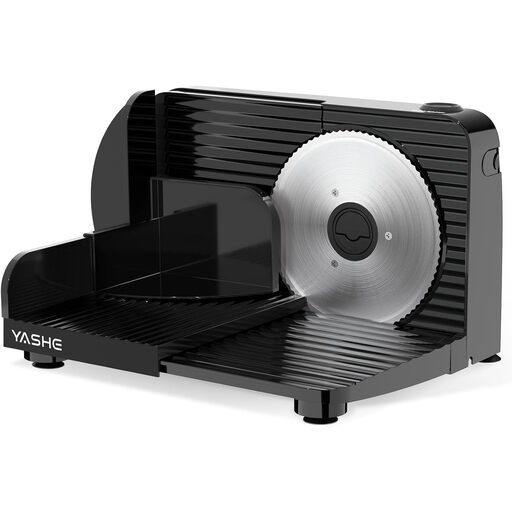 No image available
The product description lists hard cheese as a food it can slice; check the information for the specific blade and model variant.
Slice thickness: 0–15 mm. Serrated stainless steel blade: 17 cm. The appliance is described as foldable.
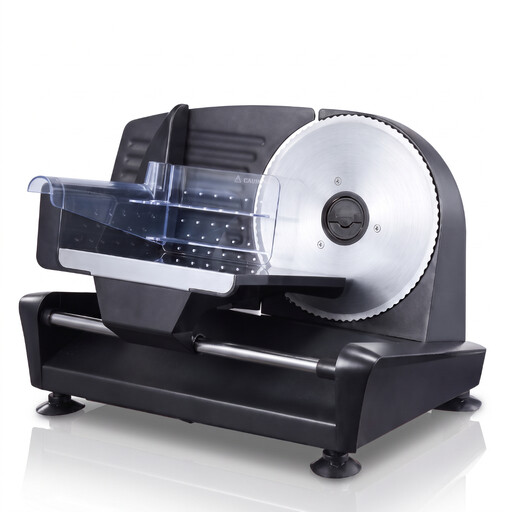 No image available
The product description recommends a smooth blade for cheese. This doesn’t confirm that it’s suitable for hard cheese; check the information on how the specific blade can be used.
Slice thickness: 0–15 mm. Two blades, each 19 cm in diameter. The carriage and blades are described as removable.
 No image available
For hard cheese, check whether the specific blade and model variant are suitable.
Features listed include a serrated blade, a removable carriage, an 18 cm slicing path and a slice thickness of up to around 20 mm. A safety momentary switch and a continuous-operation switch are also described.
No. ritter describes the smooth ham or cold-meat blade as suitable for soft foods, and the serrated blade as suitable for hard and soft foods. What matters is the information for the specific model and blade combination.
Not just because of the switch. For the ritter E 16, the manufacturer specifies both a continuous-operation switch and a short-time operating period of 5 minutes. Plan work periods and breaks in line with the instructions for your specific appliance.
Disconnect the appliance from the mains before dismantling and cleaning it, and follow the instructions for your model. The German Federal Institute for Risk Assessment recommends refrigerating perishable foods and storing them covered and separately. This doesn’t mean there’s one general shelf life for every type of cheese.
Electrical appliances covered by the Low Voltage Directive 2014/35/EU must meet the relevant requirements, including conformity assessment and CE marking. EU rules on food-contact materials, including Regulation (EC) No 1935/2004, apply to parts intended to come into contact with food. A CE mark alone doesn’t prove that a specific appliance has been independently safety-tested.
For a purchase in Germany, the seller is generally responsible for the statutory warranty. The Verbraucherzentrale states that new goods are covered for two years from delivery. An additional manufacturer’s guarantee is voluntary and comes with its own terms and conditions.