People who slice cheese regularly
If you prepare cheese for packed lunches several times a week, compare the slice thickness, carriage movement and ease of cleaning for the specific model.


If you regularly slice hard cheese during the week, start by comparing each model’s suitability for cheese, adjustable slice thickness and how it guides the cheese. Folding models can make storage easier; with larger metal models, check the space they’ll take up on your worktop and how easy they are to clean. Keeping cheese properly chilled for a packed lunch is a separate consideration that a food slicer can’t solve.
If you prepare cheese for packed lunches several times a week, compare the slice thickness, carriage movement and ease of cleaning for the specific model.
If you need to put the slicer away after use, its folded dimensions and the storage space available are important factors to consider.
If safe guidance of the cheese matters to you, check the food holder, finger guard and instructions for the specific model. Always unplug the appliance before cleaning it.
| What matters | What to check before buying | Who is it important to? |
|---|---|---|
| Even cheese slices | The specific model’s suitability for cheese and slice thickness range; blade type and carriage movement. | If I’m preparing slices for packed lunches, I want to set the thickness to suit my needs and check that the model is suitable for cheese. This matters most to around 31% of consumers, who prioritise the quality of the cut. |
| Safe guidance | Check the food holder, finger guard, stability and instructions for use. | If I’m slicing a small piece of cheese, I want to guide it using the holder provided and keep my hands away from the blade. Around 25% of consumers put safe handling first. |
| Cleaning | Check which parts can be removed and what the instructions say about cleaning. | If I use the slicer regularly, I want to be able to reach the food-contact surfaces easily after use. Around 25% of consumers prioritise ease of cleaning above all else. |
| Storage space | Compare the dimensions when set up and stored, as well as the space needed to move the carriage and clean the appliance. | If I put the slicer away after preparing packed lunches, it needs to fit in the storage space I have. Around 19% of consumers put space-saving storage first. |
Ritter recommends a serrated blade for hard and soft foods, while Graef describes the smooth spare blade supplied with the G52 TWIN as suitable for thinly sliced cold meats. This does not provide evidence that a smooth blade offers an advantage for hard cheese.
Check the intended use and what’s included with the exact model, rather than assuming the blade type alone determines the result.
The adjustable thickness range on its own doesn’t tell you whether the appliance is right for your cheese, how it guides the piece of cheese or how well it fits your cleaning routine.
For the specific model, also compare the blade type, food holder, carriage and ease of cleaning. Measure the space you have for using and storing it, too.
Slicing doesn’t replace proper storage and chilled transport if the cheese needs to be kept cool. The German Federal Institute for Risk Assessment warns against inadequate chilling of perishable foods during transport and storage; the consumer advice centre recommends keeping cheese chilled.
Follow the storage instructions for the cheese you’ve bought and consider the conditions it will be kept in until it’s eaten.
The MA 451 CB is worth considering if you’re looking for a metal appliance that’s specifically stated to be suitable for cheese and bread.
The Classic C20 is a metal appliance; for the G52 TWIN, Graef also lists a smooth blade for thinly sliced cold meats.
Ritter describes the E 16 as having a serrated blade and offers recommendations on blade types for different foods.
The AS 3917 is worth considering if you want to compare an appliance specifically stated by the manufacturer to be suitable for cheese and to have removable parts.
The AS 100 is designed for compact storage; for the AS 200, Steba lists a blade for ham and cheese.
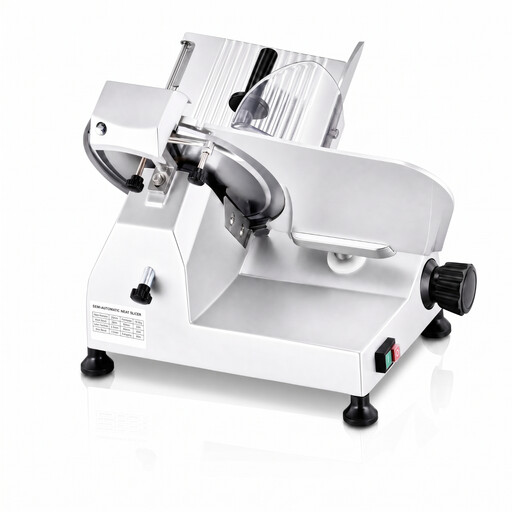
The electric food slicers below list cheese as a food they can cut. If you want to put the appliance away after slicing, also compare how easy the folding models are to store and clean.
 No image available
An option if you want to slice cheese and then store the appliance away neatly.
Adjustable slice thickness: 0–15 mm.
Stainless steel blade; product details also list a food holder and safety guard.
 No image available
The product details list hard cheese as a food it can cut. Removable parts are worth considering when comparing how easy an appliance is to clean.
Power: 240 W; carbon steel blade: 25,4 cm; adjustable slice thickness: 0–12 mm.
The blade is removable; a food holder and safety guard are also listed.
 No image available
An option if you’re comparing foldable slicers for hard cheese and want to put the appliance away after use.
Power: 180 W; 17 cm stainless steel serrated blade; adjustable slice thickness: 0–15 mm.
The product details list removable parts, a food pusher and a safety switch.
Check the intended use for both foods for the specific model. Ritter recommends a serrated blade for hard and soft foods on its food slicers. According to Ritter, its smooth blade for cold meats is suitable for soft foods, but not for bread.
Follow the instructions for the specific model and use the safety and holding devices provided. Ritter explicitly requires the E 16 to be unplugged before assembly, disassembly or cleaning. The German Federal Institute for Risk Assessment explains why it’s important to clean food-contact surfaces.
There’s no single safe time limit that applies in every case. Follow the storage instructions for the specific cheese and plan transport accordingly: the German Federal Institute for Risk Assessment warns against inadequate chilling of perishable foods during transport and storage; the consumer advice centre recommends keeping cheese chilled.
No. According to the consumer advice centre, your statutory rights are a claim against the seller if a product is faulty; a guarantee is offered voluntarily and is subject to its own terms. Also check whether spare blades are available for your exact model.
The EU product rules that apply to the appliance are what matter. The European Union explains that CE marking is required only for products covered by EU harmonisation legislation that specifically requires it; it isn’t an independent quality mark. The Federal Network Agency also notes that the required instructions for use and safety information must be checked when a product is placed on the market, including whether they are provided in German.