For crusty home-baked bread, a serrated blade is a sensible place to start; the adjustable cutting range should suit the slices you want. After a late shift, easy-to-control operation and cleaning that fits into your daily routine matter too. Folding models save storage space, but you’ll need to set them up securely before slicing.
Who is a food slicer suitable for?
Late-night snackers who put safety first
If you only slice a few pieces after work, pay particular attention to controlled operation, finger protection and a safe routine before cleaning. The German Federal Association for More Safety for Children points out that the sharp blade can cause injury even when the appliance is switched off.
Regular home bakers
If you often slice crusty bread, check the blade type and cutting thickness range of the specific model against your preferred slice thickness. GRAEF specifically describes the serrated blade on the SKS100 as suitable for hard crusts too.
People with small kitchens
If you want to put the slicer away after eating, check its folded dimensions separately from the space it needs while slicing. With a folding model, you’ll also need to plan for a secure set-up and enough room for the carriage to move.
What should you look for when buying one?
First check that the blade and cutting range suit your bread, then compare the controls, cleaning requirements and footprint to see how well the slicer fits your routine.
| What matters when buying |
What to look for |
Who is it important to? |
| Controlled operation |
Check the carriage guide, food holder, finger guard and switch on the specific model. |
After a long shift, I want to guide the carriage with control and avoid accidentally touching the blade before cleaning. That’s why around 31% of consumers put safe handling first. |
| Slicing home-baked bread |
Check whether a serrated blade is included and whether the adjustment range covers your preferred slice thickness. |
If I want to slice crusty bread to my preferred thickness, I compare the blade and adjustment range. Around 25% of consumers prioritise a slicer that’s right for bread. |
| Cleaning after just a few slices |
Check which parts can be removed according to the instructions, and how they should be cleaned. |
After a short session, I want to reach crumbs and cutting surfaces without being careless when removing the blade. Around 25% of consumers prioritise easy cleaning. |
| Counter space and storage |
Compare the dimensions when in use and when folded, as well as the space needed for the carriage to move. |
If my worktop space is limited, I want to be able to put the appliance away after slicing without overlooking the space it needs when set up. Around 19% of consumers prioritise storage space. |
Avoiding common misconceptions
-
Confusing folded dimensions with the space needed for slicing
The stated folded dimensions describe the appliance when stored away. For slicing, it needs to be unfolded and set up securely, and the carriage needs room to move too.
Measure your storage space and worktop separately, and allow for the carriage’s travel.
Setting up and safely putting the appliance away are extra steps in using it.
-
Assuming a higher wattage guarantees better slices of bread
Motor power figures alone don’t prove that one model will slice better than another. The blade, guide and texture of the bread all play a part too.
First compare the blade type, cutting range and handling of the specific model.
-
Assuming a removable blade means effortless cleaning
Removable parts can make access easier, but the blade is still sharp. Before removing parts or cleaning, disconnect the appliance from the mains in line with the instructions.
Follow the instructions for your model and take care when removing, cleaning and refitting parts.
Removing, cleaning and refitting parts safely takes extra time.
Notable models from leading brands
ritter
The E 16, icaro 7 and markant 7 models show the differences between a freestanding and a folding food slicer.
- According to ritterwerk, all three models mentioned have a serrated blade. The manufacturer states a cutting thickness of up to around 20 mm for the E 16, around 14 mm for the icaro 7 and around 15 mm for the markant 7.
- These measurements apply only to the respective models. A model’s folded dimensions don’t tell you how much space it needs while slicing.
GRAEF
The SKS100 is a compact freestanding model, while the folding MYtiny offers a different storage solution.
- GRAEF specifies a 170 mm serrated blade, an adjustment range of 0–20 mm and a carriage lock for the SKS100. For the MYtiny, the manufacturer gives a folded height of 8 cm.
- The MYtiny has a stated cutting thickness range of 0–15 mm. Manufacturer specifications are not comparative tests under real-world conditions.
SEVERIN
The folding AS 3912 and freestanding AS 3917 can be compared on factors including storage space and cutting thickness range.
- SEVERIN gives a range of 0–15 mm for the AS 3912 and 0–23 mm for the AS 3917. According to the manufacturer, the blade and support table can be removed from the AS 3917.
- The description of the AS 3912 as comparatively quiet is a manufacturer’s claim, not a verified noise comparison.
Joybuy models for bread
The following Joybuy models are described as suitable for slicing bread. They differ in areas including cutting range, design and removable parts.
 Image unavailable
Folding electric food slicer, 0–15 mm
The folding design may suit you if you want to put the appliance away after slicing.
- Adjustable cutting thickness up to 15 mm
- Stainless steel blade, food holder and safety guard
- According to the product description, not for use with frozen food or bones
Joybuy
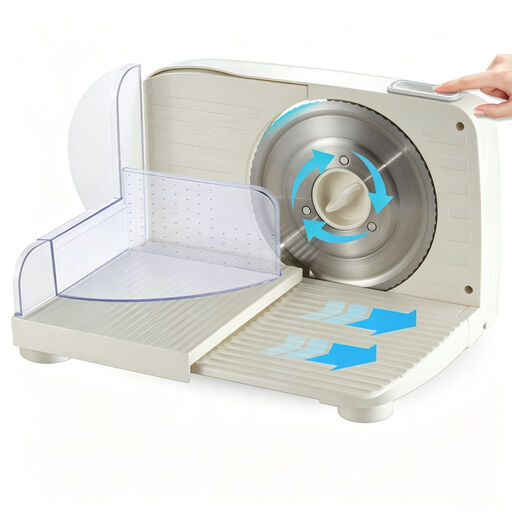 Image unavailable
Electric bread slicer, 250 W, two blades
The folding design and removable parts are worth considering if you want to put the appliance away and clean it after slicing.
- Two blades, each 17 cm; one is serrated
- Adjustable cutting thickness from 0 to 15 mm
- Finger guard on the end stop and non-slip feet, according to the product description
- Designed for domestic use, according to the product description
Joybuy
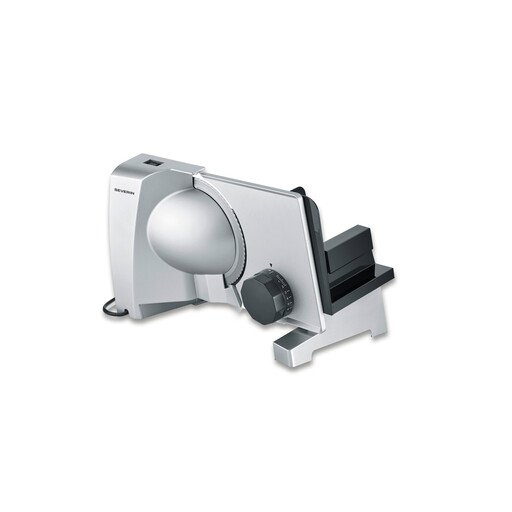 Image unavailable
SEVERIN AS 3917, 0–23 mm
The cutting range of up to 23 mm may be useful if you want to slice thicker pieces too.
- Continuously adjustable cutting thickness from 0 to 23 mm
- Stainless steel blade, plus removable blade and support table, according to the product description
- Metal housing and 130 W, according to the product name
Joybuy
 Image unavailable
ritter serano⁷ Professional
The described choice of serrated and smooth blades gives you two blade types for different slicing tasks.
- Serrated and smooth blades
- Cutting thickness up to 23 mm
- Removable carriage and momentary and continuous-operation switches, according to the product description
Joybuy
 Image unavailable
ritter Sono¹
The removable carriage may be useful when cleaning; check the instructions for the steps required for this model.
- Serrated blade and cutting thickness up to around 20 mm
- Carriage with an 18 cm cutting travel
- Momentary and continuous-operation switches, according to the product description
Joybuy
Frequently asked questions
Which blade should I check first for my bread?
For crusty bread, a serrated blade is a sensible place to start. GRAEF specifically describes the blade on the SKS100 as suitable for hard crusts too; also check that the cutting range suits your preferred slice thickness.
What should I do before cleaning?
Disconnect the food slicer from the mains before removing any parts or cleaning it. Follow the instructions for the specific model and take care around the sharp circular blade.
Who should I contact if I find a fault after buying in Germany?
Under the statutory guarantee, the seller is generally responsible. For a consumer purchase in Germany, the seller is generally liable for two years, according to the German consumer advice centre, for ensuring the goods were free from defects when they were handed over. A voluntary manufacturer’s guarantee has its own terms and conditions.
Is the CE mark an independent safety test?
No. For products that must carry a CE mark under the relevant EU rules, the manufacturer uses it to declare that the product conforms to those requirements. The European Commission points out that the CE mark is not an independent certification mark.


