Regular bread preppers
You slice homemade bread into several portions. Check that the collection tray and stated operating time suit your slicing session.


For slicing several homemade loaves, choose a food slicer whose blade, usable guide, thickness range and permitted operating time suit your loaves and slicing session. Graef describes its serrated blades as suitable for bread and states that the G50 can accommodate bread up to 22 cm wide with the carriage; this figure applies to that model. If storage space is your priority, a foldable model may be a good fit, but its folded dimensions tell you nothing about the space needed or operating time while slicing.
You slice homemade bread into several portions. Check that the collection tray and stated operating time suit your slicing session.
For wide loaves or a firm crust, check that the blade and usable guide on the specific appliance are a good match for your bread.
If you want to put the appliance away after slicing, check both its folded dimensions and the space it needs while in use.
First, check that the shape of your loaf and the blade are suited to the guide. Then compare the operating time, slice thickness and available space with your planned slicing session.
| Consideration | What to look for when buying | Who should pay particular attention? |
|---|---|---|
| Slicing several portions | Check the operating mode and permitted running time; consider whether there is a collection tray. | When I slice several loaves to store, the permitted running time matters more to me than a continuous-operation switch. Around 36% of consumers prioritise slicing several loaves into portions. |
| Loaf and crust | Compare the loaf’s width and height with the stated guide dimensions; check the blade type and model variant. | For wide loaves with a firm crust, I want to know whether the bread and blade are suited to the guide. Around 29% of consumers prioritise a good fit for the shape of the bread and its crust. |
| Limited storage space | Check the folded dimensions and the space needed during use separately. | When my kitchen has limited storage, I want to be able to put the appliance away without overlooking how much space it needs while slicing. Around 21% of consumers prioritise a compact size for storage. |
| Handling and cleaning | Check the food holder and safety features; follow the instructions for cleaning and removing the blade. | If I need to clean the appliance regularly, I look for a secure guide and clear cleaning instructions. Around 14% of consumers prioritise safe handling and easy access for cleaning. |
The ritter E 16 has both pulse and continuous-operation switches, alongside a stated ‘5 minutes of short-time operation’. The continuous-operation switch does not override this model-specific running time.
Before buying, check the running-time and rest-period information for the specific appliance, especially if you want to slice several loaves in a row.
Graef states that the G50 can accommodate bread up to 22 cm wide with the carriage. DOMO gives the MS171/N a maximum cutting height of 15 cm. Width and height are different measurements.
Measure your usual loaves and compare their width and height with the corresponding measurements for the specific appliance variant.
The foldable base plate on the Severin AS 3912 makes it easier to store; it does not account for the space needed for carriage movement and slices while the appliance is in use.
Allow for both storage space and a clear work surface for the fully assembled appliance.
Graef describes serrated blades for bread and smooth blades for, among other things, thinly sliced cold meats and soft bread. What’s included and what’s compatible depends on the model and version.
If you want to slice thinly cut cold meats as well as bread, check what’s included and which blades are compatible with that specific variant.
The G50 and Classic C20 have different features when it comes to loaf guidance and design.
The E 16 is a slanted metal appliance, while the E 18 guides food in from the left.
The AS models differ in areas such as design, food holder and slice thickness range.
The MS171/N is described as a food slicer for bread and other foods.
The Joybuy products listed here have been selected for slicing bread with adjustable slice thickness; they include both foldable and guided designs. Check that the guide, blade and adjustment range suit your loaves and the space you have available.
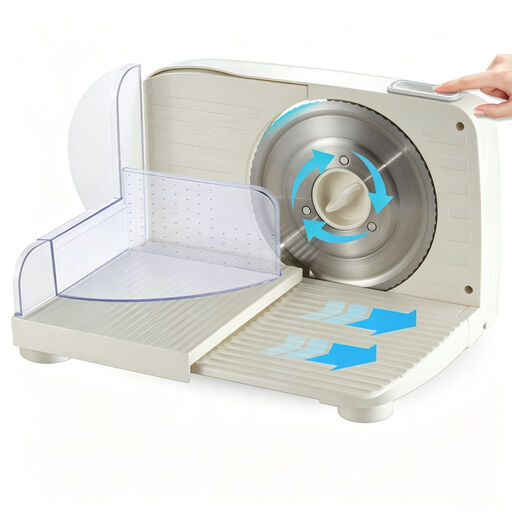 No image available
For slicing bread, the stated adjustment range of 0–15 mm is what you’ll need to compare with your preferred slice thickness.
The product name specifies 250 W and two blades.
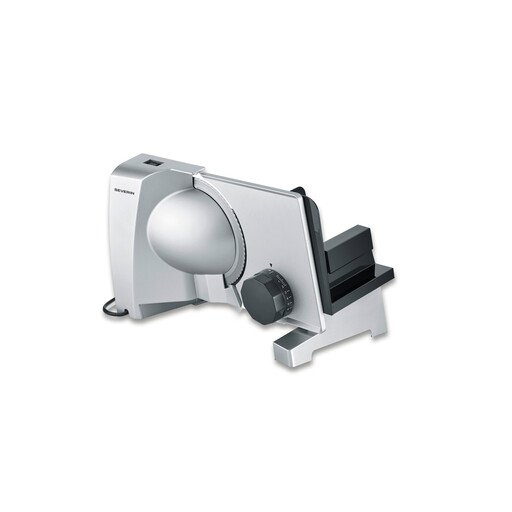 No image available
For slicing bread, compare the stated slice thickness range of 0–23 mm with your preferred slice thickness.
The product name specifies a metal housing and a grey finish.
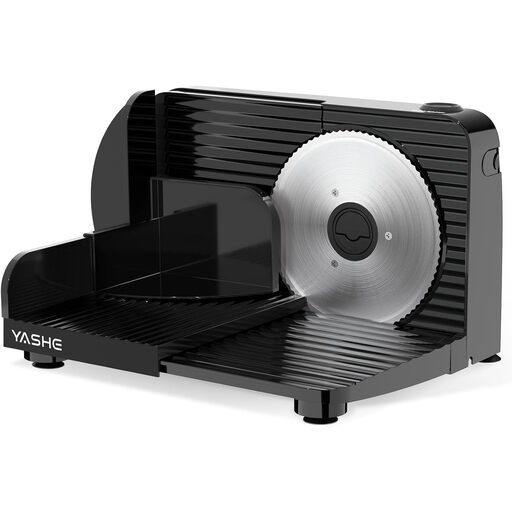 No image available
The foldable design is an option if you want to put the appliance away after slicing; also check how much space it needs while in use.
The product name specifies a 17 cm stainless steel blade and an adjustment range of 0–15 mm.
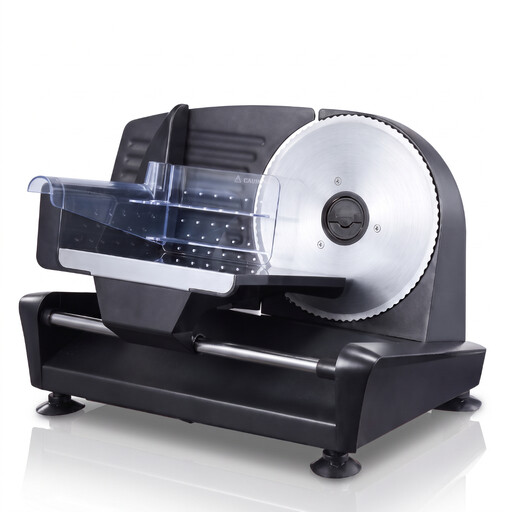 No image available
For bread slices of varying thickness, compare the stated range of 0–15 mm with what you need.
The product name specifies two 19 cm stainless steel blades.
 No image available
If you’re preparing sliced bread, check that your preferred slice thickness and loaf guidance match the specifications for the version in question.
The product name specifies a metal construction, a removable carriage and a shatter-resistant glass base.
The German Federal Centre for Nutrition recommends freezing bread as fresh as possible and already sliced if you plan to store it for longer. It gives one to three months as a guide for frozen bread; this is not a guaranteed shelf life for every homemade loaf.
Follow the instructions for the specific appliance and disconnect it from the mains before cleaning if the instructions say to do so. For the E 16, ritterwerk specifically advises unplugging the appliance before dismantling or cleaning it; this model-specific instruction does not replace the instructions for other appliances.
Electric food slicers placed on the market in Germany are subject to the relevant EU product safety requirements; CE marking is required where the applicable harmonised legislation requires it. The European Union describes CE marking as the manufacturer’s declaration that the product meets the applicable EU requirements, not as an independent quality mark.
No. The Verbraucherzentrale (German Consumer Advice Centre) distinguishes statutory rights against the seller for faulty goods from an additional voluntary guarantee, whose terms depend on the guarantor. Also check whether replacement blades or other model-specific spare parts are available for the version you want.