What should you look for when buying?
First, check that the blade and slice thickness suit your bread. Then compare how easy it is to clean, how securely it guides the food and how much space it needs when in use and when stored away.
ritterwerk points out that its smooth ham and cold-cutting blade is not suitable for bread. When switching between foods, the German Federal Institute for Risk Assessment recommends using separate kitchen utensils.
| Consideration |
What to check before buying |
Who particularly values this? |
| Bread blade and slice thickness |
Whether a serrated blade is included and the slice thickness range of the specific model; the loaf support surface and carriage travel. |
If I want to cut crusty bread to a particular thickness, I need a suitable blade and enough adjustment. Around 31% of consumers put blade type and desired slice thickness first. |
| Cleaning when switching between ingredients |
Check whether the blade, carriage or support table can be removed, and how the instructions say to clean them. |
If I slice other prepared foods after bread, I want to be able to reach the cutting areas easily and clean them as instructed. Around 25% of consumers prioritise cleaning between ingredients. |
| Safe guidance |
Check the food holder, finger guard, carriage guide and switch system on the specific model. |
When I’m slicing bread or a smaller leftover piece, controlled feeding is important to me. Around 25% of consumers put safe guidance and protective features first. |
| Worktop and storage space |
Compare the dimensions when in use and when folded separately; also allow room for the carriage to move. |
If I have limited worktop space, the machine needs room while slicing and must be easy to put away afterwards. Around 19% of consumers prioritise worktop or storage space. |
Joybuy food slicers for bread
The following Joybuy food slicers are listed for cutting bread; blade type, slice thickness, cleaning and design vary by model.
 No image available
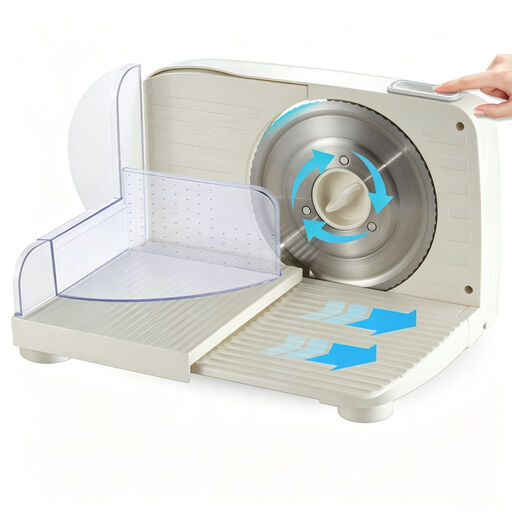
Foldable electric food slicer (0–15 mm)
The specifications list bread as a suitable use and give an adjustable slice thickness of 0 to 15 mm.
Foldable design; stainless steel blade.
View product at Joybuy
 No image available
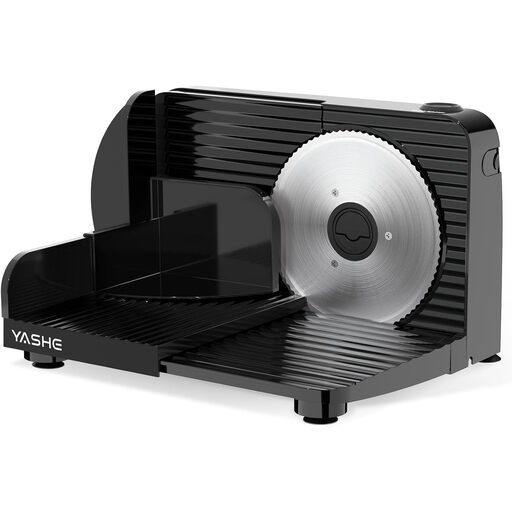
250 W electric food slicer (0–15 mm)
A 17-cm serrated blade is specified for bread; check which of the two blades is intended for your needs.
Power rating: 250 W; slice thickness: 0 to 15 mm; two blades.
View product at Joybuy
 No image available
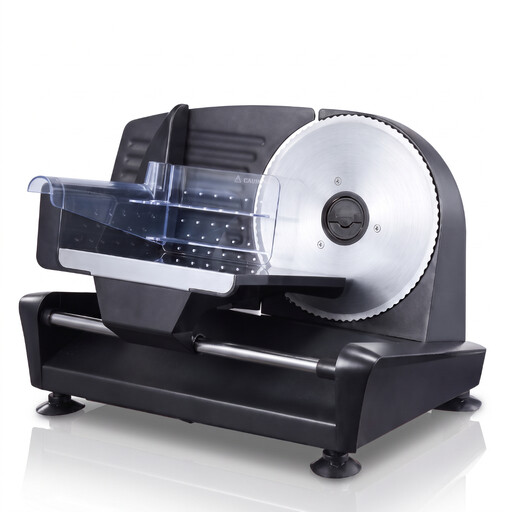
YASHE SL-5801D23B3, 180 W
A serrated blade is specified for bread; according to the product details, the slice thickness can be adjusted from 0 to 15 mm.
17-cm blade; foldable design; removable parts and safety features listed.
View product at Joybuy
 No image available
FOHERE food slicer, 200 W (0–15 mm)
A serrated blade is specified for bread; removable blades and a removable carriage are listed for cleaning when switching between ingredients.
Two 19-cm stainless steel blades; slice thickness: 0 to 15 mm; safety lock and food holder.
View product at Joybuy
 No image available
ritter serano⁷ Professional
A serrated blade is listed for bread and other ingredients; the removable carriage may be useful when cleaning.
Two blades; safety switch; slice thickness up to 23 mm.
View product at Joybuy
Frequently asked questions
Which blade is suitable for homemade bread?
First check whether a serrated blade is included, then look at the slice thickness range for the specific model. ritterwerk explicitly describes its smooth ham and cold-cutting blade as unsuitable for bread.
What should I consider if I slice other ingredients as well as bread?
Check the instructions to see which parts can be removed for cleaning and how they should be cleaned. The German Federal Institute for Risk Assessment recommends using separate kitchen utensils for raw, cooked and ready-to-eat foods to avoid cross-contamination.
Who is responsible if the appliance develops a fault: the retailer or the manufacturer?
The seller is generally responsible for your statutory rights, which are separate from any voluntary manufacturer’s guarantee. The Verbraucherzentrale states that new purchases generally have a two-year warranty period. Additional rules may apply to purchase contracts from 31 July 2026 if you choose a repair.
Which markings and requirements should I look out for when buying in Germany?
For an electrical appliance, check whether it is covered by EU regulations that require CE marking. This marking is the manufacturer’s declaration of conformity, not an independent quality mark. Parts that come into contact with food must also meet the applicable requirements for food contact materials.
Can an old electric food slicer go in household waste?
No. According to the German Federal Ministry for the Environment, old electrical appliances must be collected separately and taken to an authorised collection point. Retailers’ take-back obligations apply under the relevant legal conditions.


