Preparing food for several participants
You want to slice portions of a consistent thickness and are comparing the thickness settings and blades available. Manufacturers including Ritter, ETA and SEVERIN provide information about these features.


Choose a machine designed for slicing sausage, with an adjustable thickness setting, a safe-to-use food holder and surfaces that are easy to reach for cleaning. An additional smooth blade may be useful for fine slicing, while a folding machine saves storage space. Neither feature removes the need to check the intended use and safe operating instructions.
You want to slice portions of a consistent thickness and are comparing the thickness settings and blades available. Manufacturers including Ritter, ETA and SEVERIN provide information about these features.
You want to make sure the food and leftover pieces can be guided safely, and that everyone operating the machine understands its safety features. The German Social Accident Insurance Institution for the Food and Hospitality Industry provides guidance on safe handling of food slicers.
You only need the machine for occasional classes and want to put it away afterwards. Ritter gives the folded dimensions of the icaro 7 and markant 7; compare these with the space required when the machine is set up, too.
| What matters | What to look for | Who should pay particular attention? |
|---|---|---|
| Slice thickness and blade | Compare the adjustment range and blade type, and check whether the specific model is explicitly suitable for sausage or salami. | If I’m preparing slices for several participants, I want to be able to adjust the thickness to suit the salami and choose a suitable blade. Around 31% of consumers put adjustable slice thickness and the quality of the cut first. |
| Safe handling | Check the food holder, carriage guide and safety features. The German Social Accident Insurance Institution for the Food and Hospitality Industry recommends keeping the food against the back of the carriage and using the food holder. | When different people are operating the machine, I want the carriage and food holder to help guide the food, and everyone to know how the safety features work. Around 31% of consumers say safe handling is their main concern. |
| Cleaning between tasks | Check the instructions to see whether the blade and carriage are accessible or removable. The German Federal Institute for Risk Assessment recommends using separate utensils for raw, cooked and ready-to-eat foods. | If I’m slicing salami and other ready-to-eat foods one after another, I want to be able to reach and clean the blade and food-contact surfaces in line with the instructions. Around 23% of consumers prioritise cleaning between slicing tasks. |
| Storage and worktop space | Compare the dimensions when set up and folded, as well as the space needed for the carriage to move. The folded dimensions alone don’t tell you how much worktop space you’ll need for slicing. | If I only use the machine on class days, I want to be able to put it away afterwards without underestimating the space needed to set it up. Around 15% of consumers say storage space is their main concern. |
Even when folded, a machine needs a stable surface and enough room for the carriage to move while you’re slicing.
Before buying, compare its dimensions in use with its storage dimensions.
The GRAEF G52 TWIN comes with an additional smooth blade. For the STYLE S10005, GRAEF lists a compatible blade as a separate accessory.
Check the exact model and what’s included rather than assuming a blade comes with it because of the brand name.
The compatible smooth blade for the STYLE S10005 may need to be bought separately.
An award in the CHIP test dated 12 August 2026 does not change the manufacturer’s guidance on how the machine may be used. Ritter explicitly excludes commercial use of the markant 7.
Before buying a machine for workplace use, check that the specific model is approved for that purpose.
The foldable icaro 7 and markant 7 domestic models may suit buyers with limited storage space.
The range includes freestanding models with a serrated blade, and depending on the version, either an additional smooth blade or a compatible blade available as an accessory.
ETA explicitly lists salami as suitable food for slicing with the Tempo 1094 90000.
SEVERIN describes the AS 3917 as a domestic food slicer for bread and sausage.
The Joybuy range includes food slicers for meat and sausage with adjustable slice thickness, as well as models with smooth and serrated blades.
 No image available
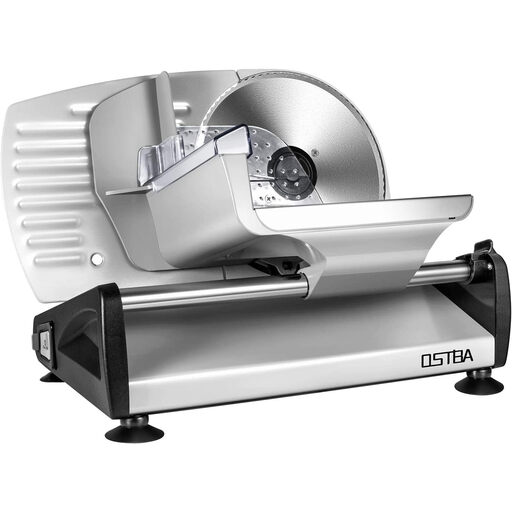
For slicing meat when you want to adjust the thickness and fold the machine away after use.
The title specifies 0–15 mm and a stainless steel blade. According to the product description, the machine is not designed for frozen food or bones.
 No image available
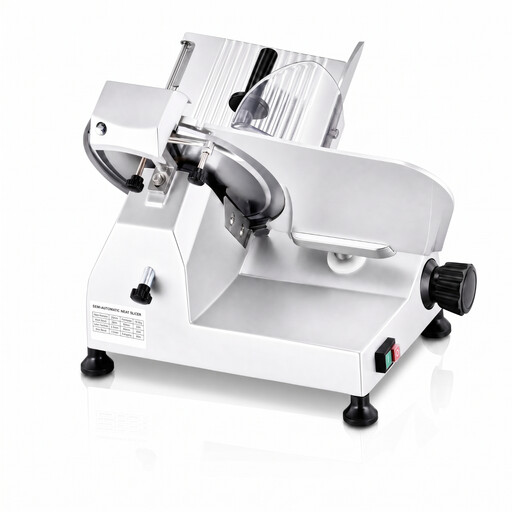
An option for slicing meat when you want to adjust the thickness for different cuts.
The manufacturer specifies a serrated stainless steel blade, a safety lock, non-slip feet, and removable, dishwasher-safe parts.
 No image available
For meat and sausage if you’re looking for an adjustable slice thickness range and removable parts for cleaning.
The description specifies a setting from 0 to 12 mm, a removable blade and a food holder.
 No image available
An option for cold cuts if you want to switch between a smooth and a serrated blade.
The product description lists both blade types, a slice thickness of up to 23 mm, electronic speed control and a removable carriage.
 No image available
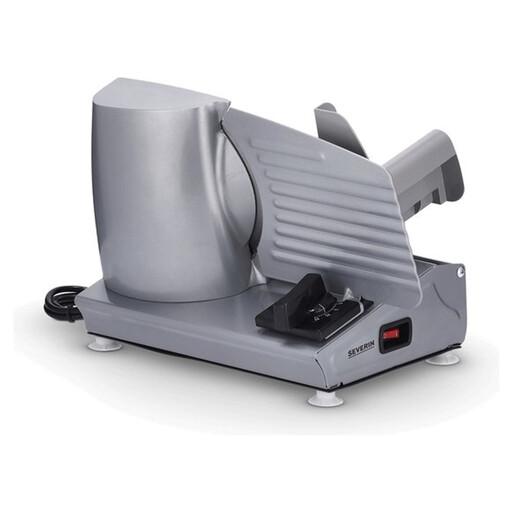
For cold cuts when you want to vary the slice thickness and switch between blades for different slicing tasks.
The product description lists a smooth and a serrated blade, continuously adjustable from 0 to 15 mm, finger protection and a collection tray. According to the description, removed parts must be cleaned by hand and are not dishwasher-safe.
Before slicing, explain how to use the carriage, safety features and food holder, referring to the instructions for that specific machine. The German Social Accident Insurance Institution for the Food and Hospitality Industry recommends, among other things, keeping the food against the back of the carriage and never reaching under the food holder.
Switch off the machine and follow the instructions for removing and cleaning its parts. The German Federal Institute for Risk Assessment recommends using separate utensils for raw, cooked and ready-to-eat foods to avoid cross-contamination.
Your statutory rights are a claim against the seller; a manufacturer’s guarantee is an additional voluntary offer with its own terms and conditions. For online orders, consumers generally have 14 days from receipt to cancel, as explained by the consumer advice centre.
No. According to the European Commission, the CE mark is the manufacturer’s declaration that a product meets the applicable EU requirements; it is not a centrally issued EU certificate. The requirements depend on the specific machine. For a mains-powered food slicer, you should also check the rated voltage.