Fine slicing for a meat platter
If you want to serve thinly sliced roast beef, check the type of blade and which blade actually comes with the model you choose.


For thin slices of roast beef, a smooth slicing blade is a good choice, provided it comes with the specific model or is confirmed as compatible. A serrated blade may be more suitable if you also slice bread regularly, but the manufacturer’s claims are no substitute for a comparison test with roast beef. If you’re preparing several portions, also check the food guide and operating time, and keep the meat well chilled until serving.
If you want to serve thinly sliced roast beef, check the type of blade and which blade actually comes with the model you choose.
When preparing several portions, look for an easy-to-use food guide, check the model’s operating time and make sure the surfaces are easy to reach for cleaning. Also plan how you’ll keep the meat chilled and serve it.
If you want to put the appliance away after your event, compare its folded dimensions with the space it needs while in use.
A good fit if: roast beef and other soft sliced meats are your main focus. ritterwerk describes a smooth blade as suitable for particularly thin slices.
Things to consider: The blade supplied depends on the exact model variant; according to ritterwerk, a smooth blade is not suitable for bread.
A good fit if: you often slice bread as well as cold meats; ritterwerk describes its serrated blade as suitable for this.
Things to consider: ritterwerk recommends a smooth blade for particularly thin slices of soft cold meats. Check whether a compatible additional blade is available for the specific model.
A good fit if: you want to put the appliance away in a cupboard after your guests have left. According to the manufacturer, the ritter icaro 7 folds away and measures 10,0 cm wide when folded.
Things to consider: A folding design says nothing about whether the blade is suitable for roast beef. Also check the worktop space, carriage movement and access for cleaning when the appliance is open.
| Buying priority | What to look for when buying | Who is it important for? |
|---|---|---|
| Thin slices of roast beef | Check the exact model variant, the blade included and whether an additional blade is compatible; also check the adjustable slice thickness. | If I want to serve roast beef as thinly as possible, I pay particular attention to the blade and settings. Around 36% of consumers put fine slicing first. |
| Cleaning and handling | Check the finger guard, food holder and access to the blade, carriage and contact surfaces. Also plan for chilling and keeping raw and cooked foods separate. | When preparing food for guests, you want to guide the appliance safely and reach the contact surfaces easily after use. These factors account for around 29% of the priorities of consumers who focus mainly on hygiene and handling. |
| Several portions | Check that the roast fits the usable support area; read the operating and resting instructions for the specific model. | If you’re preparing several portions, a suitable food guide and operating time are crucial. Around 21% of consumers prioritise preparing several portions. |
| Space requirements | Compare the dimensions when in use and folded away, and allow space for the carriage to move, for operation and for plates. | If you need to put the appliance away after your guests have left, consider not only its folded dimensions but also how much room it needs while slicing. Around 14% of consumers say storage is their main priority. |
A blade supplied with one variant may not be included with every appliance based on the same standard model. GRAEF specifically lists the additional smooth blade for the G52 TWIN; the F.A.Z. Kaufkompass selection includes a G52 without evidence that this variant comes with it.
Compare the full model and package name with the stated contents.
If a suitable slicing blade isn’t included, you may need to buy a separate compatible blade.
The wattage alone doesn’t tell you the permitted operating time or how well the appliance slices roast beef. For example, the manufacturer lists a carriage travel of approximately 15 cm and a short-time operating period of five minutes for the ritter E 18; these specifications don’t automatically apply to other models.
Check that the size of your joint is suitable for the food guide, and follow the operating and resting instructions in the manual for the appliance you choose.
The German Federal Institute for Risk Assessment recommends keeping perishable foods as cold as possible until they’re eaten or processed. It also advises using separate kitchen utensils for raw and cooked foods.
Slice suitable portions, keep any roast beef you don’t need chilled, and follow the instructions for using and cleaning your appliance safely.
If you’re looking for a smooth blade for fine slices, the exact package variant is important for the G52 TWIN.
The E 18 and icaro 7 have different strengths when it comes to food guidance and storage.
According to the manufacturer, the AS 3915 includes blade and food-guiding features to help prepare a range of foods.
For the MS171, DOMO describes an infinitely adjustable slice thickness and a lightly serrated stainless steel blade.
The models below are electric food slicers for cold meats or a range of slicing tasks. For appliances covered by the relevant EU regulations for electrical products, check the product’s conformity information and the required CE marking. According to Your Europe, the CE marking is a declaration by the manufacturer, not an independent quality mark.
 No image available
The description lists roast beef as a use and an adjustable slice thickness for cold meats.
The slice thickness can be adjusted from 0–15 mm; a safety guard and food holder are also specified. According to the description, don’t use it for frozen foods or bones.
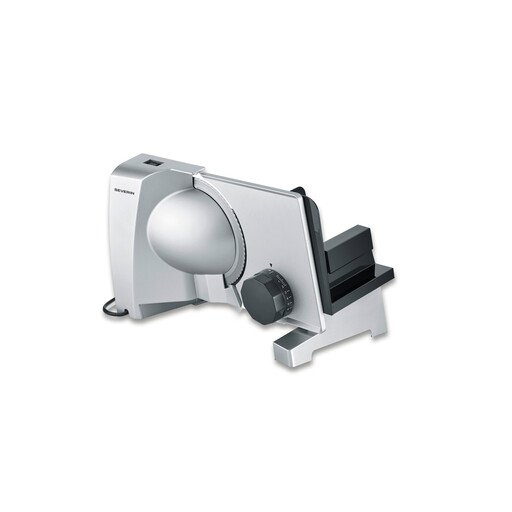 No image available
For cold meats, if you want to adjust the slice thickness and prefer removable parts for cleaning.
Infinitely adjustable slice thickness from 0–23 mm; the blade and support are removable. The specific blade type isn’t stated here.
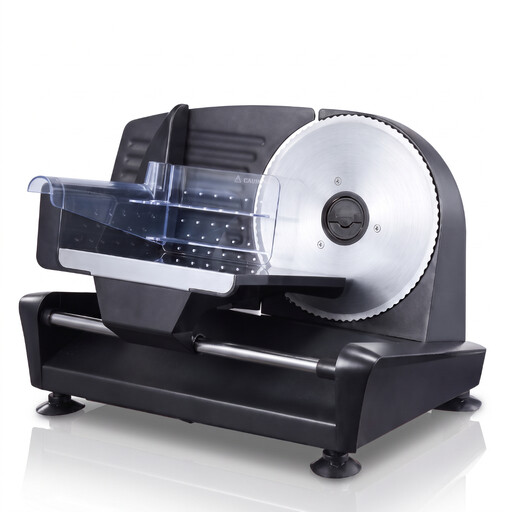 No image available
For cold meats and bread, if you want to use the different blade types listed in the offer.
Includes a smooth blade for meat and a serrated blade for bread; slice thickness from 0–15 mm. The description says the blades and carriage are removable.
 No image available
For cold meats and other slicing tasks, if two blade types and a removable carriage are important to you.
The description lists a smooth and a serrated blade, variable speed and a carriage travel of 24 cm. Slice thickness up to 23 mm; the carriage is removable.
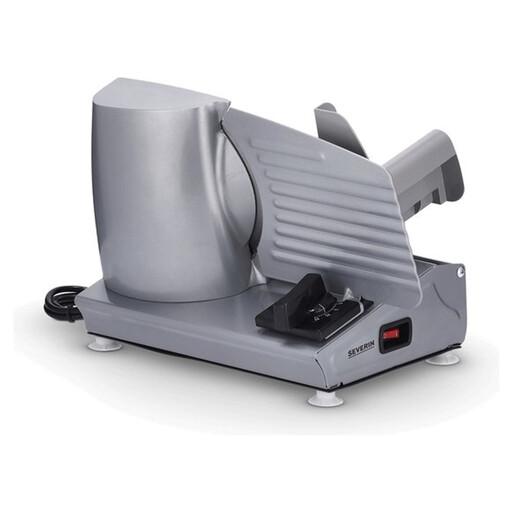 No image available
For cold meats, with a ham blade and adjustable slice thickness; a finger guard and food holder are also listed.
Slice thickness from 0–15 mm. The description lists a tilting carriage for access when changing the blade and cleaning.
There’s no general answer. ritterwerk describes a smooth blade as suitable for particularly thin slices of soft cold meats, and the serrated blade as a versatile option. This is the manufacturer’s recommendation, not a comparative test with roast beef.
Follow the instructions for the specific appliance and unplug it before taking it apart or cleaning it. This safety instruction is explicitly included in the information for the ritter E 18; for the SEVERIN AS 3915, the manufacturer describes removable blades and a carriage that tilts for blade changes.
The German Federal Institute for Risk Assessment recommends keeping perishable foods as cold as possible until they’re eaten or processed. It also advises using separate kitchen utensils for raw and cooked foods. A food slicer can’t keep food chilled or prevent cross-contamination.
When you buy from a retailer, you have statutory rights against the seller; a manufacturer’s guarantee is separate and voluntary. The Verbraucherzentrale advises that, if there’s a fault, you should first ask the seller to remedy it.