Even slices of cheese
If you want to slice hard cheese after work, first check what the manufacturer says about the blade supplied. GRAEF specifically lists harder cheese as a suitable use for the SKS110.


If you mainly want to slice hard cheese, first check whether the manufacturer specifically says the blade supplied is suitable for it: GRAEF lists harder cheese as a suitable use for the SKS110. Then compare the carriage guide, cleaning requirements and storage space with your evening routine. Manufacturer information is not an independent performance test.
If you want to slice hard cheese after work, first check what the manufacturer says about the blade supplied. GRAEF specifically lists harder cheese as a suitable use for the SKS110.
If you want to get slicing quickly after a long shift, look for a well-guided carriage and easy-to-use controls. GRAEF and ritter describe these features on selected models.
If you only slice a few pieces and put the appliance away afterwards, check which parts can be removed and how much space it takes up when in use and when folded. ritter and SEVERIN provide model-specific details.
First check whether the specific blade is listed as suitable for hard cheese. Then consider how easy the slicer is to use, clean and store.
| Priority | What to check before buying | Who is this important to? |
|---|---|---|
| Hard cheese and slice thickness | Check the information about the blade supplied and the slice-thickness settings for the specific model. | If I want to slice hard cheese to a particular thickness, the blade’s stated suitability is the first thing I check. Around 36% of consumers put suitability for cheese first. |
| Safe operation | Compare the carriage guide, food holder and controls; unplug the appliance before cleaning it. | If I want to slice small leftovers after a shift without having to hold them awkwardly, I look for clear guidance and straightforward controls. Around 29% of consumers prioritise safe handling. |
| Cleaning | Check which parts can be removed and what the instructions say about cleaning. | If I want to clean the food-contact surfaces after slicing a few pieces, it matters to me which parts I can remove to do so. Around 21% of consumers prioritise cleaning. |
| Storage space | Check the appliance’s dimensions both in use and when stored; allow for any parts that need to be removed. | If my kitchen has limited storage, I want to know how much space the appliance and its accessories will take up after use. Around 14% of consumers put ease of storage first. |
Manufacturers’ descriptions vary: GRAEF specifically lists harder cheese for the SKS110, while SEVERIN mentions cheese for the AS 3917 without specifying its hardness. This is not a direct performance test.
If you want to slice hard cheese, check what the manufacturer says about the blade supplied with that particular model.
GRAEF describes the additional smooth blade on the G52 TWIN primarily as suitable for thin slices of ham and carpaccio, not as a proven advantage for hard cheese.
Choose the blade configuration to suit the food you plan to slice, and check exactly which blades are included.
With the ritter icaro⁷, the dimensions in use differ from those when folded; you also need to store the carriage.
Measure your worktop and storage space separately, and allow for all the parts you remove.
Worth considering if you want a specific model that is explicitly listed as suitable for harder cheese.
Worth considering if you’re looking for a folding design, removable parts or left-handed operation on selected models.
Worth considering if you’re looking at the AS 3917 as a slicer for a range of foods, with removable parts for cleaning.
This selection includes electric food slicers, including folding models and appliances with adjustable slice thickness. If you mainly want to slice hard cheese, check the blade information and what’s included with each model.
 No image available
For anyone looking for an electric food slicer with adjustable slice thickness for cheese.
Listed in the product name: 0–15 mm slice thickness, stainless steel blade and folding design.
 No image available
The product description mentions hard cheese; also check that the blade configuration supplied is suitable for the food you plan to slice.
Listed in the product name: 180 W, 0–15 mm slice thickness and a 17 cm stainless steel serrated blade.
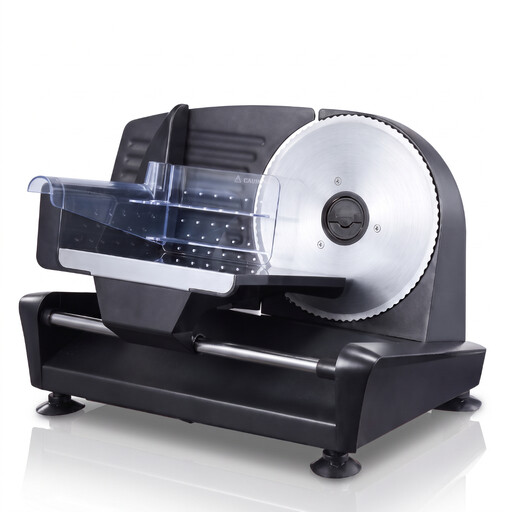 No image available
For anyone looking for an electric food slicer for cheese and other foods listed in the product name.
Listed in the product name: 200 W and two 19 cm stainless steel blades.
 No image available
For anyone comparing electric food slicers based on the design and motor features listed in the product name.
Listed in the product name: metal construction, angled design, DC motor and electronic speed adjustment.
 No image available
For anyone who wants to consider a removable carriage when choosing an electric food slicer.
Listed in the product name: metal construction, removable carriage and glass base.
No, not necessarily. For the SKS110, GRAEF specifically says the supplied serrated blade is suitable for harder cheese. Check the information for the model you’re considering rather than assuming its suitability based on the blade type alone.
Follow the instructions for the specific model and unplug the appliance before taking it apart or cleaning it. ritter explicitly recommends this safety measure for its appliances; removable parts are not automatically dishwasher-safe.
According to information from the European Union, CE marking is not an approval or award granted by a central EU body. On its own, it also says nothing about how well an appliance slices hard cheese.
No. The German Environment Agency explains that old electrical appliances must be collected separately from unsorted household waste.
The seller is generally responsible for your statutory rights, not the manufacturer. The consumer advice centre also distinguishes statutory rights from an additional guarantee.