Class leaders with a cheese station
If you need even slices of hard cheese, check the blade specifications for the exact model. Graef explicitly states that the serrated blade supplied with the SKS100 is suitable for harder cheese.


For hard cheese in a weekend cookery class, the clearest choice is a model whose manufacturer explicitly states that its blade is suitable for harder cheese. Graef specifies this for the serrated blade supplied with the SKS100. If different people will be operating it, a food holder, safe handling and easy cleaning are also important. Before using it for extended periods or in a potentially commercial setting, check the operating time and permitted use of the exact model.
If you need even slices of hard cheese, check the blade specifications for the exact model. Graef explicitly states that the serrated blade supplied with the SKS100 is suitable for harder cheese.
If different people will be using it, important considerations include the carriage, food holder and supervised operation. Graef advises in its instructions that the appliance should be unplugged before dismantling or cleaning.
If you put the appliance away between weekend classes, compare its folded dimensions and footprint with the space needed for the carriage and food while it is in use. Severin describes the AS 3912 as foldable; its suitability for cheese needs to be checked separately.
First, check that the manufacturer and the blade supplied are suitable for the food you plan to slice. Then make sure the way it operates, how it is cleaned and the space available all suit your class.
| Consideration | What to check before buying | Who should pay particular attention? |
|---|---|---|
| Hard cheese | Compare the manufacturer's information for the exact model and the blade supplied, the slice thickness and the space on the carriage. | If I want to slice hard cheese evenly, the suitability of the specific blade is crucial; around 33% of consumers put suitability for cheese first. |
| Safe operation | Check the food holder, finger guard, stable positioning and operating instructions for the exact model. | If different people will be using it, I want to be able to guide the food safely and supervise use properly; around 27% of consumers prioritise safe operation. |
| Cleaning | Check which parts of the blade, carriage and food platform can be removed, and how the manufacturer says to clean them. | If I’m preparing different foods, I need easy-to-reach contact surfaces that can be cleaned between tasks; around 20% of consumers put cleaning first. |
| Space needed | Compare the footprint, carriage travel and storage space needed once the appliance is folded. | If I only use the appliance at weekends, it needs to fit both the worktop and the storage space; around 20% of consumers prioritise setting up and storing the appliance. |
Product descriptions vary in how specifically they name the food to be sliced. A general mention of cheese does not automatically confirm suitability for every type of hard cheese.
Compare the manufacturer's information for the exact model and the blade supplied with the cheese you plan to slice.
A continuous-operation switch does not override the stated short-time operating limit. Ritter specifies 5 minutes for the E 16 KB and 10 minutes for the serano 7 KB.
Plan your slicing sessions in line with the instructions for the model you have.
Ritter limits use of the E 16 and serano 7 models covered here to domestic settings and excludes commercial use.
Before using an appliance for a potentially commercial class, check that the intended use is permitted by the instructions for the exact model.
A folding feature can make an appliance easier to store, but it tells you nothing about whether the worktop, food or cleaning routine will suit your class.
Measure the space available and also check the carriage travel, suitability for the food and how to clean the parts that come into contact with it.
A useful brand to compare if you’re considering models with different blade types.
A useful brand to compare if you’re looking at compact metal appliances for home use and a longer carriage travel.
A useful brand to compare if you’re choosing between a foldable design and a model with a removable blade and food platform.
Another metal food slicer to compare for slice thickness and blade specifications.
A useful brand to compare if you’re considering a larger design for a dedicated slicing station with plenty of space.
The Joybuy products below cover different aspects of this scenario, including foldable designs, stated suitability for cheese, and features that help with operation and cleaning. For hard cheese, always check whether the information for the exact model applies to the blade supplied.
 No image available
The product description lists hard cheese as suitable food and describes the appliance as foldable.
Slice thickness: 0–15 mm. Stainless steel blade: 17 cm. Stated power: 180 W. Removable parts and a safety switch are also mentioned.
 No image available
Cheese is listed as suitable food; if you’re slicing hard cheese, check that the blade supplied is suitable for your type.
Slice thickness: 0–15 mm. The product information lists a stainless steel blade, a folding feature, a food holder and a safety guard.
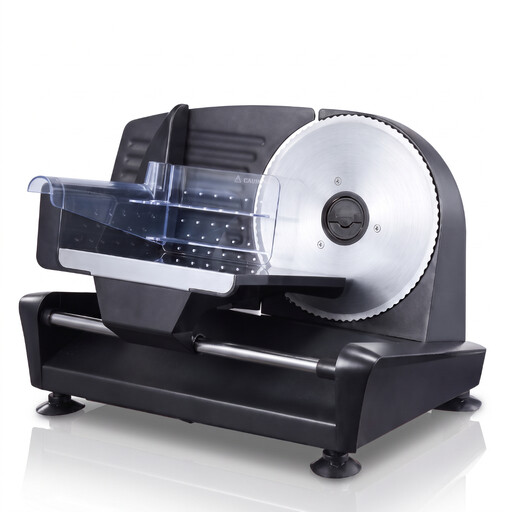 No image available
The product description says to use the smooth blade for cheese. If you’re slicing hard cheese, check that the specific blade is suitable for your type.
Two stainless steel blades, each 19 cm in diameter. Slice thickness: 0–15 mm. A food holder, safety lock and removable carriage are also listed.
 No image available
The removable carriage and momentary and continuous-operation switches may be useful for keeping a class running smoothly. Before choosing this model, check whether the specific blade is designed for your hard cheese.
The product description specifies carriage travel of 18 cm, slice thickness of up to around 20 mm and a serrated blade attachment.
Compare the manufacturer's information for the exact model and the blade supplied with the food you plan to slice. Graef explicitly specifies harder cheese for the SKS100; a general statement that an appliance is “for cheese” or a wattage rating does not confirm suitability in the same way.
Position the appliance securely and use the carriage and food holder in accordance with the instructions for the model. Unplug it before dismantling or cleaning, and clean shared appliances thoroughly between different foods. The Federal Centre for Nutrition recommends washing kitchen equipment thoroughly in hot water between uses.
Not without checking the instructions for the exact appliance. Ritter excludes commercial use for the E 16 and serano 7. Regulation (EC) No 852/2004 sets out hygiene requirements for food business operators; whether they apply to a particular class depends on how it is classified. Section 4 of the LMHV covers training in the handling of highly perishable foods.
If goods are faulty, statutory rights are claims against the seller; a guarantee is an additional voluntary promise. Section 438 of the BGB generally sets a two-year period from delivery for ordinary goods. Check the terms and conditions of any additional guarantee. The Verbraucherzentrale explains the difference between these two types of claim.
No. According to information from the European Union, the manufacturer uses the CE marking to declare that the product complies with applicable EU rules; there is no central EU body that generally issues a certificate for this. Check the markings and documentation for the exact appliance rather than assuming they mean the blade has been independently tested.