Fine-slice prepper
If you regularly slice cooked roast beef for packed lunches, pay close attention to the blade type: Graef and ritter describe smooth blades as suitable for fine, soft slices.


For especially thin slices of roast beef, a smooth slicing blade is an obvious choice: Graef and ritter describe smooth blades as suitable for fine, soft slices, but this is not the result of a roast beef test. If you regularly slice bread, particularly crusty loaves, a serrated blade may be more versatile. Check that the smooth blade is compatible with the exact model and included in the box. For packed lunches, you’ll also need to clean any parts that come into contact with the meat and keep the roast beef properly chilled – a food slicer doesn’t replace the cold chain.
If you regularly slice cooked roast beef for packed lunches, pay close attention to the blade type: Graef and ritter describe smooth blades as suitable for fine, soft slices.
If you’re preparing meat for several working days, plan how you’ll clean the slicing parts and keep the food chilled until it’s time to eat. The Federal Centre for Nutrition notes that germs can be transferred to food by contaminated knives. The German Federal Institute for Risk Assessment recommends keeping perishable food as cold as possible until it is eaten.
If you slice bread and other ingredients as well as roast beef, compare the blades supplied and the space the appliance takes up. Graef describes serrated blades as suitable for bread, including crusty loaves, and thicker slices.
| What matters | What to look for when buying | Who is this most relevant to? |
|---|---|---|
| Thin slices of roast beef | Check the blade type, adjustable slice thickness, model compatibility and whether a smooth slicing blade is included. Graef and ritter describe smooth blades as suitable for fine, soft slices. | If slice thickness is the deciding factor for my packed lunches, I’d check the smooth-blade option first. Around 36% of consumers put fine slicing first. |
| Cleaning and lunch preparation | Check how easily you can reach the blade and carriage, and read the cleaning instructions for the exact model. Also plan how to keep the meat and prepared packed lunch chilled until it’s time to eat. | If I’m preparing meat for several working days, I want to clean the slicing parts thoroughly and keep the food chilled until my break. Around 29% of consumers prioritise cleaning and safe lunch preparation. |
| Slicing bread and other ingredients too | Compare the standard blade, any available additional blades and their compatibility. Graef describes serrated blades as suitable for bread and thicker slices. | If roast beef, bread and other lunch ingredients are all on the menu, having the right blades matters to me. Around 21% of consumers prioritise versatile slicing. |
| Counter space and ease of use | Check the appliance’s dimensions, carriage travel, guide side and storage requirements against your kitchen. The dimensions given for the ritter E 18 apply to this model only. | If my worktop space is limited, the appliance needs to fit my kitchen and the way I work. Around 14% of consumers prioritise a compact design. |
GRAEF says the G52 TWIN includes an additional smooth blade. That doesn’t mean a version without the “TWIN” suffix comes with the same accessories.
Before buying, compare the full model name and the accessories listed as included.
According to ritter, a smooth slicing blade isn’t suitable for bread, particularly baked goods. Graef recommends a serrated blade for crusty bread.
Choose a blade to suit the food you slice most often, and check whether a compatible additional blade is available for other jobs.
The Federal Centre for Nutrition notes that contaminated knives can transfer germs to food. According to the German Federal Institute for Risk Assessment, perishable food should be kept as cold as possible until it is eaten; the temperature during transport matters too.
Clean the parts that come into contact with the meat according to the appliance instructions, and make sure the roast beef and packed lunch are kept properly chilled. For the ritter E 18, the manufacturer requires you to unplug the appliance before taking it apart and cleaning it.
Graef offers food slicers with different blade configurations. For the G52 TWIN, the manufacturer lists an additional smooth blade for fine slicing.
ritter offers food slicers and compatible blades for different types of food. The E 18 has a left-hand guide and is described as coming with a 17 cm serrated blade.
The F.A.Z. Kaufkompass singled out the Berkel Home Line 200 Plus specifically in connection with ham.
The F.A.Z. Kaufkompass included the Domo MS171 in its selection of food slicers.
The electric food slicers below are relevant for meat and cooked-slice preparation. For each model, compare the blade type, adjustable slice thickness and cleaning options with your lunch routine.
 No image available
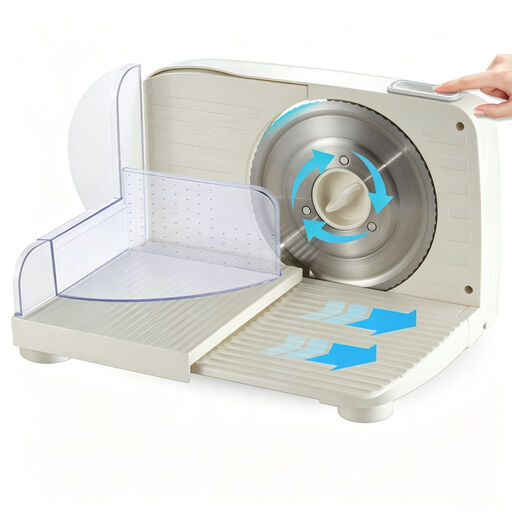
An option if you want to slice roast beef to an adjustable thickness.
The slice thickness is stated as 0–15 mm. It’s also described as having a stainless steel blade, foldable design, food holder and blade guard.
 No image available
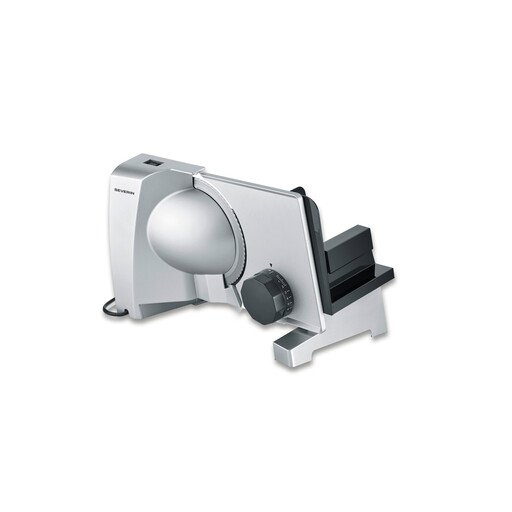
The listed combination of a smooth blade for meat and a serrated blade for bread is useful if you want to handle both types of food.
The slice thickness is stated as 0–15 mm. The appliance folds away, and removable parts and a safety switch are also listed.
 No image available
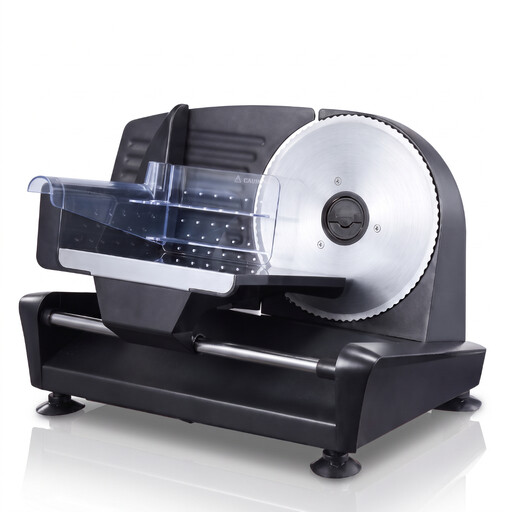
The removable blade and support table may be useful if you’re planning to clean the appliance after slicing meat.
The slice thickness can be adjusted continuously from 0–23 mm. It’s also described as having a metal housing and a power rating of 130 W.
 No image available
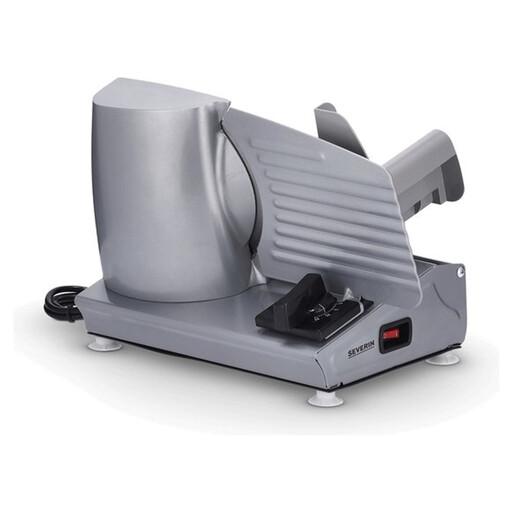
For fine slices of meat, the listed smooth blade is relevant; the serrated blade is intended for bread.
The slice thickness can be adjusted continuously from 0–15 mm. Two 19 cm stainless steel blades are listed as included, and the blade and carriage are removable. A food holder and safety lock are also described.
 No image available
The listed smooth blade for meat and serrated blade may be useful if you switch between slicing roast beef and other foods.
The slice thickness is stated as 0–15 mm. A tilting carriage, finger and food holder and safety switch are also listed.
No, it isn’t essential. Graef and ritter describe smooth blades as suitable for especially fine slices of soft foods. Check whether the exact appliance includes a smooth blade or whether one is available that’s compatible with it. The manufacturers’ specifications aren’t the result of a comparative roast beef test.
Follow the instructions for the particular model and clean any parts that come into contact with meat thoroughly. For the ritter E 18, the manufacturer requires you to unplug the appliance before taking it apart and cleaning it.
The German Federal Institute for Risk Assessment recommends keeping perishable food as cold as possible until it is eaten; the temperature during transport matters too. Make sure you have a suitable way to keep your packed lunch chilled rather than assuming that using a food slicer will make it last longer.
Your statutory rights against the seller are separate from any voluntary manufacturer’s warranty. For additional blades and repairs, you should also check the spare parts and service information for the specific model.
No. Where relevant EU rules require an electrical appliance to carry a CE marking, the manufacturer uses it to declare that the appliance complies with the applicable requirements. It isn’t a roast beef slicing test, nor is it automatically a certificate from a central EU testing body. The rules that apply depend on the specific appliance design.