
当日/次日达

品质保障

开启新人专享福利: 全场免邮 | 低至 2 折 | 免费试用 30 天 JoyPlus 会员
下载 Joybuy
A well-organized kitchen is the foundation for stress-free cooking and effortless home management. The right food storage container set promises tidy cabinets, extended shelf life for your food, and protection from pests. However, the market is saturated with products whose promises often fall short in practice. Many buyers discover after a short time that their new containers create more problems than they solve.
This guide, written by the Joybuy Product Recommendation Officer, will walk you through the most common pitfalls of purchasing and explain which objective criteria you should focus on to find a functional and durable solution for your kitchen.
Before you invest, you should be aware of the typical flaws in low-quality products that often only become apparent after a few weeks of use:
To avoid these problems, you should base your selection on three key product features. These define the functionality and longevity of any food storage container set.
Each material has specific advantages and disadvantages that make it suitable for different purposes.
A food container is only as good as its seal. A truly airtight lock protects the contents from oxidation, moisture, and pests. Look for these features:
For maximum space efficiency, shape and design are crucial. Square or rectangular kitchen storage boxes utilize the available space in cabinets and drawers much more efficiently than round containers. A good system is characterized by the following properties:
Based on these objective criteria, we have identified several products that offer a suitable solution for different user profiles and requirements.
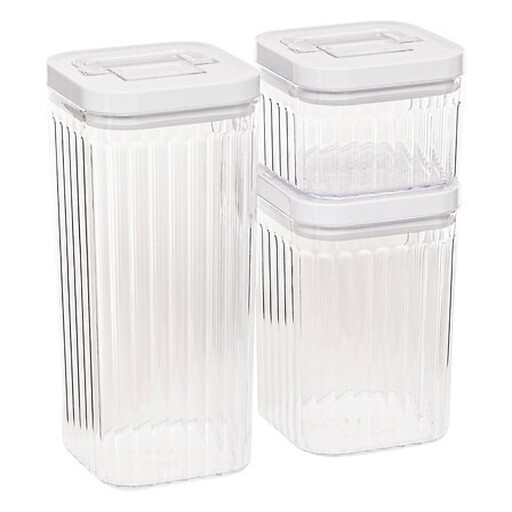
Why This Fits Their Persona: Ideal for taking the first step toward an organized kitchen without a large budget. It offers basic functionality for dry goods like pasta, rice, or cereal and quickly creates visible order.
The design is engineered for simple vertical stacking, and its square shape uses cabinet space more efficiently than round or irregular containers.
Transparent material for an at-a-glance view of contents; uniform, space-saving shape; set includes three coordinated sizes (0.35 L, 1 L, 1.5 L).
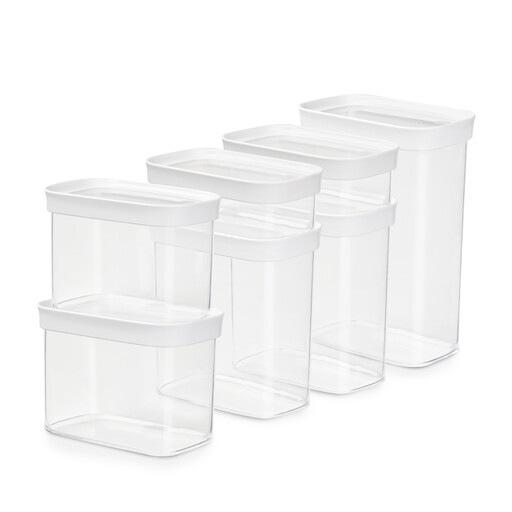
Why This Fits Their Persona: Perfect for users seeking a well-designed, durable, and hygienic system for their pantry. According to the manufacturer, the sizes are optimized for standard kitchen cabinets to eliminate wasted space.
The locking mechanism with an audible click and integrated gasket ensures reliable, airtight storage, protecting against moisture and pests as stated by the manufacturer.
Dishwasher-safe design with no crevices for germs; non-slip stacking rims for a secure hold; 7-piece set provides a comprehensive starter kit.
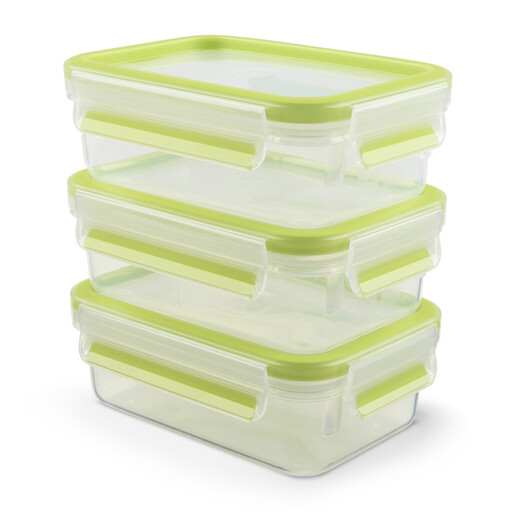
Why This Fits Their Persona: Designed for transporting meals, including liquids like soups. The compact size is ideal for meal prep boxes and for lunch at the office or on the go.
The 100% leak-proof construction with an injected seal, as claimed by the manufacturer, reliably prevents spills in bags—a common problem with basic containers.
Suitable for the freezer, microwave (container and lid), and dishwasher; temperature-resistant from -40°C to +110°C according to manufacturer specifications.
We have compiled a complete, up-to-date list of products that fully meet these strict selection criteria and safety regulations.
There is no one-size-fits-all answer; it depends on the intended use. Glass is hygienic, doesn't absorb odours, and is ideal for acidic or heavily staining foods. Plastic is lighter, shatterproof, and often more practical for transport or for households with children. For dry goods like flour and pasta, high-quality, BPA-free plastic is a very good and practical solution.
Rinse the containers with cold water immediately after use before cleaning them with warm water and dish soap. This helps prevent proteins and odours from setting. Many high-quality plastic containers are dishwasher-safe. For stubborn odours, it can help to fill the container with a mixture of water and vinegar or baking soda and let it sit for a few hours.
BPA (Bisphenol A) is a chemical compound used in the production of certain plastics (e.g., polycarbonate). It is suspected of being harmful to health as it can leach from the plastic into food. The "BPA-free" label guarantees that the plastic was manufactured without this substance, which is a critical safety feature, especially for food containers and meal prep boxes.