
Lieferung heute & morgen

Qualitätsgarantie

Willkommens-Angebote freischalten: KOSTENLOSE Lieferung | Bis zu 80 % RABATT | Kostenlose 30-Tage-JoyPlus-Testphase
App herunterladen
A food storage container set can help keep your fridge, freezer and pantry more organised. However, it is only worth buying if the sizes, closure and material suit your everyday needs. Families have different requirements from students with limited storage space or working people who prepare meals in advance.
The term airtight food storage containers is not, on its own, enough to guide your choice. What matters is the lid design, a continuous silicone seal and a closure that shuts evenly. With basic lids, liquids may leak during transport even if the container appears sealed in the cupboard.
For soups, sauces and dressings, you should therefore look for leakproof food storage containers with clips or a tested sealing system. Before using them for the first time, test them with water, particularly if you plan to carry them in a work bag or rucksack.
Not every material is suitable for every heat source. Plastic containers can often only be used in the microwave without their lids and are not designed for use in the oven. The same applies to glass: the lid will generally need to be removed. Stainless steel is not suitable for microwaves because metal can cause sparks.
Before buying a container for the fridge and freezer, you should therefore check the specific temperature ranges and usage instructions. A container described as suitable for freezing down to −20 °C should not be placed directly from the freezer into a hot oven. Sudden temperature changes can damage glass.
Large sets may seem practical at first glance, but can sometimes include dimensions that do not fit your fridge. Round containers make less efficient use of corners than rectangular models. Very deep containers can also be inconvenient in the upper shelves of a fridge or in kitchen drawers.
Before buying, compare the internal dimensions, external dimensions and available storage space. Stackable food storage containers are particularly useful when the lids and containers can be stacked securely rather than simply pushed loosely inside one another.
Material details such as “304 stainless steel” should explicitly refer to the container body. For lids and seals, additional information about PP plastic, silicone or glass is relevant.
Look for:
A steam valve can make reheating in the microwave easier. It must be opened as instructed. For transport, all closures should be fully clicked into place.
For everyday use, different sizes work best for different tasks:
A food storage container set with several sizes is not automatically more useful than a smaller selection. What matters is whether you will actually use the containers regularly.
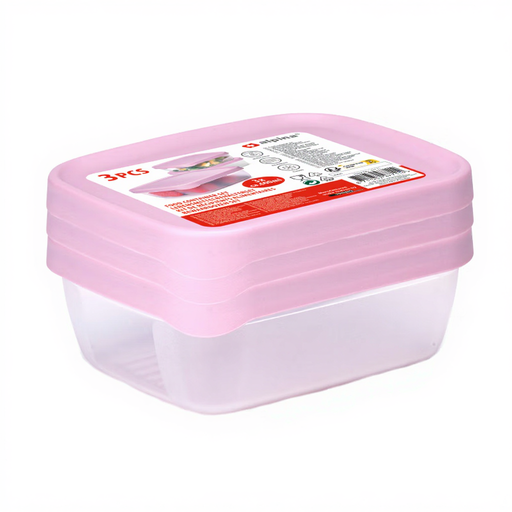
Why it is suitable: Three containers with one universal lid can be enough for simple food storage, leftovers and smaller portions.
The smaller set reduces unused sizes. Check the temperature and cleaning instructions on the packaging before use.
Three sizes, transparent design, stackable; BPA-free according to the product description.
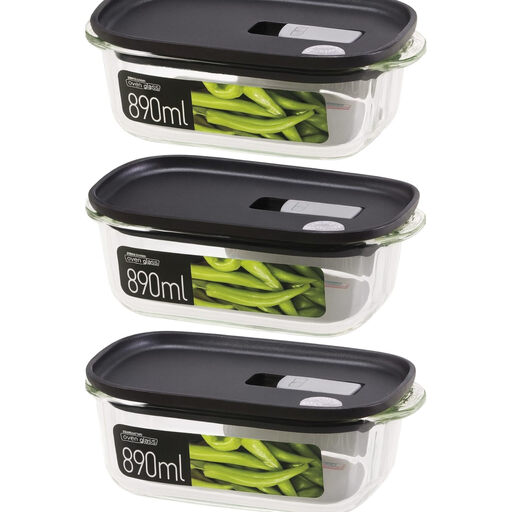
Why it is suitable: Three square glass containers, each with a capacity of 890 ml, are ideal for leftovers, prepared meals and serving food straight at the table.
The instructions advise removing the lid in the oven and avoiding thermal shock.
Glass containers, BPA-free PP lids according to the product description, steam-release valve, suitable for the oven, microwave, freezer and dishwasher in accordance with the instructions.
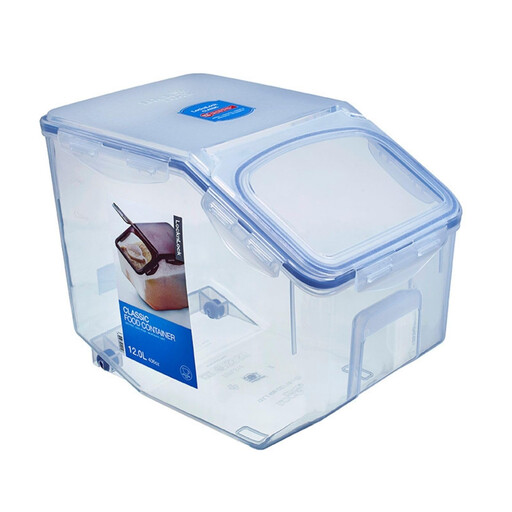
Why it is suitable: The 12-litre capacity is designed for storing flour, rice, cereal, pasta or pet food in the pantry.
The transparent design makes it easier to check the contents. For dry foods, the container should be completely dry before filling.
Flip-top lid, measuring cup, stackable design, BPA-free plastic according to the product description, suitable for the freezer and dishwasher in accordance with the manufacturer’s information.

Why it is suitable: The 1,000, 1,800 and 3,000 ml sizes are designed for prepared meals, salads, leftovers and days out.
The product information clearly states: do not use in the microwave or over an open flame. This makes the limitations of the metal clear.
304 stainless steel, borosilicate glass lids, silicone seal, three capacities, stackable and suitable for the fridge and freezer according to the product description.
Explore the complete selection to find more containers in different materials and sizes, with a range of closure systems for the kitchen, pantry and use on the go.
Even dishwasher-safe food storage boxes require appropriate cleaning. Seals and valves should be removed regularly and washed separately. After cleaning, all parts must dry completely before being reassembled. This helps reduce moisture build-up, particularly in containers used for flour, rice or pet food.
Damaged lids, cracks, chipped glass or heavily deformed seals should be taken as a reason to stop using the container. With glass containers, gradual temperature changes are also advisable: allow frozen containers to thaw first, and do not place hot containers on cold or wet surfaces.
For meal prep, rectangular or square food storage containers with a capacity of around 500 to 1,000 ml are practical. According to the relevant product description, some glass models are suitable for reheating. Plastic and stainless steel containers should only be used in accordance with their specific instructions.
That depends on the closure. Models with a continuous silicone seal and several clips are generally more suitable for liquids than containers with a loose-fitting lid. Before transporting one, close the lid securely and carefully check that the container is leakproof.
Six to ten containers in different sizes may be enough for one person. Families or people who regularly prepare meals often need more containers and larger capacities. It makes sense to choose a set whose sizes suit your fridge, freezer and pantry, rather than deciding solely on the number of pieces.