
Lieferung heute & morgen

Qualitätsgarantie

Willkommens-Angebote freischalten: KOSTENLOSE Lieferung | Bis zu 80 % RABATT | Kostenlose 30-Tage-JoyPlus-Testphase
App herunterladen
A forklift work cage is a practical solution for temporary tasks at height, whether for maintenance, inventory checks, or minor repairs. However, the market offers a bewildering variety of options, and not every model is suitable or safe for commercial use, especially under strict German safety regulations. The wrong purchase can lead not only to financial loss but also compromise operational safety.
As your Joybuy Product Recommendation Officer, I have analysed the most common pitfalls that occur during procurement. This guide will help you make an informed decision and choose a product that meets your operational requirements.
To avoid these mistakes, you should check three core parameters before purchasing. These features determine not only the safety but also the efficiency and longevity of your investment.
A compliant safety cage for forklifts must have certain mandatory features. Look for:
The construction is the foundation of safety. A robust frame made of powder-coated steel provides protection against corrosion and mechanical stress. The load capacity should be designed for at least two people plus tools; common ratings range from 300 kg to 600 kg. Check the platform dimensions: Is it large enough for the planned work, yet compact enough to manoeuvre in narrow aisles?
The choice between a rigid and a foldable model depends on your use case.
Based on these criteria, we have identified products that are suitable for specific commercial users.
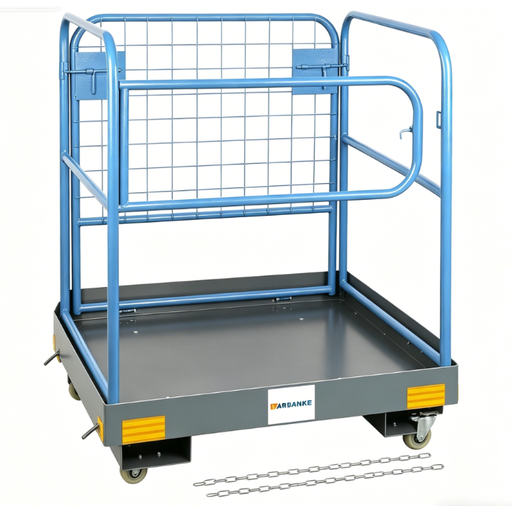
Why This Fits Their Persona: Ideal for demanding environments like construction sites or large warehouses where high load capacity and space for two people plus materials are required. The robust steel construction ensures durability in daily use.
The high load capacity of 590 kg provides a large safety margin, avoiding the pitfall of an insufficient load rating. The folding mechanism solves the problem of bulky storage.
High Load Capacity: Offers space and capacity for 1-2 adults with equipment. Flexible Folding Mechanism: Allows for easy transport and space-saving storage.
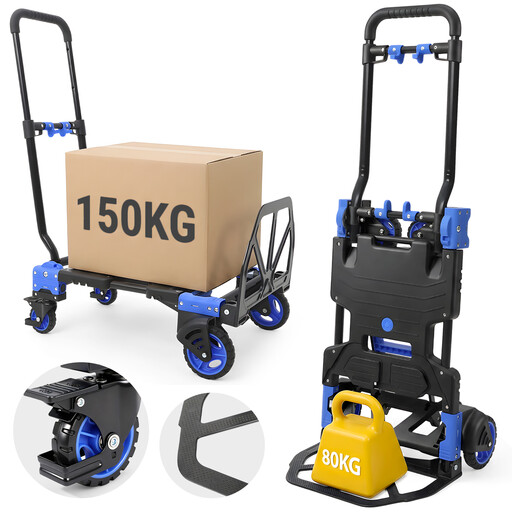
Why This Fits Their Persona: A smart addition to any operation. Before the work cage is lifted, tools and materials often need to be moved on the ground. This cart reduces physical strain and increases the efficiency of work preparation.
It avoids the loss of efficiency and the risk of accidents caused by unergonomic, manual carrying of heavy loads. It's an investment in ground-level workplace safety.
2-in-1 Design: Converts from a hand truck (80 kg capacity) to a platform cart (150 kg capacity) in seconds. Compactly Foldable: Fits easily into company vehicles or storage corners.
We have compiled a complete, up-to-date list of products that fully meet these strict selection criteria and German safety regulations.
1. Can any employee use a work cage on a forklift? No. Operating a forklift with an attached work cage requires special instruction provided by the employer. The employee must be familiar with the operation of the cage and the associated hazards. The specific requirements are defined in the German Ordinance on Industrial Safety and Health (BetrSichV) and DGUV regulations.
2. How is the man cage securely attached to the forklift? The cage is slid over the forklift's forks using its fork pockets. It must then be positively secured against unintentional slipping. This is typically done with locking pins that are secured behind the fork carriage. Check that these locking elements are secure before every use.
3. What regular inspections are required for a forklift cage? A visual and functional check must be performed by the user before each use. In addition, an annual inspection by a "competent person" (qualified inspector) is required by law. This inspection must be documented. It includes checking welds, locking pins, the condition of the floor, and the door's functionality, among other things.