What should you look for when buying?
First, check which ingredients your picnic guests must avoid. Then compare only bars whose specific ingredients and allergen information meet those requirements, and finally check the packaging and storage instructions.
| What matters |
What to check |
Who it matters to |
| Several allergens |
Check the current ingredients list and highlighted allergens against your list of ingredients to avoid; take any ‘may contain’ information into account. |
If I’m bringing a bar for guests with several allergies, it must meet every relevant requirement for that specific variety. This is the top priority for around 36% of consumers. |
| Gluten-free options |
Look for the “gluten-free” claim and check for other allergens separately. EU Implementing Regulation (EU) No 828/2014 sets a maximum gluten content of 20 mg/kg for this claim. |
I mainly want to avoid gluten when choosing a snack to take on the go, without assuming that the gluten-free label rules out other ingredients. This is the main reason for buying for around 29% of consumers. |
| Vegan or specific dietary requirements |
Check the ingredients and any specific restrictions stated for that variety; “vegan” alone does not answer questions about nuts or soya. |
I’m looking for a vegan recipe or a bar with a particular suitability profile for our group. This requirement comes first for around 21% of consumers. |
| Transport and storage |
Check that the packaging is undamaged, the best-before date and the storage instructions; transport perishable accompaniments separately and keep them chilled. |
If there are no other dietary requirements to consider, I want to bring a bar whose packaging and storage needs suit the trip. Around 14% of consumers start with this practical question. |
Gluten-free bars on Joybuy
This product is part of the gluten-free bar selection for taking on the go. If you also need to avoid hazelnuts, milk or soya, don’t rely on the gluten-free label alone.
 No image available
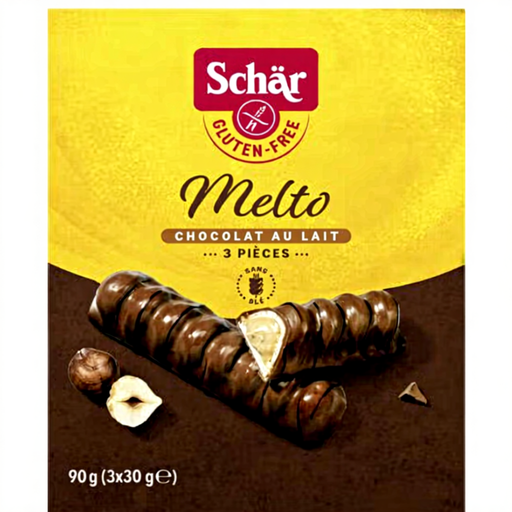
Schär Gluten-Free Melto Hazelnut Wafer Bars, 3x30g
An option for your picnic if you need to avoid gluten but do not need to avoid hazelnuts, milk or soya.
The pack contains 3x30g. Before buying, check the current ingredients list and any information about possible traces of peanuts or other tree nuts.
View on Joybuy
Frequently asked questions
What does “gluten-free” mean on a snack bar?
The claim relates to gluten, not to all allergens. Under EU Implementing Regulation (EU) No 828/2014, foods sold to consumers can be labelled “gluten-free” only if they contain no more than 20 mg/kg of gluten. Other ingredients and allergens must be checked separately.
Is a gluten-free bar also free from milk, soya and nuts?
No. “Gluten-free” does not mean that any of these other ingredients are excluded. For example, according to Schär, its Cereal Bar contains milk, soya and almonds. Check the information for the exact bar you want to take with you.
What does “may contain traces of …” mean?
This voluntary statement warns that accidental cross-contamination may have occurred; it does not mean the allergen is an ingredient. If you have an allergy, assess the warning in line with your individual needs rather than relying on a general free-from claim.
Do snack bars need to go in a cool bag for a summer picnic?
Follow the storage instructions on the bar’s packaging. Keep any perishable foods you bring separately as cool as possible; the German Federal Institute for Risk Assessment advises this for such foods.
How can I check for a product recall before a picnic?
Compare the product, batch and best-before date with the relevant recall notice. Public food safety alerts in Germany are published by the federal states and the Federal Office of Consumer Protection and Food Safety. For MadeGood, also check the manufacturer’s notice for certain Granola Bars made between January and November 2024.


