
Lieferung heute & morgen

Qualitätsgarantie

Willkommens-Angebote freischalten: KOSTENLOSE Lieferung | Bis zu 80 % RABATT | Kostenlose 30-Tage-JoyPlus-Testphase
App herunterladen
A freestanding freezer, also known as a deep freezer, offers valuable extra storage for your provisions—whether for a large family, a single household, or as a secondary unit in the basement. However, the market is confusing and full of marketing promises that often lead to expensive mistakes. Before you invest, it's crucial to know the common pitfalls that frequently only surface after you've made the purchase.
The 2 most common traps when buying a freezer:
No-Frost freezer technology is convenient as it eliminates the need for manual defrosting. However, it often comes with a higher purchase price, slightly increased electricity consumption, and potentially louder operating noise. For a unit in the basement, this feature may be less critical than for a model in an open-plan kitchen.To make an informed decision, you should focus on objective technical specifications rather than advertising claims.
The first decision concerns the required size and design. As a rule of thumb for planning your needs:
An upright freezer offers better organisation and easier access to frozen items thanks to its drawers. It is ideal for the kitchen or a utility room. A chest freezer is generally more energy-efficient and offers more storage space for the same external dimensions, as no drawers take up room. It is particularly suitable for large, bulky frozen goods and is often placed in a basement or garage.
Since March 2021, a new EU energy label has been in effect, with classes from A (very efficient) to G (less efficient). Choosing an energy-efficient freezer is crucial, as the appliance runs 24 hours a day. Don't be deterred by seemingly poor ratings like D or E. A device with the new E rating can be more efficient than an old model with an A++ label. Always compare the annual energy consumption in kilowatt-hours (kWh) shown on the label.
The climate class indicates the ambient temperature range in which an appliance will function correctly. This is especially important for a freezer for a garage or basement.
For unheated rooms where temperatures can drop below 10 °C, an appliance with the SN climate class, or a model explicitly approved by the manufacturer for lower temperatures, is a mandatory requirement.
For appliances placed in or near living areas, a quiet freezer is an important criterion. The operating noise is specified in decibels (dB). Models below 40 dB are considered quiet. The airborne acoustical noise emission class on the energy label (A to D) also provides a quick reference.
Here are some models tailored to specific user profiles that take the above criteria into account.
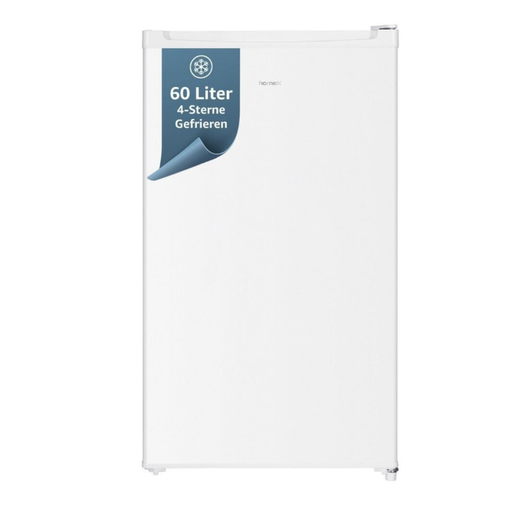
Why This Fits Their Persona: Ideal for singles, couples, or as a supplementary freezer in small kitchens. With 60 litres of capacity, this small freezer offers enough space for the essentials without taking up much floor space. The reversible door hinge provides maximum flexibility for placement.
At around 40 dB, the unit is suitable for living spaces and avoids the noise disturbance that can occur with budget No-Frost models. It focuses on the core function of freezing without costly extras.
Compact dimensions (approx. 45 cm wide) and a reversible door hinge allow for easy integration into existing kitchen units or alcoves.

Why This Fits Their Persona: For families who store large quantities and value convenience. With 286 litres of usable capacity and No-Frost technology, the tedious task of defrosting is eliminated. The numerous drawers and compartments ensure everything stays organised.
This model is explicitly designed for operation in unheated rooms down to -15 °C, thus bypassing the "garage trap." The No-Frost function is a genuine added value here, as it minimises maintenance on such a large appliance.
No-Frost technology prevents ice build-up. At just 34 dB, the appliance is also very quiet and can even be placed in open-plan kitchens.
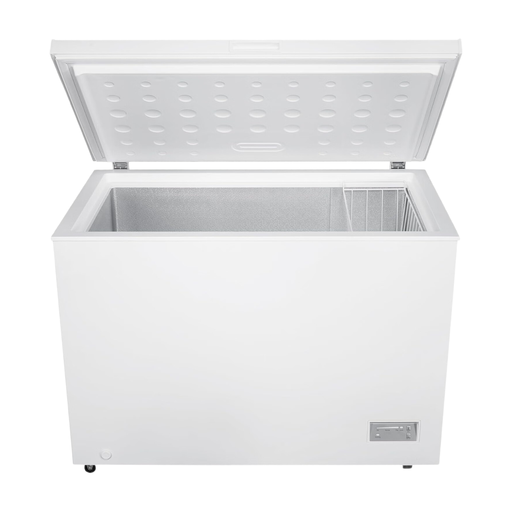
Why This Fits Their Persona: A classic chest freezer for maximum storage capacity in the basement or garage. With 308 litres, it offers enormous space for bulk purchases, garden harvests, or bulky frozen items.
The SN-T climate class and explicit suitability for unheated rooms guarantee reliable operation even in cool ambient temperatures. The temperature alarm provides an additional warning in case of malfunctions.
Chest freezers are inherently more energy-efficient by design, as less cold air escapes when the lid is opened. Transport castors make it easier to move the unit for cleaning.
We have compiled a complete, up-to-date list of products that fully meet these strict selection criteria and safety regulations.
An upright freezer is a tall, narrow appliance with a front-opening door and drawers inside. It provides good organisation and easy access. A chest freezer is a wide, low appliance with a top-opening lid. It offers more usable storage space for its volume and is often more energy-efficient, but organising the contents is less straightforward.
The No-Frost function is a convenience feature. It prevents ice from forming, which eliminates the need for manual defrosting and ensures consistent cooling performance. The downside can be slightly higher energy consumption and louder operating noise. For a unit in a basement that is opened infrequently, manual defrosting (once or twice a year) is often an acceptable trade-off for a lower purchase price and running cost.
No. A standard freezer is typically designed for ambient temperatures from +10 °C or +16 °C upwards (Climate Class N or ST). In an unheated garage or basement, the temperature can drop below this in winter. This can cause the compressor to stop running, leading to your frozen goods spoiling. Therefore, it is essential to look for the SN climate class or an explicit manufacturer approval for operation at low temperatures (e.g., down to -15 °C).