
Lieferung heute & morgen

Qualitätsgarantie
App herunterladen
Kategorien
Choosing a freestanding fridge-freezer involves analysing technical specifications that determine its everyday practicality. Key factors include net capacity, energy efficiency, noise level, and special features like No-Frost technology. This article breaks down the essential criteria and presents a selection of models with varying specifications to help you make an informed decision.
An appliance's technical data are the primary indicators of its performance and suitability for your household. Consider the following aspects in your evaluation.
The net capacity, measured in litres, defines the appliance's storage space. Here’s a general guide to help you determine your needs:
The external dimensions (height, width, depth) are crucial for fitting the appliance into your existing kitchen layout. Freestanding models offer placement flexibility but require adequate space for air circulation on the sides and back to ensure optimal cooling performance.
The energy efficiency class is displayed on the EU energy label on a scale from A (most efficient) to G (least efficient). Operating an energy-efficient fridge-freezer reduces running costs. Models with an energy efficiency class of C or better represent a good standard for economical operation. The annual energy consumption in kilowatt-hours (kWh/a) provides a tangible figure for comparison.
A No-Frost fridge-freezer prevents ice and frost build-up in the freezer compartment using a circulating air system that reduces humidity. This offers two key advantages:
The noise level, measured in decibels (dB(A)), is a critical factor, especially in open-plan kitchens. A quiet fridge-freezer enhances your living comfort. Levels below 38 dB(A) are considered quiet. The noise emission class on the EU label (A to D) offers an additional quick reference.
The exterior finish influences how well the appliance integrates into your kitchen's design. Common options include:
The following models have been selected based on their technical specifications and feature sets.
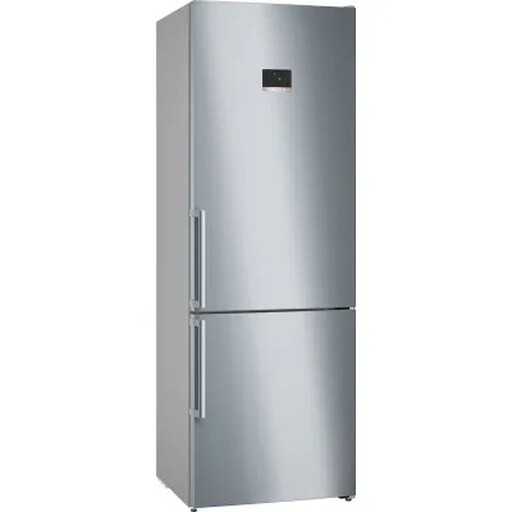
The Bosch KGN49AIBT Serie 6 is a spacious model with a 440-litre total capacity and a high energy efficiency class of B. The appliance is equipped with advanced freshness systems and a very quiet inverter compressor.
Why we recommend this product: This model combines a very large capacity with excellent energy efficiency (Class B) and extremely quiet operation at just 35 dB(A). The VitaFresh system, with separate zones for meat/fish and fruits/vegetables, provides specialised storage conditions to extend the shelf life of your food.
Pros:
Best for: Households with high storage needs who prioritise maximum energy efficiency, very quiet operation, and advanced food preservation technologies.
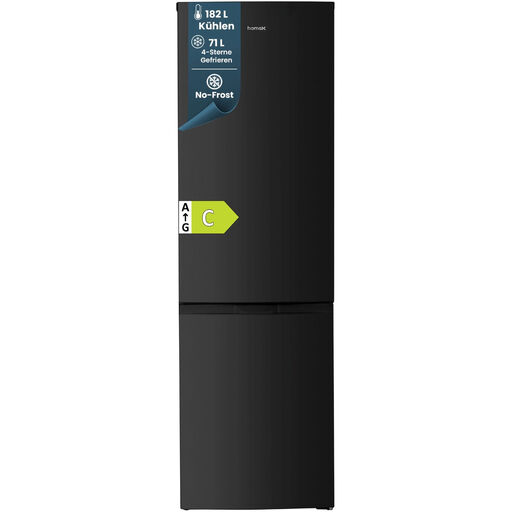
The homeX CFSN2531C-B is a large fridge-freezer with a 253-litre capacity and a modern black design. It features Total No-Frost technology and a solid energy efficiency class of C.
Why we recommend this product: This model offers a balanced combination of essential features like Total No-Frost, a good energy efficiency class (C), and quiet operation (39 dB(A)). Its elegant black design and flexible installation options, thanks to the reversible door hinge, make it a practical choice for many kitchens.
Pros:
Best for: Budget-conscious households looking for a solid appliance with core modern features like No-Frost and an attractive design.
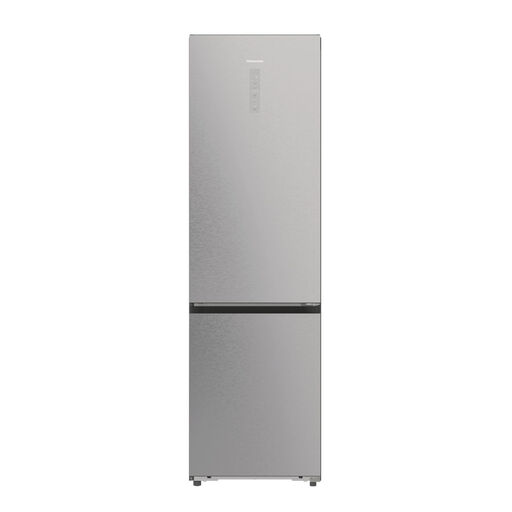
The Hisense RB5P410SACC offers a very large 413-litre capacity combined with extremely quiet operation at just 34 dB(A). The appliance is rated energy efficiency class C and features Total No-Frost.
Why we recommend this product: This appliance stands out for its excellent capacity-to-noise ratio. At 34 dB(A), it is one of the quietest models on the market, making it ideal for open-plan living spaces. The combination of large storage space, Total No-Frost, and a Class C energy rating offers a strong overall package.
Pros:
Best for: Large families or shared homes that need maximum storage space and also place the highest value on minimal noise levels.
| Feature | Bosch KGN49AIBT Serie 6 | homeX CFSN2531C-B | Hisense RB5P410SACC | | :--- | :--- | :--- | :--- | | Total Net Capacity | 440 L | 253 L | 413 L | | Energy Efficiency Class | B | C | C | | Annual Energy Consumption | 142 kWh/a | 141 kWh/a | approx. 182 kWh/a | | Noise Emission | 35 dB(A) | 39 dB(A) | 34 dB(A) | | No-Frost Technology | Yes (Total NoFrost) | Yes (Total NoFrost) | Yes (Total NoFrost) | | Dimensions (H×W×D) | 203 × 70 × 66.7 cm | 181 × 54.5 × 61.6 cm | 203 × 59.5 × 65.8 cm | | Design | Stainless Steel (Anti-Fingerprint) | Black | Stainless Steel |
If the models featured here don't perfectly match your requirements, you can find a wider selection of appliances with different specifications and designs in our main freestanding fridge-freezers category.
1. What does No-Frost mean in a fridge-freezer? No-Frost is a technology that circulates air within the freezer compartment to remove moisture. This prevents ice and frost from forming on the interior walls and on your frozen goods. As a result, manual defrosting of the freezer is no longer necessary.
2. How quiet should a fridge-freezer be? Noise level is measured in decibels (dB(A)). A value below 38 dB(A) is generally considered quiet and is well-suited for open-plan kitchens. Models with ratings around 35 dB(A) or lower are considered exceptionally quiet.
3. Which energy efficiency class is recommended for a fridge-freezer? Since the introduction of the new EU energy label in March 2021, the standards have become stricter. Appliances in classes A and B are the most efficient. An energy efficiency class of C already represents a very good and economical standard, making it a cost-effective choice for most households.