
Lieferung heute & morgen

Qualitätsgarantie

Willkommens-Angebote freischalten: KOSTENLOSE Lieferung | Bis zu 80 % RABATT | Kostenlose 30-Tage-JoyPlus-Testphase
App herunterladen
By the Joybuy Product Recommendation Officer, July 09, 2026
Choosing a new fridge-freezer can be a daunting task. The market is filled with a vast array of models, each with different sizes, features, and energy efficiency ratings. This article is designed to guide you through the process. It outlines objective criteria for your purchasing decision and presents a selection of appliances suited for various needs and household sizes.
To find the right appliance for your needs, a few technical aspects are crucial. The following points will help you better compare the specifications of different models.
Since March 2021, the new EU energy label with classes from A (very efficient) to G (less efficient) has been in effect. A high energy efficiency class, such as Energy Efficiency Class B or C, results in lower annual power consumption. This not only reduces operating costs over the appliance's entire lifespan but also protects the environment. Pay attention to the annual consumption in kilowatt-hours (kWh/a) indicated on the label to estimate potential costs.
The required usable capacity depends on the size of your household and your shopping habits. As a rule of thumb:
For large families or individuals who shop less frequently and store more supplies, an XXL fridge-freezer with over 400 litres of total capacity may be a sensible choice. Before buying, measure the available space in your kitchen accurately and plan for sufficient clearance from the wall and other furniture to ensure good ventilation.
Modern appliances offer convenience features that make daily life easier. A No Frost fridge-freezer uses a convection system to prevent ice from forming in the freezer compartment. This completely eliminates the need for manual defrosting.
Another important factor, especially in open-plan kitchens, is the noise level. The noise emission is specified in decibels (dB). An appliance considered a quiet freestanding model has a value of 38 dB or less. Models around 35 dB are barely audible and contribute to a peaceful home environment.
Here you'll find a curated selection of models that cover a range of requirements—from compact units for small kitchens to large-capacity solutions for families.
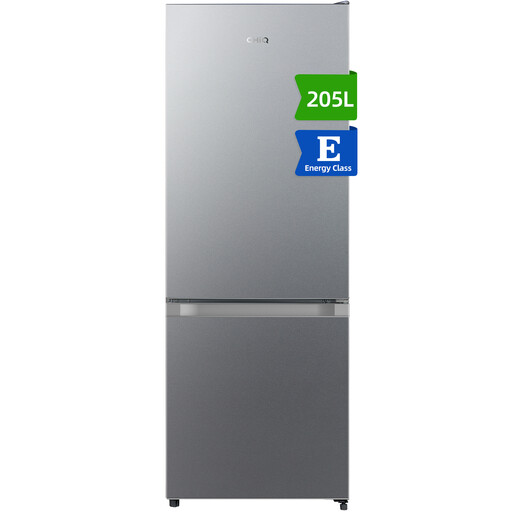
Why it stands out: With its slim design and a total capacity of 205 litres, the CHiQ JR205LSE is a practical choice for singles, couples, or as a second appliance. Its Low Frost technology reduces ice build-up in the freezer, making defrosting easier.
Pros:
Who is it for? This model is ideal for those with limited space who are looking for a functional and budget-friendly fridge with a freezer compartment.
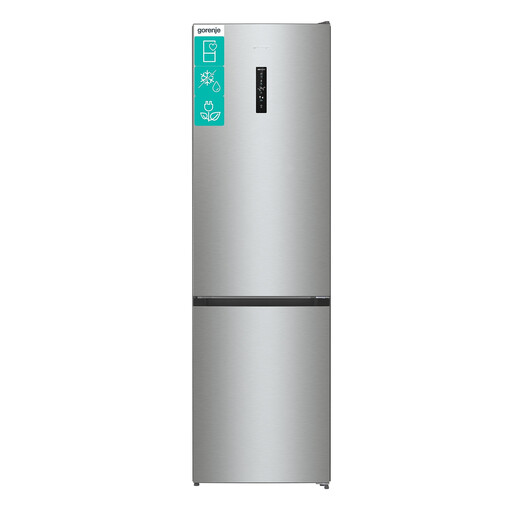
Why it stands out: The Gorenje fridge-freezer NRK620CA2XL4 offers an excellent balance of capacity, efficiency, and modern features. With 331 litres of usable capacity and full No Frost technology, it is well-equipped to meet the demands of a family.
Pros:
Who is it for? This model is aimed at families and households looking for a reliable No Frost fridge-freezer with generous storage space and quiet operation.

Why it stands out: The Bosch Serie 8 KGP86AXB0N is an XXL fridge-freezer that meets the highest standards with 621 litres of usable capacity and advanced technology. The black stainless steel design with an anti-fingerprint coating also makes a stylish statement.
Pros:
Who is it for? This premium model is designed for large families and discerning users who value maximum capacity, high energy efficiency, and innovative features.
The appliances presented here cover a broad spectrum, but the requirements for a fridge-freezer are individual. If you would like to compare other models with different dimensions, designs, or features, you can find a larger selection in our main category.
Explore Our Full Range of Fridge-Freezers
"No Frost" is a technology that prevents the formation of ice and frost in the freezer compartment. A fan circulates cold, dry air evenly and wicks moisture to the outside. This eliminates the need for manual defrosting, prevents food from freezing together, and keeps energy consumption consistently low as no insulating layer of ice can form.
A general recommendation is to plan for about 100 to 150 litres of cooling capacity for a one- to two-person household. For each additional person in the household, you should add around 50 litres. The need for freezer capacity depends heavily on individual habits. Those who batch cook or buy in bulk will need more space (approx. 50–80 litres per person) than someone who primarily consumes fresh food (approx. 30 litres per person).
The noise level of a refrigerator is measured in decibels (dB). In an open-plan kitchen, a quiet appliance is particularly important. Models with a noise emission of 40 dB or more can be perceived as disruptive. Appliances considered quiet freestanding models typically operate at 38 dB or below. Especially quiet models achieve levels around 35 dB, which is roughly the volume of a whisper and is barely noticeable in the normal hustle and bustle of a kitchen.