
Lieferung heute & morgen

Qualitätsgarantie

Willkommens-Angebote freischalten: KOSTENLOSE Lieferung | Bis zu 80 % RABATT | Kostenlose 30-Tage-JoyPlus-Testphase
App herunterladen
A freestanding shelf is more than just a place for storage. It structures rooms, showcases your favourite items, and brings order to chaos. But the selection is vast, and not every model lives up to its product images. Many buyers only realise after assembly that their new furniture wobbles, has a delicate surface, or is unsuitable for its intended purpose.
As a Joybuy Product Recommendation Officer, I analyse product data and customer feedback daily. In doing so, the same problems consistently emerge. This guide will help you navigate the typical pitfalls and find a freestanding shelf that is functional, durable, and a perfect aesthetic match for your home.
Before we dive into the key features, let's look at the three most common reasons for a bad purchase. If you know what they are, you can search for quality more effectively.
To avoid these mistakes, you should carefully check three technical aspects before buying. These define the durability and functionality of your new furniture.
The material is the primary factor determining a shelf's stability and lifespan.
Two numbers are critical here: the maximum load capacity per shelf and the total load capacity. For books or binders, you should plan for at least 10–15 kg per shelf. For heavy loads, such as with a storage rack, much higher values are required.
An indispensable safety feature, especially in households with children, is an anti-tip device. This allows the shelf to be securely anchored to the wall, preventing it from tipping forward. Adjustable feet are also a plus, as they help compensate for uneven floors and ensure a solid stance.
Measure the available space precisely—in height, width, and depth. Think about how the shelf will be used. A tall, narrow bathroom shelf makes optimal use of space in small bathrooms. A corner shelf fills unused niches effectively. If you want to visually divide a large room, a room divider shelf that is accessible from both sides can be a stylish and functional solution. Unlike a permanently mounted wall-mounted shelf, a freestanding shelf offers the advantage of flexibility and can be moved if needed.
Based on objective criteria such as material, stability, and functionality, we have identified several models suitable for different needs and interior styles.
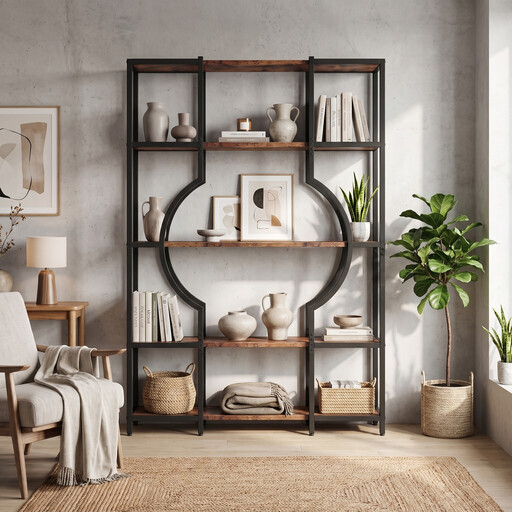
Why This Fits Their Persona: Ideal for users seeking a functional piece of furniture with a strong design character. The combination of a metal frame and wood-effect finish perfectly complements industrial and vintage styles, making the shelf a focal point in a living room or home office.
The construction, featuring a sturdy metal frame and MDF boards, avoids the stability trap. The high specified load capacity of 113 kg and the included anti-tip device ensure safety.
With 12 open compartments across 5 tiers, it offers versatile storage for books and decor. The curved silhouette gives it a unique design.
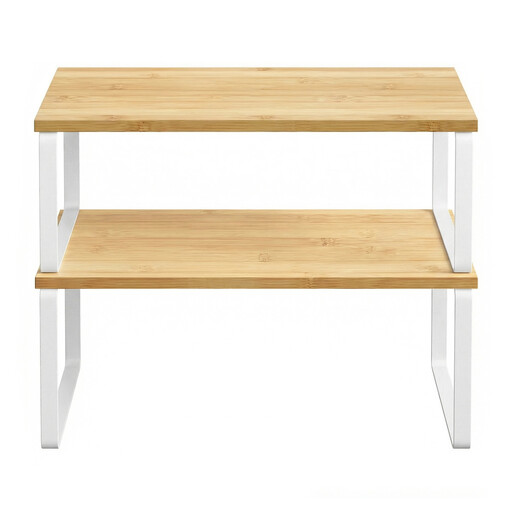
Why This Fits Their Persona: Perfect for anyone looking for a flexible solution for existing furniture, such as creating more storage space in kitchen cupboards or on a countertop. This set is not a classic freestanding shelf but a multifunctional organiser.
It bypasses the material bluff with an honest combination of metal and engineered wood, suitable for use as a kitchen shelf. The solid construction ensures a good load capacity of 15 kg per shelf.
Extremely flexible: The two elements can be stacked, nested, or used separately to customise storage space.
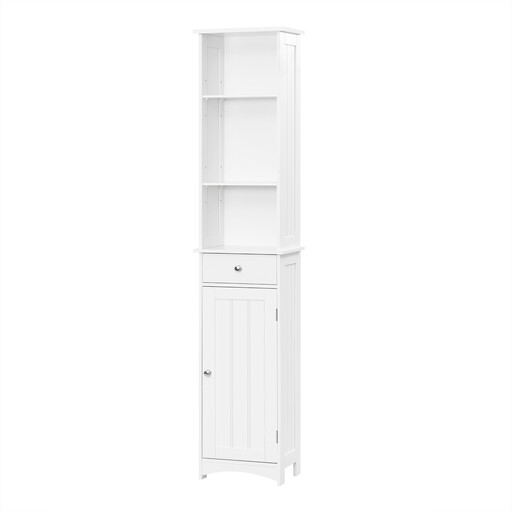
Why This Fits Their Persona: Designed for people who need to create vertical storage in tight spaces like a bathroom or hallway. Its slim design makes it an ideal corner or bathroom shelf without taking up much floor space.
The material (E1-grade MDF) is painted on both sides, making it more resistant to moisture than foil-wrapped particleboard—a crucial advantage in the bathroom.
Maximises space utilisation with its tall and narrow design. The inner shelf is adjustable to 3 positions, allowing flexible adaptation to its contents (e.g., towels, bottles).
We have compiled a complete, up-to-date list of products that fully meet these strict selection criteria.
1. How do I securely fasten a freestanding shelf to the wall? Most taller freestanding shelves come with an anti-tip device. This usually consists of a bracket or strap that is screwed to the top of the shelf and to the wall. Use wall plugs and screws that are appropriate for your wall type (e.g., concrete, plasterboard). This is a crucial step to ensure stability.
2. What is the most durable material for a bookshelf? For heavy books, a shelf made of solid wood or high-quality MDF with a thickness of at least 18 mm, combined with a sturdy metal frame, is a very durable solution. Pay attention to the specified maximum load capacity per shelf and distribute the weight evenly.
3. Can I also use a freestanding shelf as a room divider? Yes, many open-back freestanding shelves are excellent as room dividers. Choose a model that is visually appealing from both sides (i.e., has no unsightly back panel) and has a stable, wide base. For safety, even a shelf used as a room divider should be fixed to a wall or the floor if possible.