
Lieferung heute & morgen

Qualitätsgarantie

Willkommens-Angebote freischalten: KOSTENLOSE Lieferung | Bis zu 80 % RABATT | Kostenlose 30-Tage-JoyPlus-Testphase
App herunterladen
A freestanding shelving unit provides extra storage space, but choosing the wrong one can be surprisingly easy. A model that appears suitable may be too deep for the intended space, support less weight than expected or be difficult to secure safely to the wall. Before buying, you should therefore check not only the colour and price, but above all the dimensions, load capacity, material and anti-tip protection.
Details such as “650 kg load capacity” often refer to the shelving unit’s total static load capacity. The load per shelf is also crucial. If heavy boxes, tools or supplies are stacked on a single shelf, the permitted individual load may be exceeded.
You should therefore check:
The external dimensions alone are not sufficient when planning where to put the unit. Skirting boards, radiators, doors and the space needed to move around can reduce the usable area. With a freestanding shelving unit, you should also check that it can stand against a level wall and be secured with an anti-tip fitting.
An open bookcase made from wood-based material and metal is often suitable for a living room or office. For cellars, garages and workshops, however, sturdy shelves, adjustable levels and a higher load capacity are more important. Conversely, a dedicated heavy-duty shelving unit may be functional in a living room, but may not look as well suited to the space.
Measure the available area in width, height and depth. A tall shelving unit makes efficient use of wall space, but requires a secure base and usually wall fixing. For small rooms, an corner shelving unit may be a practical choice: L-shaped models make use of unused corners without taking up too much of the central floor area.
A shelving unit for a living room or office should also provide enough space between the shelves for books, folders and decorative items. For cellars and garages, a depth of 30 cm is sufficient for many toolboxes and household items; larger containers require more space.
With a heavy-duty shelving unit, it is not just the advertised total figure that matters. Check whether the stated capacity applies to a static load and how it is distributed per shelf. Steel frames can be suitable for workshops, cellars and garages. Metal shelving units with wooden shelves combine a metal frame with MDF or chipboard, and their load capacity and sensitivity to moisture can vary considerably depending on the design.
The following details are particularly relevant for heavy items:
A tall storage shelving unit should stand on a level surface. The supplied anti-tip fitting must be secured to the wall in accordance with the assembly instructions. This is particularly important in households with children or pets. Items should be distributed evenly, with heavy loads placed at the bottom.
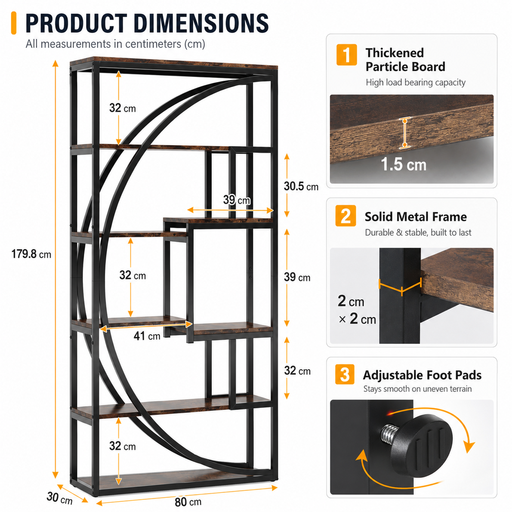
Why this product suits this profile: This freestanding shelving unit provides vertical storage for books, decorative items and everyday essentials. Measuring 80 × 179.8 × 30 cm, it is suitable for living rooms, bedrooms, studies or home offices.
The five shelves and eight open compartments make the available storage space easy to assess. The stated dimensions help you check the intended location before ordering.
Chipboard shelves, black metal frame, five levels and an open design; assembly accessories and instructions are included.
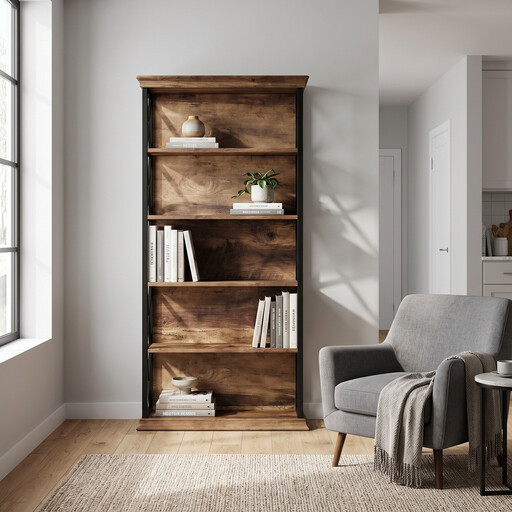
Why this product suits this profile: Standing 180 cm tall and featuring E0-grade MDF and a metal frame, this shelving unit is designed for living areas, studies, bedrooms or kitchens. It combines open shelves with an industrial look.
The stated load limit of 34 kg per shelf removes any uncertainty when assessing its capacity. The wall-mounting anti-tip fitting is listed as included.
E0-grade MDF, metal frame, X-shaped side elements, dimensions of 80 × 30 × 180 cm and even weight distribution according to the product details.
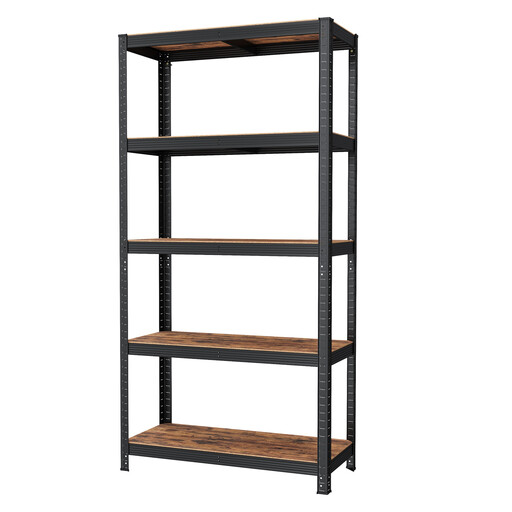
Why this product suits this profile: This heavy-duty shelving unit is designed for cellars, garages, workshops and utility rooms. Measuring 30 × 75 × 150 cm, it offers five levels with adjustable heights.
The product details distinguish between 130 kg per shelf and a total load of 650 kg. An anti-tip kit is included; wall mounting is still required.
Steel frame, adjustable MDF shelves, a screwless slot-together system and the option to split the shelving unit into two separate units.
An corner shelving unit is a practical solution for unused corners. The 7-tier “Corner Bookcase” measures 60 × 60 × 200 cm, has seven shelves and a stated load capacity of up to 45 kg per shelf. Adjustable feet and a wall-mounted anti-tip fitting help ensure stability on a level surface. For small items in the kitchen or a cupboard, however, a compact 2-Tier model measuring 40 × 40 × 35 cm and made from steel and plywood may be sufficient.
The service life depends on the load, assembly and surroundings. Wood-based materials should be protected from prolonged exposure to moisture. In cellars and garages, condensation, high humidity and temperature fluctuations should be taken into account. Clean the shelves with a dry or slightly damp cloth and remove any standing moisture immediately.
Before use, you should:
We have put together a complete, regularly updated list of products that fully meet these strict selection criteria and the safety regulations applicable in the EU.
Place the shelving unit on a level, load-bearing floor and secure tall models to the wall using the supplied anti-tip fitting. The instructions for the individual product are the authoritative guide. Even weight distribution reduces the load on individual shelves.
This depends on the model. Product details may state 34 kg, 45 kg or 130 kg per shelf. These values must not be added together or applied to a single shelf. Always check the load capacity per shelf and the total load capacity.
For cellars, garages and workshops, heavy-duty shelving units with steel frames, adjustable shelves and a higher load capacity are often suitable. In damp rooms, you should also check whether the shelves are suitable for the environmental conditions in question.