
Lieferung heute & morgen

Qualitätsgarantie

Willkommens-Angebote freischalten: KOSTENLOSE Lieferung | Bis zu 80 % RABATT | Kostenlose 30-Tage-JoyPlus-Testphase
App herunterladen
Freezer bags are a staple in many British households. They make it easy to portion meat, vegetables, baked goods, soups and prepared meals. However, choosing the wrong option can lead to unnecessary expense: a bag that is too small may burst when filled, an unsuitable closure can let liquids escape, and a large multipack is not automatically economical if the bags are rarely used in everyday life.
This buying guide explains what households, families, meal-prep users and catering businesses should look for when choosing freezer bags.
The litre measurement describes the nominal volume. The bag’s external dimensions and shape are also important. A 1-litre freezer bag is generally suitable for individual portions, fruit, vegetables or smaller leftovers. For family portions and prepared meals, a 2-litre freezer bag may be more practical.
For bulky food, 3-litre freezer bags, 6-litre freezer bags or 10-litre freezer bags are more suitable. The actual suitability depends on whether the bag is designed to lie flat, has a gusseted base or has an especially wide opening.
Not every bag with a simple press-to-close seal is equally suitable for liquids. For soups, stock, marinades or sauces, the closure should seal securely and ideally have two sealing lines. Resealable freezer bags with a double seal can be a suitable option here.
Regardless of the model, only fill bags up to the recommended fill level, leave some air or room for expansion, and check the closure on the work surface before freezing. For extra protection, place the bag in a bowl first.
Paper breakfast or sandwich bags are not the same as freezer bags. Paper bags may be suitable for dry food in the fridge or for packed lunches, but according to the product description, they are not intended for liquid food and should not be used as a substitute for plastic freezer bags.
Choose according to the food you want to store, not just the litre capacity:
The dimensions also help you plan the available space in your freezer. Bags frozen flat can often be stacked more efficiently than irregularly filled containers.
A multilayer construction can help improve the film’s tear resistance and flexibility. Several pely models are described as having a three-layer film that is intended to remain flexible down to -40 °C, according to the product description. These specifications should be checked against the temperature of your own freezer.
Also look for:
The description “Made in Germany” indicates the product’s origin and is not, on its own, proof of quality. According to the product descriptions, the pely products listed are made in Germany.
A freezer bag with a double seal can make handling liquids or moist food easier. A gusseted base makes filling simpler because the bag can stand upright. An integrated labelling area helps you record the contents and date. This is particularly useful for meal prep and larger quantities of frozen food.
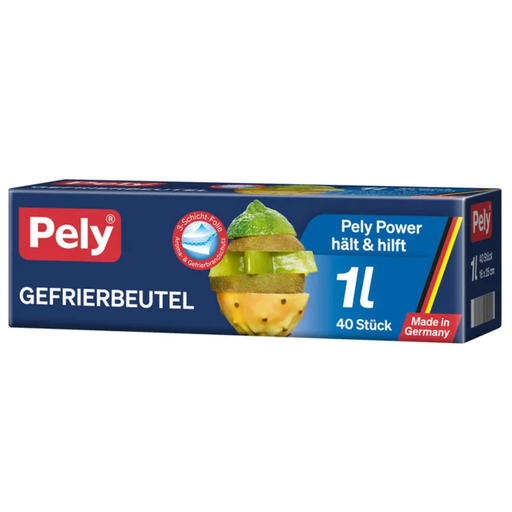
Why this product suits this profile: The pack of 40 provides a practical quantity for individual portions, leftovers and smaller purchases. The stated dimensions of 16 × 25 cm are suitable for many everyday uses.
The labelling area helps prevent mix-ups. According to the product description, the three-layer, BPA-free film remains flexible down to -40 °C and is suitable for solid and liquid food.
40 bags per pack; 1-litre format with labelling area; made in Germany according to the product description.
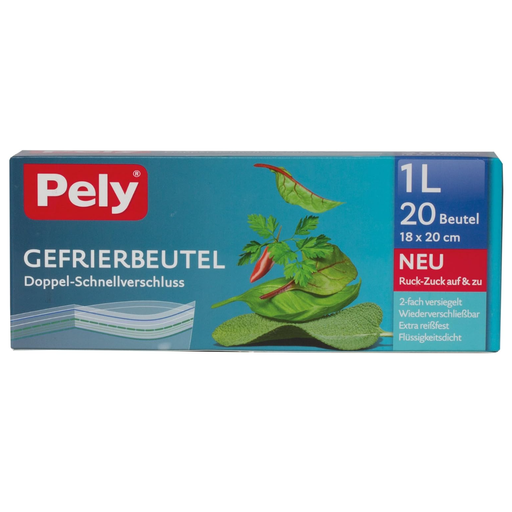
Why this product suits this profile: The double seal is ideal for people who often freeze soups, marinades or juicy food and want a clearly defined closure system.
Two sealing lines address the typical weak point of simple closures. The bag should still be transported upright and should not be overfilled.
1-litre capacity; double seal; integrated writing panel; extra-strong film according to the product description.
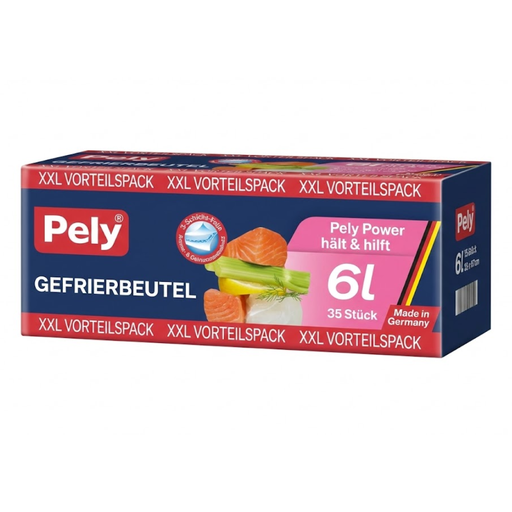
Why this product suits this profile: The pack of 35 is aimed at families, larger households and catering businesses that regularly need large bags.
The 6-litre format prevents large items from being forced into bags that are too small. According to the product description, the wide opening makes filling easier.
35 bags per pack; 29 × 44 cm; three-layer film; BPA-free and made in Germany according to the product description.
For meal prep, 1- to 3-litre bags are suitable when portions are spread out flat before freezing. This speeds up freezing and makes better use of freezer drawers. Soups and sauces should be completely cool before being placed in the bag.
For very large quantities, 6-litre freezer bags and 10-litre freezer bags are available. According to the product description, pely’s 10-litre model measures 34 × 50 cm and features a labelling area and three-layer PE film. For large joints, poultry or freshly harvested produce, check before buying that the bag is wide and tall enough.
A freezer bag multipack is particularly worthwhile if you use that size regularly. So don’t just compare the pack price: also look at the price per bag and how often you will realistically use them.
We have put together a complete, regularly updated list of products that fully meet these strict selection criteria and the safety regulations applicable in the EU.
Do not fill bags to the brim, carefully remove excess air and close the seal fully. Models with a double seal can be a suitable option for liquid food. When freezing, place the bag in a bowl first until the contents are solid.
The permitted storage time depends on the food, temperature, packaging quality and cold chain. Follow the storage recommendations for the food in question and label every bag with its contents and freezing date. Damaged, torn or very brittle bags should not be reused.
Depending on the material, soiling and intended use, resealable freezer bags may sometimes be used again. Extra care is required for raw animal products, greasy food or liquids for hygiene reasons. Bags with visible damage or residue should be disposed of. Always keep plastic bags out of the reach of babies and young children, as they pose a suffocation risk.