
Lieferung heute & morgen

Qualitätsgarantie

Willkommens-Angebote freischalten: KOSTENLOSE Lieferung | Bis zu 80 % RABATT | Kostenlose 30-Tage-JoyPlus-Testphase
App herunterladen
Freezer bags are a practical way to store food, but they are often chosen based on pack size or a striking marketing claim. What really matters is capacity, closure type, film thickness and intended use. If you overlook these points, you can quickly end up paying for bags that are too small, tear during filling or fail to contain liquids reliably.
This buying guide explains what households, families, keen cooks and meal-prep users should look for when choosing freezer bags.
A freezer bag with a capacity of 3 litres is not automatically suitable for every 3-litre portion. Its shape, opening width and dimensions all affect whether bread, pieces of meat or flat portions of food can be stored conveniently.
For small portions and individual ingredients, 1-litre freezer bags are usually easier to handle. Family-sized portions, soups and prepared meals, on the other hand, often require 3-litre freezer bags or larger. For bulky foods, 4-litre, 6-litre or 10-litre freezer bags may be more suitable.
A zip closure or double closure can reduce the risk of leaks, but it does not replace proper sealing. Liquids should not be filled right to the top. The upper edge must also be kept clean and dry so that the closure strips can seal securely.
If you use freezer bags for liquids such as soup, stock or marinades, look for a sturdy closure, enough film around the opening and a stable position while filling. A stand-up base, as found on certain models, can be helpful.
Thicker or multi-layer film can provide greater resistance to tearing and punctures. However, sharp bones, pointed edges or frozen foods with corners can still damage even extra-strong freezer bags. Food should therefore be packed as smoothly as possible, and the bags should not be overfilled.
Damaged bags should not be used again for storing food. With reusable freezer bags, you should also check whether the manufacturer explicitly allows cleaning and repeated use. A simple zip bag is not automatically a reusable freezer bag.
Do not rely solely on the litre capacity. Compare the dimensions as well:
A labelling area makes organisation easier. You can write the contents and freezing date directly on the bag, making it easier to rotate food in the freezer.
Freezer bags with a zip can be opened and resealed. A slider closure can provide visible guidance when sealing, while a double closure uses two sealing strips. Freezer bags with closure clips, on the other hand, are sealed using separate clips.
A simple closure is often sufficient for dry foods. For liquids or marinades, a sturdy double closure and filling the bag in as upright a position as possible are more practical. Before freezing, gently press out excess air without putting too much strain on the bag.
Many freezer bags are made from polyethylene (PE). The information on the packaging is what matters, including the permitted temperature range and instructions for use with food. A bag that is suitable for deep-freezing is therefore not automatically suitable for use in the oven, under the grill or on the hob.
The product information should also clarify whether the bag is suitable for liquids, whether it is labelled BPA-free and whether reuse is intended. When storing food in the freezer, flat portions can help save space and freeze more evenly.
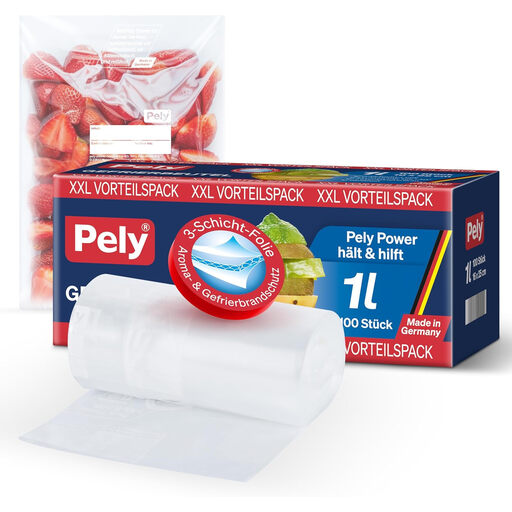
Why this product suits this profile: The pack of 100 is ideal for households that regularly freeze small portions and need a supply of freezer bags.
The stated 1-litre capacity and dimensions of 16 × 25 cm make the intended use clear, rather than simply promoting an unclear bulk pack.
100 bags, 3-layer film, labelling area and specified BPA-free material.
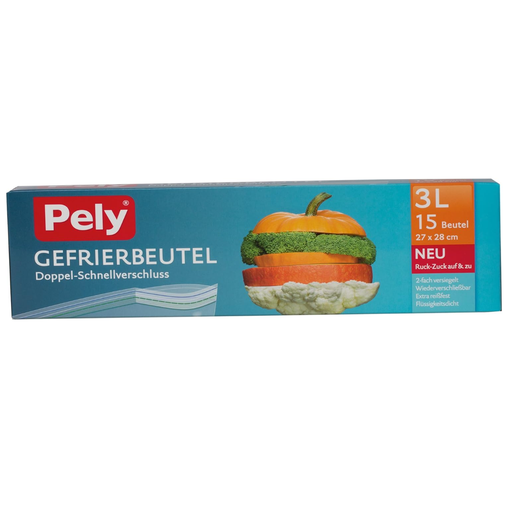
Why this product suits this profile: This 3-litre bag is designed for shoppers who want to store larger portions and liquids such as soups or marinades.
The double closure helps address the risk of the bag not being sealed completely. Even so, the edge should be kept clean before sealing.
15 bags, extra-strong PE film, double closure and labelling area.
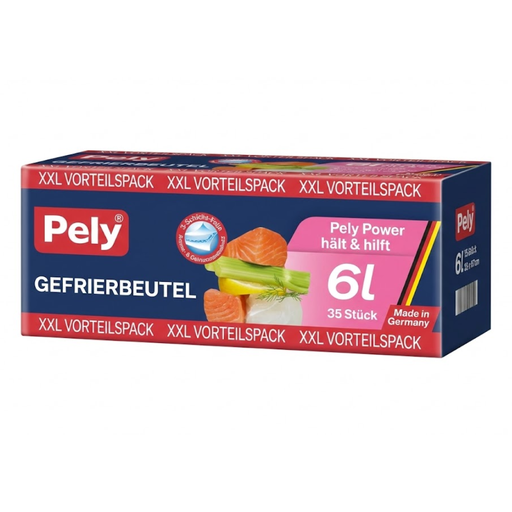
Why this product suits this profile: The 6-litre size is designed for large foods, substantial portions and bulk storage.
The dimensions of 29 × 44 cm and the wide opening make it easier to fill the bag with bulky foods without overstretching one that is too small.
35 bags, 3-layer film, extra-wide opening and labelling area.
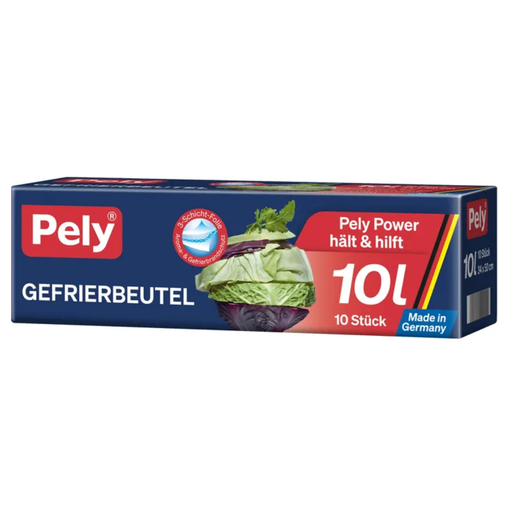
Why this product suits this profile: The 10-litre version is intended for households freezing large cuts of meat, poultry, supplies of vegetables or substantial food shops.
The stated dimensions of 34 × 50 cm help prevent large foods from being forced into bags that are too small. Sharp edges should still be protected.
10-litre capacity, 3-layer PE film, labelling area and specified suitability for low temperatures.
We have put together a complete, regularly updated list of products that fully meet these strict selection criteria and the safety regulations applicable in the EU.
For individual portions and smaller leftovers, 1-litre bags are often sufficient. Family-sized portions, soups and meal-prep dishes are more suited to 3- or 4-litre bags. Large foods require 6 or 10 litres. The dimensions and opening width are also important.
Models with a sturdy zip or double closure may be suitable for liquids according to the product information. The bag should not be overfilled and should be kept upright while filling. Before freezing, it is advisable to place the bag in an additional bowl to protect against leaks until the contents are completely frozen.
Disposable freezer bags should be disposed of after visible damage, contamination or use with raw food. Reuse is only advisable if the manufacturer explicitly permits it and the bag can be thoroughly cleaned and completely dried. Damaged closures or holes are clear reasons not to use the bag.