
Lieferung heute & morgen

Qualitätsgarantie

Willkommens-Angebote freischalten: KOSTENLOSE Lieferung | Bis zu 80 % RABATT | Kostenlose 30-Tage-JoyPlus-Testphase
App herunterladen
Freezer bags are a basic essential in many British households. They help you portion food, keep your freezer organised and make meal prep easier. However, seemingly cheap offers do not always provide the right solution. It is not just the pack size and price that matter, but also capacity, film thickness, closure type and intended use.
A freezer bag labelled 2 litres may be easier or more difficult to fill depending on its shape. Wide openings make it easier to add bread, vegetables or prepared meals. When storing liquids, it is also important not to fill the bag right to the top. Watery foods expand when frozen.
The size should suit the intended use:
However, the litre capacity alone is not enough. Check the bag dimensions as well, such as 16 × 25 cm for a 1-litre model or 34 × 50 cm for a 10-litre freezer bag.
A knot or simple clip may be sufficient for dry foods. With soups, stock or marinades, however, there is a greater risk of the bag tipping over or leaking when it is moved. Freezer bags with zip closures can be sealed more securely and reliably. Models with two closure tracks are often sold as freezer bags with double closures or double-zip bags.
A gusseted base is also recommended for liquids. This keeps the bag upright while it is being filled. Before freezing, place it in a bowl until the contents have solidified.
Terms such as “extra strong”, “leakproof” or “for long-lasting freshness” are only meaningful when supported by specific product data. Look for:
The pely models in this selection are described as featuring BPA-free 3-layer film, flexibility down to −40 °C and manufacture in Germany. These details refer to the individual product descriptions and should be checked against the packaging.
Multi-layer film can provide additional tear resistance during everyday use. This is particularly important for freezer bags holding large portions, as heavier contents place greater strain on the seams and edges. A standard model is often sufficient for dry foods. For meat, liquids or large quantities, robust freezer bags with reinforced film are a practical choice.
If you want to reduce waste, reusable silicone bags are worth considering. According to the product description, these are designed for use in the freezer, cleaning and repeated use. Before buying, check whether the manufacturer provides specific guidance on using them in the dishwasher, microwave or for heating.
A zip closure is practical when the bag needs to be opened several times. A double closure can provide an additional sealing line for liquid contents. With press closures, make sure the tracks are pressed fully together. A slider closure may be suitable for frequent opening and closing.
A labelling area prevents frozen portions from being mixed up. Write the contents and date directly on the bag before freezing. Remove as much air as possible without overfilling the bag. This saves space and helps keep your freezer neatly organised.
A pack of 40 may be enough for occasional use, while families or catering businesses buying packs of 75 or 100 bags will need to restock less often. For this reason, compare the price per bag, not just the total price. With bulk packs, the size needed should match the intended use as closely as possible. Larger bags are not automatically more economical if unused space is regularly frozen.
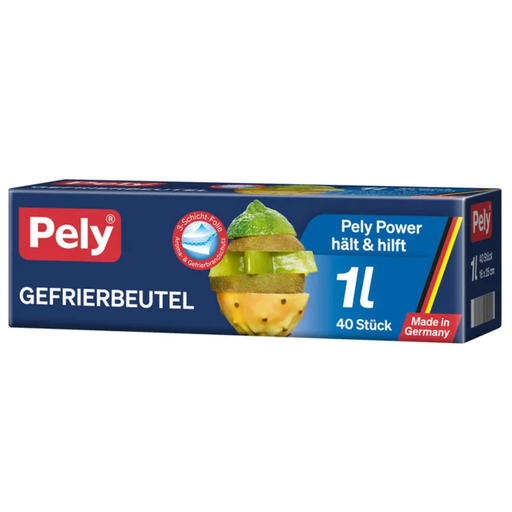
Why this product suits this profile: The 1-litre size is ideal for everyday portions, leftovers and smaller purchases. With 40 bags, the pack is manageable without committing you to a bulk quantity straight away.
The dimensions of 16 × 25 cm and the labelling area make the bag’s actual usability clear. According to the product description, the film is BPA-free and designed for temperatures down to −40 °C.
1-litre capacity, 40 bags per pack, 3-layer film and, according to the manufacturer, Made in Germany.
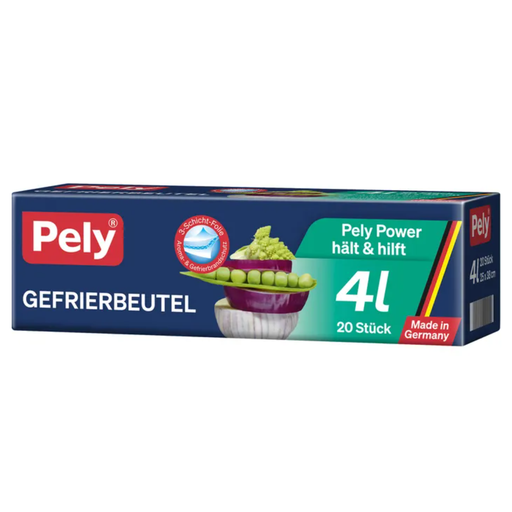
Why this product suits this profile: At 25 × 38 cm, the bag provides room for large portions, bread, poultry or prepared family meals. Its size is designed for storing larger quantities in the freezer.
The specific size information prevents the litre capacity from being used as the only purchase criterion. According to the product description, this model features BPA-free 3-layer film and a labelling area.
4-litre capacity, 20 bags, 3-layer film and flexible use for solid foods and suitable quantities of liquids.
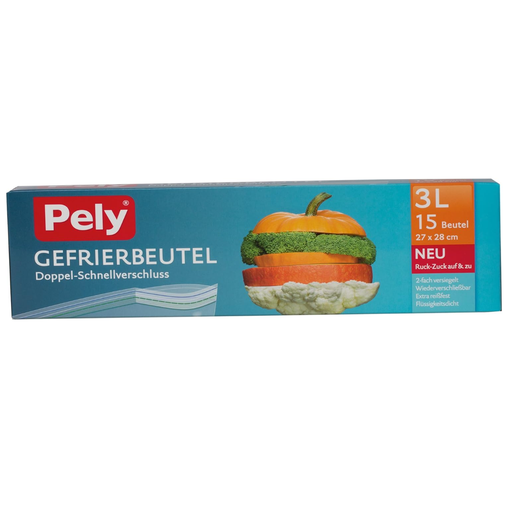
Why this product suits this profile: The 3-litre bag with double closure is aimed at people who regularly store soups, marinades, sauces or larger meal-prep portions.
Two closure tracks help reduce the risk of the bag not being sealed properly. Even so, leave a safe gap below the top when filling it.
3-litre capacity, 15 bags, double closure and, according to the product description, suitability for liquid contents.
We have put together a complete, regularly updated list of products that fully meet these strict selection criteria and the safety regulations applicable in the EU.
For individual meals, 1L freezer bags are often sufficient. For portions for two people or larger side dishes, 2-litre models are a good choice. For soups, stews and larger quantities of prepared food, a 3L freezer bag may be more practical.
According to the relevant product descriptions, models with double closures are designed for liquids such as soups, sauces or marinades. The bag should still not be overfilled and should be placed upright in a bowl before freezing.
Shelf life depends on the food, storage temperature, packaging quality and the amount of air in the bag. Follow the recommendations for the food in question and label every portion with its freezing date. Freezer bags do not protect against quality loss indefinitely, particularly if they are damaged or not sealed securely.