
Lieferung heute & morgen

Qualitätsgarantie

Willkommens-Angebote freischalten: KOSTENLOSE Lieferung | Bis zu 80 % RABATT | Kostenlose 30-Tage-JoyPlus-Testphase
App herunterladen
Freezer bags help you portion food, organise your freezer space and keep your supplies tidy. Yet buying them often leads to unnecessary costs: a bag is too small, the seal doesn't hold properly, or the material tears when you fill it. So when you're comparing freezer bags with zip closures, one-litre bags or larger options, you shouldn't just look at the pack price.
The Joybuy Product Recommendation Officer filters the most important product details and shows which features matter for different households.
A 1-litre freezer bag is often suitable for smaller portions, berries, chopped vegetables or leftovers. What also matters are the dimensions and the shape. A stand-up base, for example, makes it easier to fill with liquids, whereas a flat bag takes up less space in the freezer.
For larger portions or family meals, 3-litre freezer bags or 6-litre freezer bags could be the answer. However, a large capacity can tempt you to overfill the bag. This increases the risk of putting strain on the seal or the film.
A simple clip, a press-seal and a slider zip all differ in how they work. For liquid foods, a secure closure and a stable base are especially important. Products should only be called leak-proof freezer bags if the product details clearly state this. Even then, you should transport the bags upright and avoid overfilling them.
Reusable freezer bags need clear information about the material, cleaning and intended use. Vacuum bags for storing clothes, bedding or travel luggage are not automatically intended for food. They work with a vacuum pump and a valve, whereas classic freezer bags can be designed for direct contact with food.
Sort the bags by typical portions:
The litre capacity printed on the pack is a guide. For actual use, the width, height and available opening also count.
Look for a closure that can be sealed across the entire width. A double zip or slider closure can make it easier to control the seal. A stand-up base is useful if you want the bag to stay upright while you fill it.
With a freezer bag with a label panel, you can write the contents and freezing date directly on it. This helps with stock rotation and reduces the need to open several bags unnecessarily.
For food bags, you should pay attention to the material details and temperature instructions. Some products, for example, state a suitability down to -40 °C. That doesn't automatically mean they are suitable for the oven, grill or microwave. Such uses are only allowed if they are explicitly stated on the packaging.
BPA-free freezer bags can be relevant for shoppers who are specifically looking for this material information. Even so, you should check the full manufacturer details and the intended use. Plastic bags should always be kept out of reach of children, as they pose a suffocation risk.
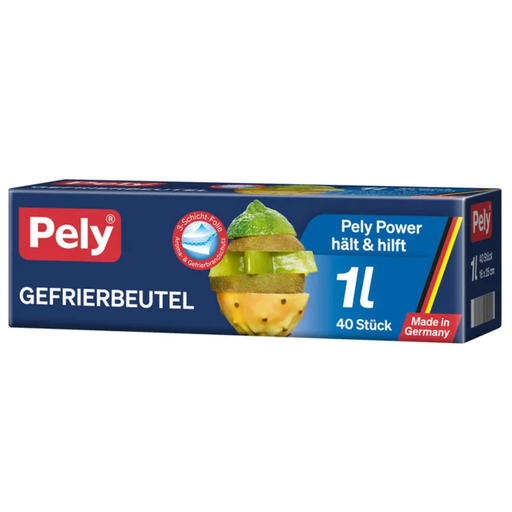
Why this product fits the profile: The 1-litre size is ideal for regular single portions and everyday leftovers. The pack contains 40 bags for repeated household use.
The product details mention a label panel, a 3-layer film and flexibility down to -40 °C. This means you can clearly note the contents, date and intended temperature range.
1 litre capacity, 40 bags per pack, BPA-free 3-layer film according to the product description, and a writable label area.
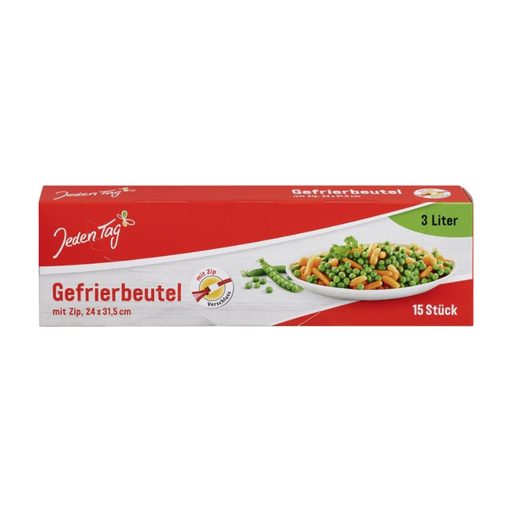
Why this product fits the profile: The 3-litre bag combines a larger volume with a slider zip and an integrated label panel. This is practical for households with prepared meals and regular stock-keeping.
The closure can be guided across the entire opening. According to the product details, the bag is designed for -40 °C to +90 °C; however, use in the oven or with a grill function is excluded.
3 litre volume, slider zip, transparent material and label area; maximum load according to the product details: 3 kg.
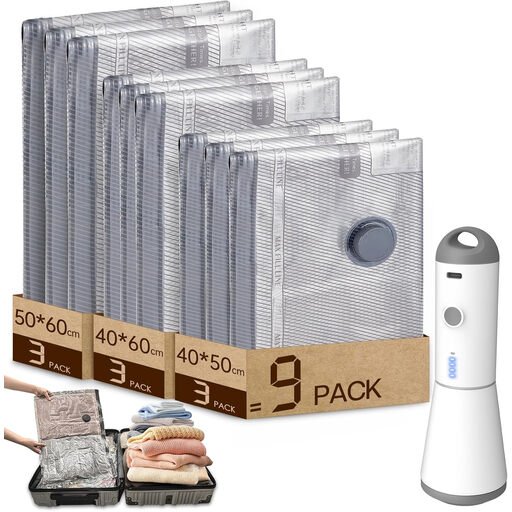
Why this product fits the profile: This set is aimed at people who want to organise clothes, bedding or blankets in a space-saving way for travel, moving house and seasonal storage.
The stated intended use is for textiles, not food. This avoids the common confusion between vacuum bags for storage and freezer bags.
Nine bags in three sizes, double zip, valves and a cordless pump; according to the product description, intended for repeated use.
We've put together a complete, regularly updated list of products that fully meet these strict selection criteria and the safety regulations in force in the EU.
As a rule, don't fill freezer bags right to the top. With liquids, leave a little space because the contents expand when frozen. Remove excess air without stretching the film too much, and check the seal before placing the bag in the freezer.
Label the bag with the contents and the date. Damaged or soiled single-use bags should not be reused for food. Drawstring bin bags, on the other hand, belong in the waste disposal area and are not suitable for storing food. For the kitchen, office or moving house, depending on the amount of waste, options with 5, 20, 25, 35 or 60 litres may be useful.
A zip closure can reduce the risk of liquids leaking out if it is fully sealed and the bag is not overfilled. However, this does not guarantee it for every transport situation. For soups and sauces, we also recommend storing the bag upright or choosing one with a stand-up base.
The possible storage time depends on the food, temperature, packaging condition and the manufacturer's recommendations. Label each bag with the contents and the freezing date. If there is freezer burn, damaged film or an unusual smell, the contents should not be used.
That depends on the product and the intended use. Bags that are labelled as reusable must be cleaned properly and dried completely. Single-use freezer bags should not be reused for raw and cooked foods. Vacuum bags for clothes are reusable, but they are not automatically suitable for food.