
Lieferung heute & morgen

Qualitätsgarantie

Willkommens-Angebote freischalten: KOSTENLOSE Lieferung | Bis zu 80 % RABATT | Kostenlose 30-Tage-JoyPlus-Testphase
App herunterladen
Freezer bags are a staple in many British households for everyday food storage. They help with portioning, freezing, transporting and organising food. However, models differ significantly in volume, closure, material and intended use. A cheap bag can be unsuitable if liquid leaks out, the closure doesn't seal properly or the size doesn't match the contents.
This buying guide shows what households, families, meal-prep users, keen cooks and travellers should look out for.
A 1-litre freezer bag is suitable for smaller portions, berries, chopped vegetables or single meals. However, the stated capacity describes the maximum volume under ideal conditions. With liquids, you should leave a gap at the top to allow for a secure seal.
A 3-litre freezer bag offers more space for soups, larger portions or prepared family meals. If the bag is overfilled, the seam can be put under greater strain during freezing or transport.
A simple zip closure can be sufficient for dry foods. For soups, marinades or defrosted foods, a freezer bag with a double seal is a more practical choice. Two closure strips provide an extra sealing layer. Even so, after closing, each bag should be checked for a fully sealed edge and, where possible, stored upright.
'Leak-proof' should not be taken as a guarantee for every situation. Sharp bones, pointed edges, overfilling and improper opening can damage even robust bags.
Resealable plastic freezer bags are primarily designed for multiple uses during storage. Whether they can be hygienically reused depends on the material, contents and cleaning. With raw meat, fish or very fatty foods, it is often sensible to replace them.
Reusable silicone bags can be of interest to users who regularly do meal prep. However, they require thorough cleaning and must be completely dry before being resealed.
A bag filled as flat as possible can be stacked in the freezer to save space. With liquids, the contents should be stored before final freezing in such a way that the closure is not under pressure.
A zip-lock freezer bag can be opened and closed quickly. A slider closure can be convenient for frequent use, while a double seal offers an extra sealing layer for liquid contents.
A stand-up bottom is useful when you want to fill the bag without needing a second person to hold it. When storing in the freezer, the upright position can also help to organise liquids neatly.
For food use, bags should be explicitly marked as food-safe and suitable for the intended temperature range. Information such as PE, 'suitable for the freezer' or a temperature guideline should be clearly stated on the packaging.
Important:
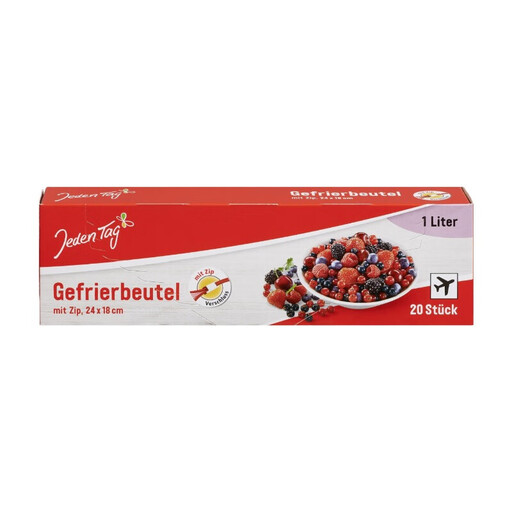
Why this product fits the profile: The 1-litre size and transparent design are suitable for smaller portions, leftovers and everyday food storage.
The clearly stated volume makes it easier to choose compared to bags that are too large with unnecessary empty space. The contents remain visible.
1-litre capacity, zip closure, transparent material and pack of 20.
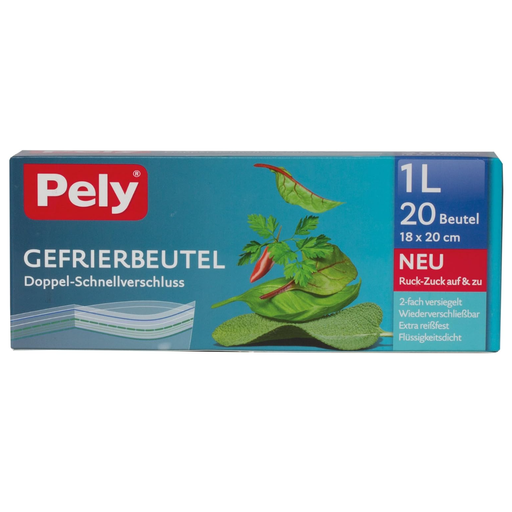
Why this product fits the profile: Two closure strips and a labelling panel are practical when smaller liquid portions need to be frozen in an organised way.
The double seal addresses the risk of a single closure not being fully sealed. However, correct sealing is still required.
1-litre capacity, two press-to-close strips, labelling panel and 20 bags per pack.
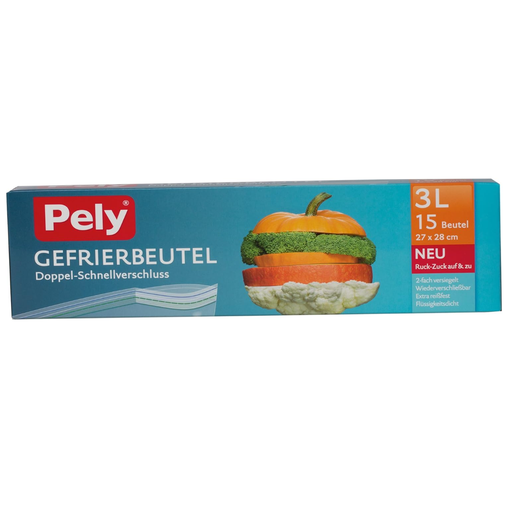
Why this product fits the profile: The 3-litre size is aimed at households that store soups, marinades, batch-cooked meals or larger meal-prep portions.
The larger volume reduces the need to split portions across several small bags. The double seal is designed for liquid contents.
3-litre capacity, extra-strong PE material, two closure strips and labelling panel.
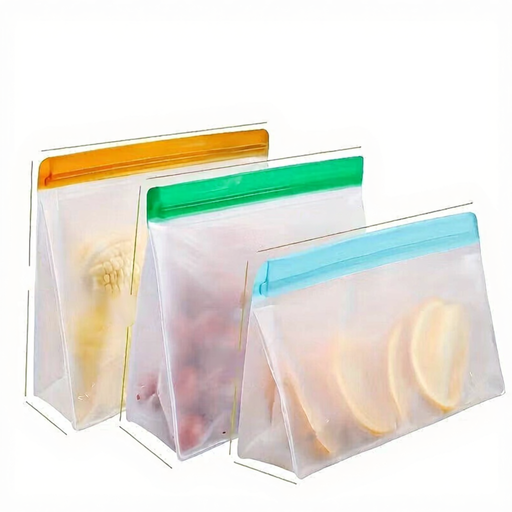
Why this product fits the profile: For users who want to use bags repeatedly for the freezer, travel, marinating or meal prep, silicone offers a durable alternative to disposable bags.
The reusable design reduces the need for disposable bags. Before next use, cleaning, drying and following the manufacturer's instructions are essential.
Food-grade silicone, resealable closure, suitable for the freezer and cleaning as per product instructions.
We have put together a complete, regularly updated list of products that fully meet these strict selection criteria and the safety regulations in force in the EU.
The pely Breakfast Bags 1L with Closure Clips, for example, are designed for sandwiches, bread, cheese or dry snacks. The breathable paper construction suits packed lunches but is not intended for soups or other liquids.
For single portions and smaller leftovers, a 1-litre freezer bag is often sufficient. For family portions, soups, sauces or larger quantities of ingredients, 3 litres is more practical. The key is not to fill the bag right to the top.
This depends on the material and the manufacturer's instructions. Classic plastic bags can, depending on their condition, be used again for dry, clean foods. After contact with raw meat, fish or very fatty foods, it is advisable to replace them for hygiene reasons. Silicone bags are explicitly designed for repeated use but must be thoroughly cleaned and dried.
Close the seal fully across the entire width, do not overfill the bag and keep sharp objects away. Liquid contents should initially be stored upright. A double seal and a stand-up bottom can make handling easier, but they do not replace checking the seal before freezing or transporting.