
Lieferung heute & morgen

Qualitätsgarantie

Willkommens-Angebote freischalten: KOSTENLOSE Lieferung | Bis zu 80 % RABATT | Kostenlose 30-Tage-JoyPlus-Testphase
App herunterladen
Freezer bags help you store food in portions, saving space and keeping it protected. Yet not every bag suits every purpose. A bag that's too small can be difficult to seal, a thin film can tear on sharp-edged foods, and an unsuitable closure can lead to leaks with liquids.
The following selection criteria will help private households, families, meal-prep users, keen cooks, and catering and hospitality businesses avoid making the wrong purchase.
A 1L freezer bag is suitable for small portions, berries, chopped vegetables or leftovers. For two people, baked goods or larger portions of meat, a 2L freezer bag is often more practical. However, the litre capacity alone doesn't tell you how wide the opening is or whether a long-shaped food item will fit inside.
That's why you should always check the product dimensions before buying. A bag measuring 16 × 25 cm is quite different from one measuring 20 × 31 cm, even if both are used for similar-sized portions.
The label extra strong freezer bags is only meaningful if details about the material or construction are provided. Multi-layer films can offer greater tear resistance than very thin single-layer materials. What really matters, though, is the specific use case: bones, hard edges and frozen foods can damage any bag.
With the pely models, for example, three-layer films are specified. For liquid foods, you should also consider the closure type, fill level and safe handling.
A simple clip or knot can be sufficient for dry foods and short storage periods. For soups, marinades or sauces, freezer bags with a double closure or freezer bags with a zipper are more practical. A stand-up base makes filling easier, but it doesn't replace careful checking of the closure.
Liquids should not be filled right to the top. They expand when frozen. The bag should be pre-frozen upright in a bowl or container until the contents are solid.
The right size depends on the contents, the portion and the space available in your freezer:
A bag shouldn't be overfilled. Leaving a little room for sealing and for the contents to expand makes it much more practical for everyday use.
For food storage bags, information about the type of plastic used, its suitability for food contact and its temperature resistance is important. For several products in the pely range, BPA-free three-layer films and flexibility down to −40 °C are specified. These product details refer to the respective manufacturer's description and should be checked against the packaging before purchase.
BPA-free doesn't automatically mean a bag is suitable for every application. Freezer bags are not generally intended for hot food, the oven or the microwave. For that, you need explicit instructions stating they are suitable.
For dry contents, a bag that can be tied or sealed with a clip is often sufficient. If you want to freeze liquids, look for leak-proof freezer bags, a zipper or a double closure. Even so, we recommend this practical step-by-step approach:
A writable label area for the contents and freezing date makes organising your stock much easier and reduces unnecessary thawing and waste.
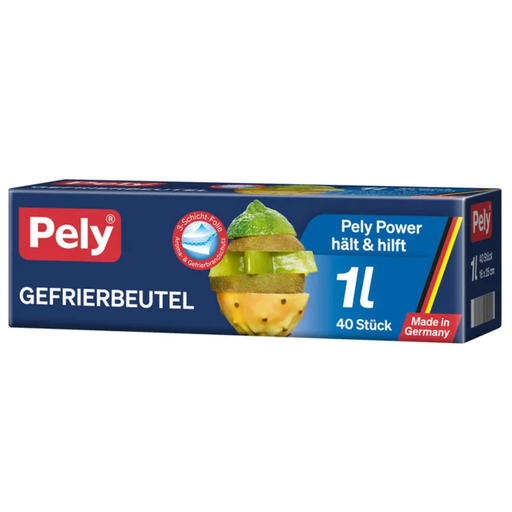
Why this product fits the profile: The 1-litre size is ideal for everyday portions and smaller households. The pack of 40 is designed for regular use.
The dimensions of 16 × 25 cm make the choice clearer than a simple litre capacity. The writable label area helps with identification.
Three-layer, BPA-free film according to product specifications; suitable for portioned foods and flexible storage down to −40 °C.
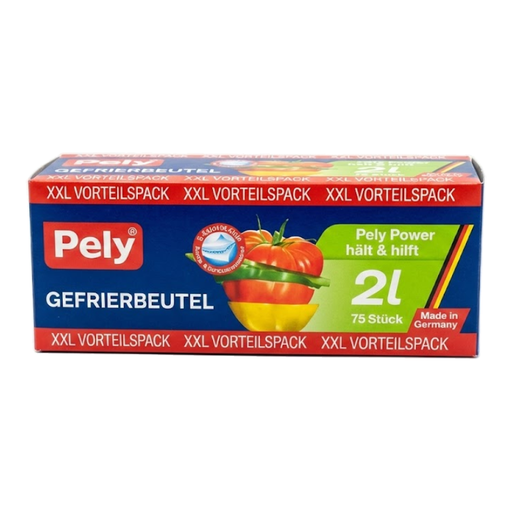
Why this product fits the profile: The pack of 75 is aimed at families, meal-prep users and households that regularly freeze food.
The 20 × 31 cm bags offer more room for medium-sized portions and have a wide opening for filling.
Three-layer film, 2-litre capacity and, according to product specifications, manufactured in Germany.
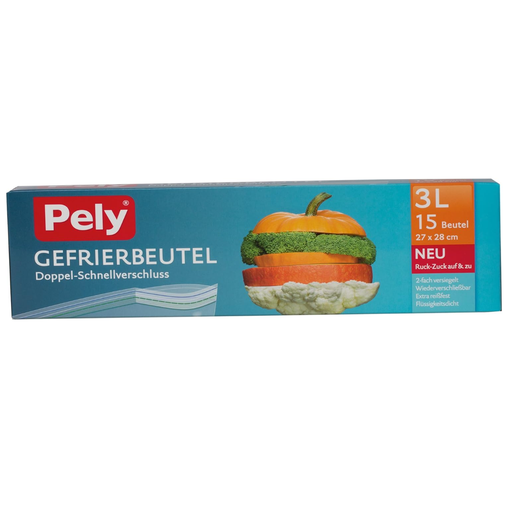
Why this product fits the profile: The 3-litre bag with a double closure is designed for larger portions, marinades, soups and other liquid contents.
Two closure lines reduce the risk of a bag not being fully sealed. However, the contents should still not sit above the closure zone.
3-litre capacity, double closure and, according to product specifications, an extra-strong PE film.
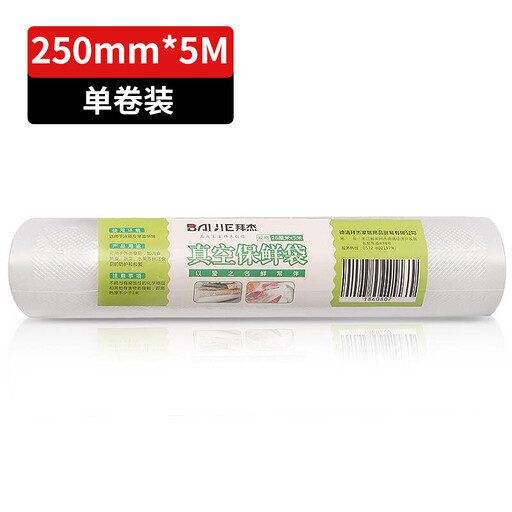
Why this product fits the profile: The roll can be cut to the desired length and is suitable for meal prep, larger cuts of meat and portioned supplies.
The variable length prevents you from having to use unnecessarily large standard bags. A compatible vacuum sealer is required.
250 mm width, 5 m roll length and a bag length that can be adjusted to the size of the food.
We've put together a complete, regularly updated list of products that fully meet these strict selection criteria and the safety regulations in force in the EU.
For larger quantities of food, 4L freezer bags, 6L freezer bags and 10L freezer bags are available. The product specifications for the pely models, for example, give the following dimensions:
These sizes can be suitable for large roasts, whole poultry pieces, loaves of bread or harvest supplies. For catering and hospitality, pack size, stackability, labelling options and safe interim storage are also important. Damaged bags should not be reused.
For single portions, 1L freezer bags are often sufficient. For meals for two people or larger quantities of ingredients, 2L freezer bags offer more space. What really matters are the actual dimensions and the shape of the prepared food.
Models with a zipper or double closure can be practical for soups, sauces and marinades. The bag must be fully sealed and must not be overfilled. When freezing for the first time, we recommend using a bowl as an extra safeguard against possible leaks.
Standard freezer bags are usually sealed with a clip, a knot or a press-seal closure. Vacuum sealer bags require a compatible vacuum sealing machine and are cut to the desired length or used as pre-made bags. For both types, you should check the material suitability, dimensions and the instructions on the packaging.