
Lieferung heute & morgen

Qualitätsgarantie

Willkommens-Angebote freischalten: KOSTENLOSE Lieferung | Bis zu 80 % RABATT | Kostenlose 30-Tage-JoyPlus-Testphase
App herunterladen
Freezer bags are a basic essential in many British households. They allow you to portion meat, vegetables, soups and prepared meals while saving space. However, a low price does not automatically mean you are getting the right product. Capacity, closure, material thickness and intended use are what really matter.
A 1-litre freezer bag is generally suitable for smaller portions, berries, chopped vegetables or individual meals. A 2-litre freezer bag offers more room for ingredients and portions for several people. A 3-litre freezer bag can hold larger quantities, soups or marinated food.
The stated capacity is only a guideline, however. If the bag is filled right up to the closure, it may be harder to seal properly. Liquids also need some room because their contents can expand when frozen.
A basic press-to-close seal may be sufficient for dry food. For liquids, marinades or moist dishes, freezer bags with a double seal or a sturdy sliding closure are more suitable. Even a high-quality closure will only provide reliable protection if the sealing edge is clean and fully closed.
Before freezing, it is worth carrying out a quick leak test over the sink. Liquid food should also be frozen upright wherever possible until it has solidified.
Reusable freezer bags can help reduce plastic waste, but they require thorough cleaning and complete drying. Raw meat and fish products have higher hygiene requirements than dry vegetables or bread. Not all reusable bags are suitable for microwaves, boiling water or ovens either.
Always follow the information on the product packaging. A freezer bag must not be heated simply because it is designed for use in the freezer.
A stand-up base makes filling easier. The bag stays upright while ingredients or liquids are added. This is particularly useful for soups, sauces and marinades.
With zip freezer bags, the closure should move smoothly and seal across the full width. A slider can make closing easier. Two sealing strips provide an additional barrier against leaks, but they do not replace correct handling.
For delicate food, it is important to remove as much air as possible and ensure the sealing edge is smooth and undamaged. Protruding bones or sharp edges can damage even a sturdy bag.
Freezer bags are commonly made from polyethylene or multi-layer composite materials. Thicker film can improve tear resistance, but this should be assessed using the specific product information. Composite bags made from PET, aluminium and PE may offer protection against light and odours.
A freezer bag with a labelling panel is particularly practical. You can write the contents and freezing date directly on the bag, making it easier to use older portions first. Also look out for:
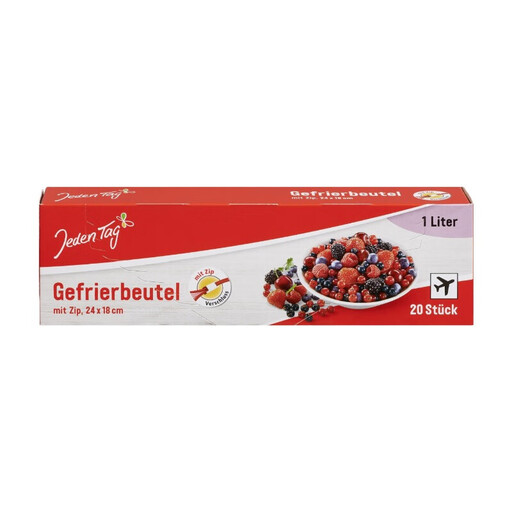
Why this product suits this profile: The pack contains 20 one-litre bags, making it suitable for smaller portions, leftovers, fruit and vegetables.
The clearly defined one-litre size makes portioning easier. The zip closure seals along the edge; overfilling should be avoided.
20 bags per pack, transparent material and use in the fridge or freezer according to the product information.
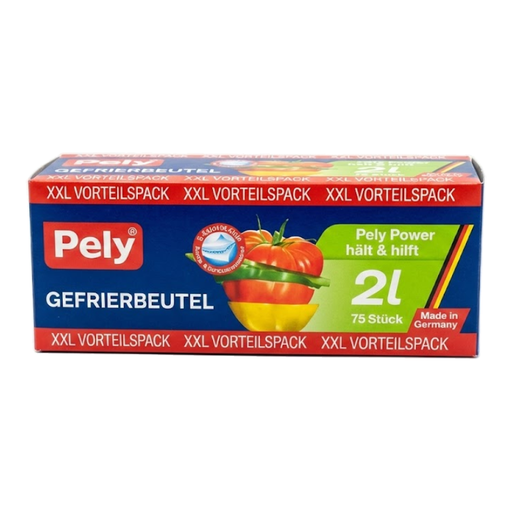
Why this product suits this profile: For regular freezing, the two-litre bag offers a medium-sized portion capacity, while the pack contains 75 bags.
The product information states that it has a three-layer film, a labelling panel and a wide opening. This makes it easy to record the contents and date.
2-litre capacity, 75 bags and a tear-resistant three-layer film according to the product description.
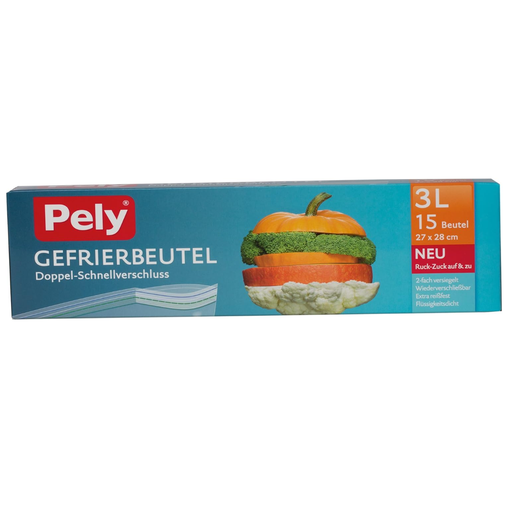
Why this product suits this profile: The three-litre bag is designed for keen cooks, families and anyone who portions soups, sauces or marinades.
Two sealing strips are designed for liquids and larger portions. Even so, the bag should be filled upright and not overloaded.
3-litre capacity, 15 bags per pack and an integrated labelling panel according to the product data.
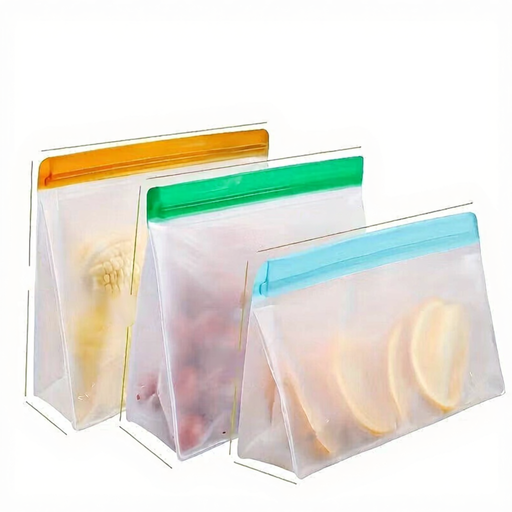
Why this product suits this profile: The silicone bags are designed for repeated use and can be cleaned and used across different temperature ranges, depending on the manufacturer's instructions.
The bags are specifically designed for reuse. They must be cleaned and completely dried before being used again.
Food-grade silicone according to the product description, a leak-proof closure and cleaning designed for repeated use.
We have put together a complete, regularly updated list of products that fully meet these strict selection criteria and the safety regulations applicable in the EU.
A 1-litre freezer bag is often sufficient for individual portions. Family portions or larger quantities generally require 2 or 3 litres. Leave enough room for liquids to expand as they freeze.
Disposable bags are designed for one-time hygienic use. The lifespan of reusable freezer bags depends on the material, closure and cleaning. Replace the bag as soon as it develops tears, leaks, deformation or persistent odours.
There is no universal answer. Many freezer bags are designed exclusively for use in the fridge and freezer. Do not use them in the oven, on the hob or under the grill. For microwave use, boiling water or sous-vide cooking, the manufacturer's instructions must explicitly state that the bags are suitable.