
Lieferung heute & morgen

Qualitätsgarantie

Willkommens-Angebote freischalten: KOSTENLOSE Lieferung | Bis zu 80 % RABATT | Kostenlose 30-Tage-JoyPlus-Testphase
App herunterladen
Freezer bags are a practical way to store food at home, in family kitchens, for meal prep and in small food businesses. But not every bag is right for every use. A bag that’s too small may not close securely, an unsuitable closure may give way when holding liquids, and a lack of space for labelling can make it harder to keep track of your supplies.
Before you buy, it’s worth checking for three common pitfalls:
The litre capacity gives you an approximate idea of how much a bag holds. Its dimensions matter too, as a flat bag is used differently in the freezer from an upright, gusseted bag.
It’s important not to fill a bag right up to the closure. Liquids can expand as they freeze, and leaving some space at the top also makes the bag easier to seal securely.
Zip freezer bags can be resealed after opening, making them useful for portioned food or supplies you use regularly. A double closure can offer extra security for liquids and marinades, but it’s still important to close the bag carefully.
When choosing leak-resistant freezer bags, look out for:
A gusseted base makes filling easier, while a write-on panel helps you keep track of food. Write the contents and freezing date directly on the bag.
Many freezer bags are made from polyethylene (PE). Any claims such as BPA-free or suitable for food contact should be clearly stated in the product description or on the packaging. According to the product information, the pely products featured here use BPA-free multilayer film.
The stated temperature range is important for how you use the bag. According to product information, some products remain flexible down to around -40 °C. However, being suitable for freezing doesn’t automatically mean a bag can be used in the oven, on the barbecue or with direct heat. If using it in the microwave, always follow the manufacturer’s specific instructions.
Food bags are handy for dry snacks, sandwiches and smaller food items. According to the product information, paper sandwich bags allow air to circulate but are better suited to dry foods rather than liquids.
Cling film is useful for covering bowls, plates and containers. A roll of cling film with a cutting edge can make everyday use easier. Only use cling film in the microwave if this is explicitly stated, and make sure steam can escape. PE film is not generally intended for use in the oven or on the barbecue.
Aluminium foil is suitable for certain cooking, baking and covering tasks. According to the product information, it shouldn’t be used in the microwave. Avoid prolonged direct contact with acidic or salty foods unless the product information says otherwise.
If you’re looking for film specifically for covering food, you can find more options in the plastic film for covering food category.
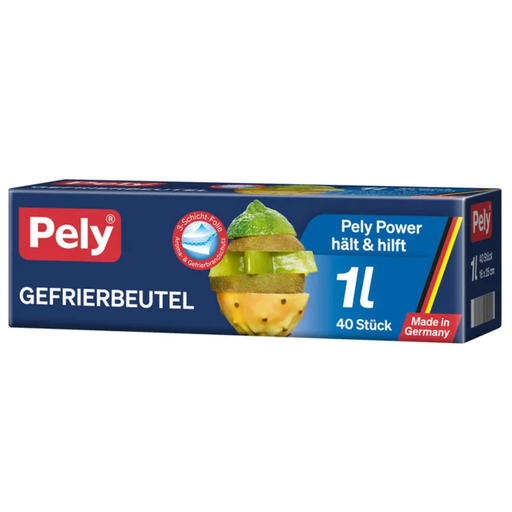
Why this product suits this need: The 1-litre size and pack of 40 are ideal for regularly portioning fruit, vegetables and leftovers at home.
The clearly stated capacity means you won’t need to use unnecessarily large bags for small portions. The write-on panel helps you keep track of your supplies.
According to the product information, it features BPA-free 3-layer film, a 1-litre capacity and flexibility down to -40 °C.
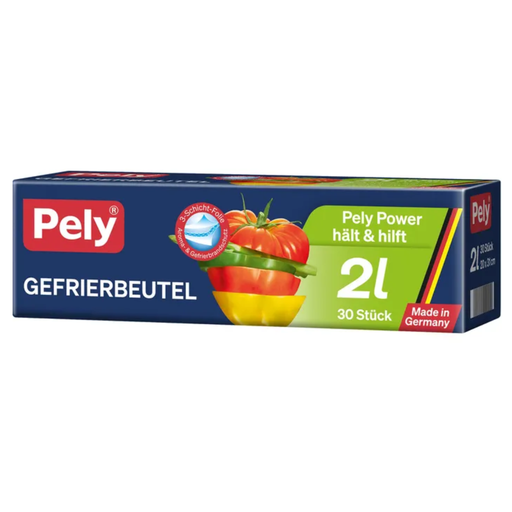
Why this product suits this need: The medium size is useful for both portioning and storing supplies, such as meals for two or larger baked goods.
The stated temperature resistance and write-on panel make it easier to plan and organise food storage in the freezer.
According to the product information, it features BPA-free 3-layer film, a 2-litre capacity and flexibility down to -40 °C.
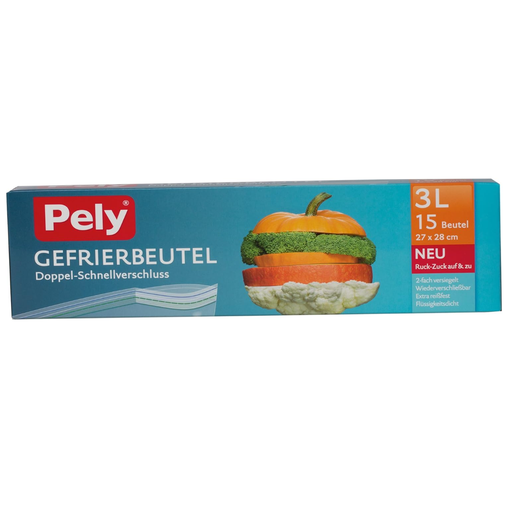
Why this product suits this need: The 3-litre size and double closure are designed for larger quantities, soups, stocks and marinades.
The double closure helps reduce the risk of a bag being incompletely sealed when storing liquids or marinated food.
According to the product information, it has a 3-litre capacity, extra-strong PE film and two closure tracks.
We’ve put together a complete, regularly updated list of products that meet these strict selection criteria and fully comply with the safety regulations in force in the EU.
For smaller quantities, 1L freezer bags are often enough. For larger portions intended for several people, 2L or 3L bags are more practical. The important thing is not to overfill the bag and to leave enough room to seal it.
A zip closure can seal securely when used correctly. However, whether a bag is suitable depends on its material, closure design, how full it is and its condition. For liquids, consider double closures or models specifically described as leakproof.
Only if the product description explicitly states that it’s microwave-safe. The film shouldn’t sit tightly against hot food, and steam must be able to escape. Standard PE cling film isn’t designed for use in the oven, on the barbecue or with direct heat.