
Lieferung heute & morgen

Qualitätsgarantie

Willkommens-Angebote freischalten: KOSTENLOSE Lieferung | Bis zu 80 % RABATT | Kostenlose 30-Tage-JoyPlus-Testphase
App herunterladen
Freezer bags make it easy to store food in portions, save space, and keep everything organised. For households, families, meal-prep users, and catering or food-service businesses, however, the decision should not be based solely on price or pack size. Capacity, material, closure type, and suitability for liquids are equally important.
A 1L freezer bag is generally suitable for smaller portions, fruit, vegetables, or leftovers. For two portions or larger baked goods, a 2L freezer bag is often more practical. From 4L upwards, there is more room for large cuts of meat, loaves of bread, or family-sized portions.
The litre capacity alone is not enough, however. The dimensions also matter. A 20 x 31 cm bag may be easier to fill in practice than a model with the same capacity but a different shape. Anyone storing bulky food should therefore consider capacity and dimensions together.
Not every basic freezer bag is suitable for soup, marinades, or liquid foods. When freezing liquids, a secure closure and careful handling are essential. Resealable freezer bags with a zip closure or double sealing strip are a practical option.
Even so, the bag should not be overfilled. Liquids expand as they freeze. It is advisable to leave some room both for sealing and for expansion. For delicate contents, upright storage in a bowl is also recommended until the contents are fully frozen.
A bulk pack of freezer bags can be useful for families, frequent shoppers, and commercial operations. However, the unit price should be assessed alongside material thickness, size, and closure type. One hundred thin bags for small portions serve a different purpose from 20 extra-strong freezer bags for large food items.
Actual usage matters too: anyone who freezes food only occasionally may not need an XXL pack. For regular meal prep or long-term stockpiling, larger packs can reduce the need for repeat purchases.
The following guide makes choosing easier:
These figures are intended as a practical guide. Actual capacity depends on the bag’s shape, how it is filled, and its closure.
A multi-layer plastic film can provide additional tear resistance when storing food. According to the product specifications, several pely models are made from a three-layer film and remain flexible down to -40 °C, depending on the version. Such details should always be checked against the product packaging.
Material information is also important for food contact. The pely models mentioned here are described as being made from BPA-free polyethylene or a BPA-free three-layer film. A BPA-free label describes a material characteristic; it is not a general guarantee of durability or health benefits.
A simple clip or knot may be sufficient for dry food and standard portions. For liquids, resealable freezer bags, a freezer bag with a zip closure, or a double press seal are more suitable. A gusseted base makes filling easier because the bag can stand upright.
Before freezing, note the contents, date, and, where applicable, portion size. A writable panel is easier to read in the freezer than loose labels. Air should be gently pressed out of the bag without crushing the contents.
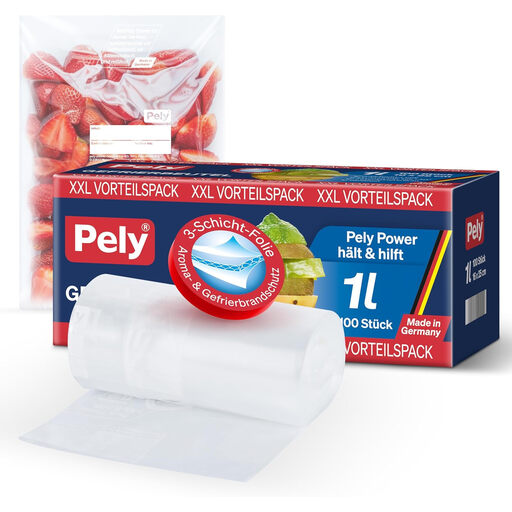
Why it’s a good fit: The 1-litre size is suitable for everyday portions and smaller leftovers. With 100 bags per pack, it is ideal for households with regular storage needs.
The stated size and pack count make the intended use clear. A writable panel helps keep stored supplies organised.
100 bags, 16 x 25 cm, three-layer film, and BPA-free according to the product specifications.
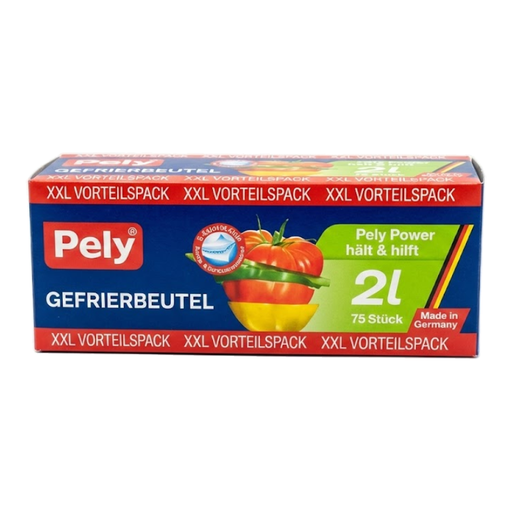
Why it’s a good fit: The medium size, measuring 20 x 31 cm, is designed for meal prep, portions for two, and larger ingredients.
According to the product description, the wide opening makes it easier to fill the bags with medium-sized portions and helps prevent unnecessary overfilling.
75 bags, three-layer film, writable panel, and made in Germany according to the product specifications.
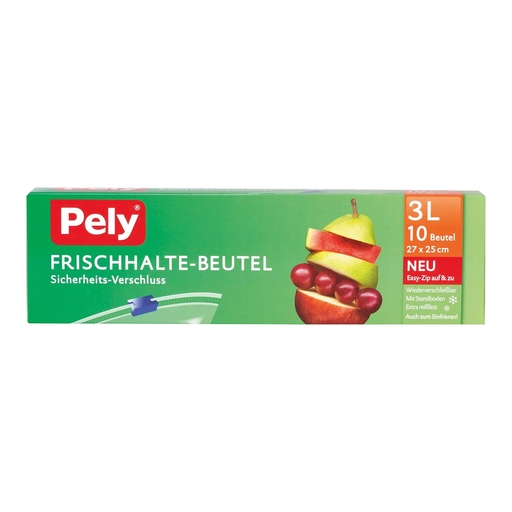
Why it’s a good fit: The 3-litre bags feature a safety zip closure and gusseted base, making them suitable for soups, marinades, and larger portions.
The gusseted base makes upright filling easier. The closure is better suited to liquid contents than a simple knot.
3-litre capacity, zip closure, gusseted base, and writable surface.
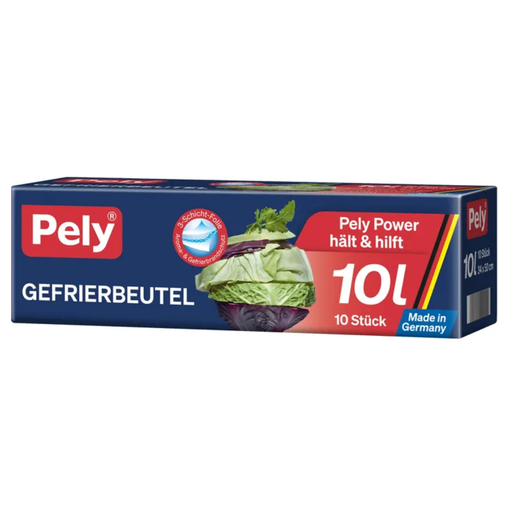
Why it’s a good fit: The 10-litre size, measuring 34 x 50 cm, is designed for large food items, substantial harvests, and larger quantities for professional kitchens.
The dimensions indicate whether the bag is suitable for bulky contents. Before filling, check that any sharp edges are protected.
10 litres, 34 x 50 cm, three-layer PE film, writable panel, and BPA-free according to the product specifications.
The full category includes further bag options for food preservation, freezing, keeping food fresh, and storing supplies.
For particularly airtight storage, vacuum bags may be worth considering. According to the product description, the BJ vacuum bags are designed for standard vacuum sealers and are available in various widths or as a 5-metre roll. Before purchasing, check that the format is compatible with your appliance.
For dry snacks, packed sandwiches, or transport, sandwich bags and food storage bags are more suitable. According to the product specifications, the 1-litre pely sandwich bags are made from paper and intended for dry food. They should not be used for liquids or for extended storage of foods with a high oil content.
A 1L freezer bag is often sufficient for individual portions. Two-litre bags are suitable for meals for one or two people. For family-sized portions or larger food items, 3L, 4L, 6L, or 10L bags are practical choices. The bag’s dimensions and shape are also important.
Models with a double sealing strip or safety zip closure are more practical for liquids than basic bags. The bag should still not be overfilled. Space must be left for expansion during freezing. Placing the bag in an additional bowl during the initial freezing stage can provide protection against leaks.
Shelf life depends on the food, temperature, packaging quality, and amount of air remaining in the bag. Labelling the bag with its contents and freezing date makes monitoring easier. Damaged, leaking, or badly deformed bags should no longer be used for food. Plastic bags must also always be kept away from babies and young children, as they pose a suffocation risk.