
Lieferung heute & morgen

Qualitätsgarantie

Willkommens-Angebote freischalten: KOSTENLOSE Lieferung | Bis zu 80 % RABATT | Kostenlose 30-Tage-JoyPlus-Testphase
App herunterladen
Freezer bags make it easy to portion food economically and keep your freezer organised. However, not every bag is suitable for every use. Small bags are handy for individual portions, while larger formats are needed for soups, bread or family meals. Closures, material thickness and pack sizes also vary considerably.
The most common unsuitable purchases are not caused by the price, but by choosing the wrong product:
The litre specification indicates the approximate capacity. However, the dimensions are also important when choosing a bag, as wide and tall bags are suited to different types of food.
Always leave some space when filling a bag. Liquids expand when frozen. An overfilled bag may therefore split or put strain on the seal.
A freezer bag with a zip closure can be resealed after opening. This is useful when you want to remove food in portions or store it temporarily in the fridge.
A freezer bag with a double seal has two sealing lines. According to the product description, the relevant Pely models are intended for liquids such as soups and marinades. Even so, a bag containing liquid should also be frozen in a bowl or box. This reduces the risk of an unnoticed damaged bag leaking inside the freezer.
Stand-up bags can remain more stable while being filled. The 3-litre quickpack model is specified as having a double press seal and a stand-up base. This combination is particularly practical for sauces, stews and larger portions.
A multi-layer plastic film can offer greater tear resistance than thin films. The listed Pely models are described as having a 3-layer film; some variants are described as BPA-free freezer bags. This information should be checked directly on the product packaging or in the data sheet.
Important points to check include:
A freezer bag does not automatically protect food from freezer burn indefinitely. Removing as much air as possible, choosing a suitable pack size and maintaining a constant freezer temperature are also important.
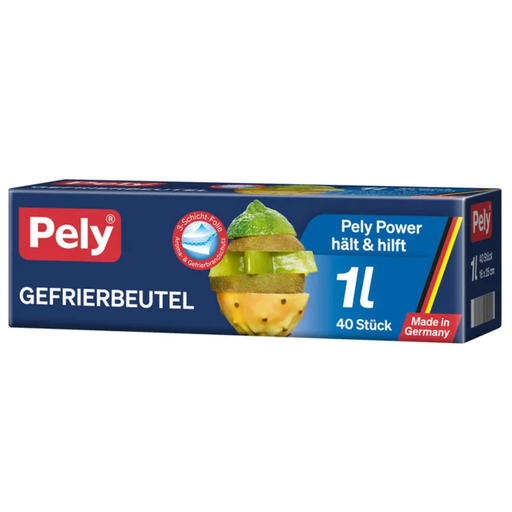
Why this product suits this profile: The 1-litre format is suitable for everyday portions and comes in a pack of 40 bags.
The 16 × 25 cm dimensions and the specified labelling panel make the choice more transparent than a simple marketing claim about size.
1-litre capacity, 40 bags per pack and, according to the product details, a BPA-free 3-layer film.
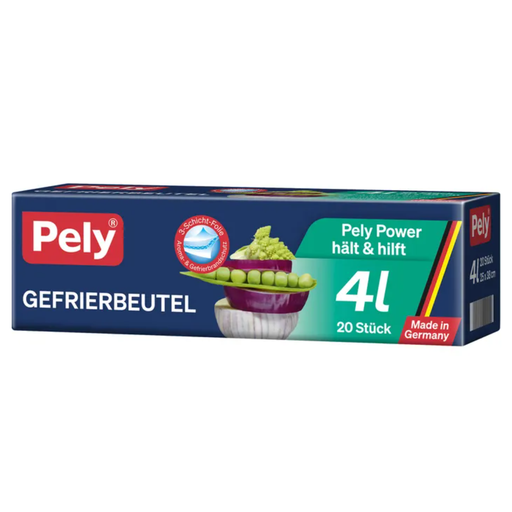
Why this product suits this profile: The 4-litre format combines a larger usable area with a specified 3-layer film and is suitable for family portions.
The information on the 25 × 38 cm dimensions, BPA-free material and temperature resistance down to –40 °C provides specific points of comparison.
4-litre capacity, 20 bags, a labelling panel and, according to the product description, a tear- and leak-resistant design.
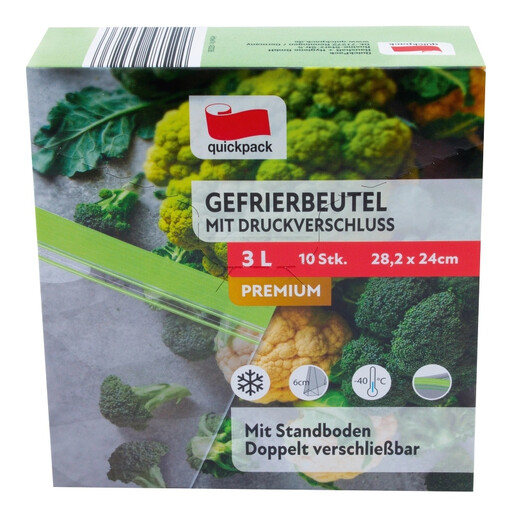
Why this product suits this profile: The stand-up base and double press seal are designed for meal prep, liquids and frequent filling.
The design addresses two typical weak points: filling the bag upright makes it easier to handle, while the double seal reduces the risk of the bag not being closed properly.
3-litre capacity, 10 bags per pack, stand-up base and double seal according to the product description.
Vacuum bags for food are a separate product category. They generally require a compatible vacuum sealer and are often available as individual bags, rolls or bulk packs. The BJ vacuum bags measuring 20 × 30 cm, 25 × 35 cm or 30 × 40 cm are designed for different food sizes. A roll measuring 300 mm wide and 5 m long may be suitable when you need bags of customised lengths.
Before buying, check the following:
Breakfast bags are not interchangeable with freezer bags when storing dry snacks and bread. The intended use must be expressly stated on the packaging.
We have put together a complete, regularly updated list of products that fully meet these strict selection criteria and the safety regulations applicable in the EU.
Shelf life depends on the food, temperature, amount of air in the bag and packaging quality. A freezer bag is not a substitute for dating your food. The contents and freezing date should always be noted. The relevant manufacturer's instructions and recommendations for the food's storage period are decisive.
For individual portions, 1L freezer bags are often sufficient. For two portions or larger ingredients, 2L freezer bags may be more suitable. Family meals, soups and larger quantities usually require 3 or 4 litres. For whole poultry portions or large harvests, 6 or 10 litres are more practical.
A double seal can improve closure security, provided both sealing lines are fully closed. Nevertheless, no bag remains permanently leak-proof under all conditions if it is damaged. Liquid food should be frozen upright and also placed in a bowl or box.