
Lieferung heute & morgen

Qualitätsgarantie

Willkommens-Angebote freischalten: KOSTENLOSE Lieferung | Bis zu 80 % RABATT | Kostenlose 30-Tage-JoyPlus-Testphase
App herunterladen
Freezer bags are a staple in many British households. They can be used to portion meat, vegetables, bread, soups or prepared meals, while making flexible use of the available space in your freezer. However, a low price per bag does not automatically mean you are getting the right solution. Capacity, film thickness, closure type and intended use are the key factors.
The “1 l” or “4 l” specification describes the nominal volume. However, how useful the bag is in practice also depends on its width, height and opening. A narrow bag may be suitable for flat portions, while bulky food requires a wider opening. For whole loaves, poultry or larger joints of meat, extra-large freezer bags with suitable dimensions are more practical than several smaller bags.
A freezer bag for dry foods can often be closed with a clip or knot. With soups, sauces and marinades, however, the risk of leakage increases. Freezer bags with a zip or double closure are more suitable for these uses. A stand-up base also makes filling easier, but it does not replace a properly closed seal.
Claims such as “tear-resistant”, “leak-proof” or “suitable for low temperatures” should always be considered in relation to the material, filling quantity and intended use. Even a sturdy bag can be damaged by sharp bones, frozen edges or overfilling. Specifications such as temperature resistance down to -40 °C only apply when this is expressly stated by the retailer or manufacturer.
Sizes can be broadly divided according to typical uses:
When choosing a bag, capacity is not the only consideration. Dimensions such as 16 × 25 cm, 20 × 31 cm or 25 × 38 cm provide a better indication of whether a particular food will actually fit inside.
BPA-free polyethylene freezer bags are widely available for storing food. Buyers should check the information on the packaging and only use bags that are expressly suitable for the intended food contact and for freezing. According to the product description, a multilayer film can provide additional strength. For example, the pely models are specified as having a three-layer film and flexibility down to -40 °C.
These specifications should not be equated with unlimited storage life. Food should be packaged correctly, filled with as little air as possible, and labelled with its contents and freezing date.
A labelling panel makes it easier to rotate food in the freezer. At a minimum, note the contents and freezing date. When storing liquids, do not fill the bag right to the top, as the contents can expand when frozen.
A bulk pack of freezer bags is particularly worthwhile for regular meal prep, large households or commercial use. To compare value, look at the price per bag rather than just the total pack price.
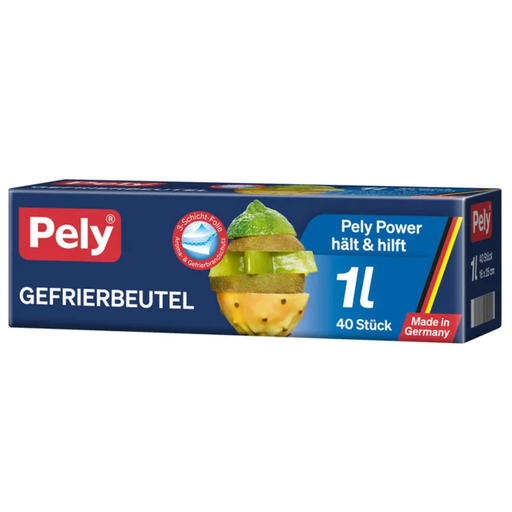
Why this product suits this profile: The 1-litre size is ideal for everyday individual portions and smaller leftovers. With 40 bags, it provides a manageable supply for the household.
The capacity and dimensions of 16 × 25 cm are clearly specified. A labelling panel helps you keep your freezer organised.
40 bags per pack; according to the product details, BPA-free three-layer film with flexibility down to -40 °C.
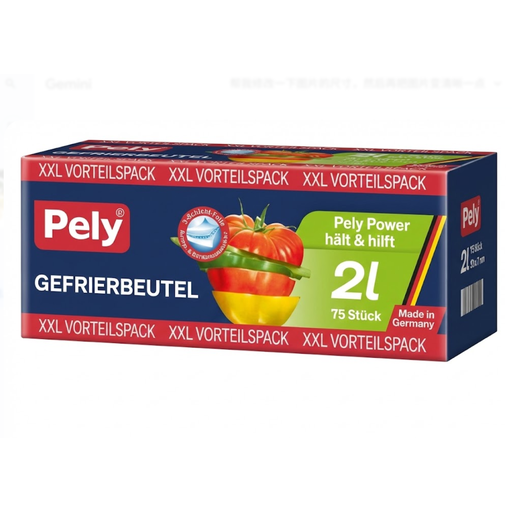
Why this product suits this profile: With a capacity of 4 litres and dimensions of 25 × 38 cm, these bags provide room for large family portions, loaves of bread or poultry. According to the product description, the wide opening makes them easier to fill.
The specified three-layer film and labelling panel address common problems such as torn film and poorly organised supplies.
45 bags per pack; according to the retailer, BPA-free film, tear resistance and suitability for temperatures down to -40 °C.
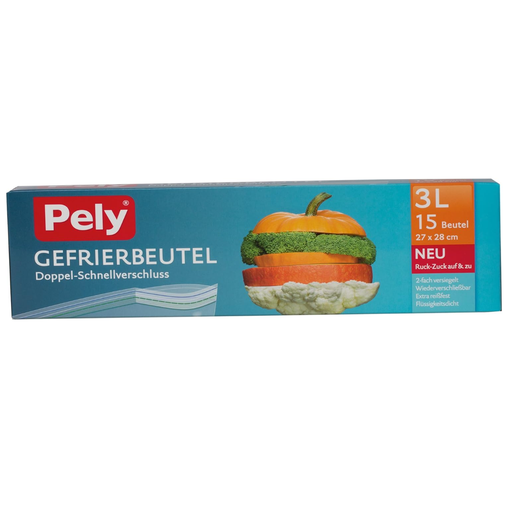
Why this product suits this profile: The 3-litre bag with a double press-seal closure is designed for liquid or marinated food. It is suitable for meal prep, catering and larger quantities of food.
The double closure is designed for uses where there is a greater risk of leakage. Nevertheless, the bag should be frozen upright in a bowl.
15 bags; double press-seal closure and integrated labelling panel according to the product details.
Why this product suits this profile: The stand-up base keeps the bag upright while it is being filled. This is useful for liquids, leftovers and small portions when you want to minimise spills.
The stand-up base reduces the risk of the bag tipping over while being filled. The double zip addresses a common weak point of basic closures.
20 bags per pack; 1-litre capacity, plus a stand-up base and double zip closure according to the product description.
Only fill the bag to the point where the closure can be sealed completely. When storing liquids, leave some room at the top for expansion. Carefully remove excess air without distorting the bag, and place liquid contents flat or in a bowl in the freezer initially.
Label every bag with its contents and date. This helps prevent food from being stored for too long or becoming impossible to find in the freezer. Damaged bags should no longer be used for food. Plastic bags must also be kept away from babies and young children, as they pose a suffocation risk.
We have put together a complete, regularly updated list of products that fully meet these strict selection criteria and the safety regulations applicable in the EU.
For individual portions, 1-litre freezer bags are usually sufficient. Two-litre bags provide more space for meals for two people or larger quantities of ingredients. For family portions, 3-litre or 4-litre bags may be more suitable. The key consideration is whether the meal will be frozen flat or stored as a bulky item.
A zip closure can reduce leakage, provided it is fully closed and the bag is not overfilled. Freezer bags with a double closure have two sealing tracks. Even so, upright storage is recommended for liquids, particularly while they are freezing.
The possible storage life depends on the food, temperature, packaging quality and amount of air in the bag. There is no single storage period that applies to all contents. Label bags with the date and follow the recommendations for the relevant food group.