
Lieferung heute & morgen

Qualitätsgarantie

Willkommens-Angebote freischalten: KOSTENLOSE Lieferung | Bis zu 80 % RABATT | Kostenlose 30-Tage-JoyPlus-Testphase
App herunterladen
Freezer bags may seem straightforward at first glance. In practice, however, capacity, film thickness and closure type determine whether food can be stored efficiently, liquids leak or bags split in the freezer. Households, families, meal-prep users and professional kitchens should therefore not choose solely on the basis of pack price or advertising claims.
A 1L freezer bag is often suitable for individual portions, fruit, vegetables or leftovers. For meals for two and larger quantities of ingredients, a 2L freezer bag is usually more practical. If you want to freeze bread, poultry or large joints of meat, you are more likely to need 4L or 6L freezer bags.
The litre measurement indicates the nominal capacity. If the bag is overfilled, it can often no longer be closed securely. The shape of the contents can also affect the amount of usable space. Dimensions such as 16 × 25 cm, 20 × 31 cm or 29 × 44 cm are therefore equally important when choosing.
Not every zip freezer bag is suitable for soups, marinades or sauces. A simple press seal can leak if the bag is filled incorrectly, exposed to sharp edges or subjected to heavy pressure. For liquid foods, freezer bags with a double closure or a sturdy safety seal are the better choice.
Even with products described as leak-proof freezer bags, the closure should be fully sealed and the bag frozen upright. Placing an additional bowl underneath the bag can help reduce the risk of mess when freezing liquid food.
A bulk pack of freezer bags can be cost-effective for families, high-volume users or catering businesses. However, the price per bag is what matters, not just the total price. A small pack with a high-quality closure may be more suitable for occasional use than 100 basic bags that do not meet your needs.
Choose according to the contents you typically store:
Bags with a stand-up base are easier to fill. This is particularly useful for liquid food. Before buying, you should also check whether the bag will fit in your existing freezer drawers.
Multi-layer films can offer greater tear resistance than single-layer films. According to pely’s product information, several models are made from an optimised three-layer film and remain flexible down to -40 °C. These details should be understood as product specifications; they do not replace the instructions on the packaging.
If you are looking for BPA-free freezer bags, you should specifically check this feature in the product details. For food use, it is also important that the manufacturer states that the product is suitable for contact with food. Damaged or torn bags should no longer be used.
A zip closure with one or two sealing tracks makes opening and closing easier. A double closure can provide additional security for liquid dishes, but it must be closed correctly along the entire sealing edge.
A labelling area helps you record the contents and freezing date. This prevents food from being left unnoticed in the freezer for too long. If you want to reduce waste, you could consider reusable silicone bags. Check the information provided on cleaning, dishwasher suitability, microwave use and temperature range.
For a vacuum sealer, on the other hand, you will need vacuum bags for food. These are not automatically compatible with every appliance. Check the width, length and type of bag supported by the machine.
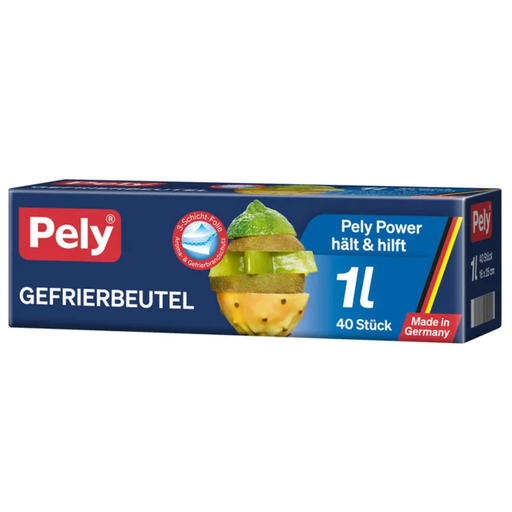
Why this product suits this profile: The 1-litre size is designed for everyday portions and smaller leftovers. According to pely’s product information, the pack contains 40 bags measuring 16 × 25 cm.
The clear size specification prevents unnecessarily large bags being bought for small portions.
Three-layer film according to the product information, BPA-free design and labelling area.
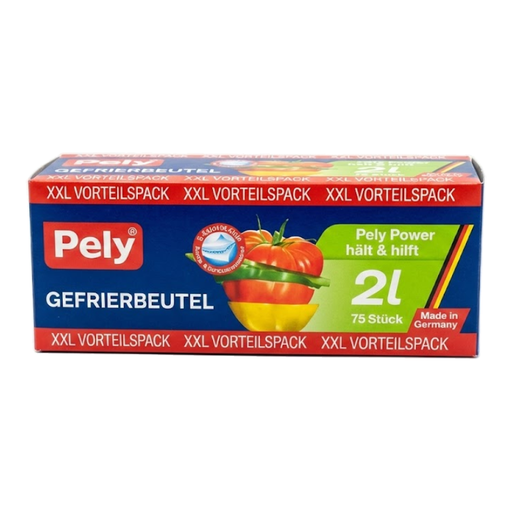
Why this product suits this profile: With 75 bags, the 2-litre size is aimed at households that regularly freeze medium-sized portions. According to pely’s product information, each bag measures 20 × 31 cm and features a three-layer film.
The pack size and bag dimensions are clearly stated, making it easier to calculate the price per bag.
75 bags per pack, extra-wide opening, labelling area and tear-resistant three-layer film according to the supplier’s information.
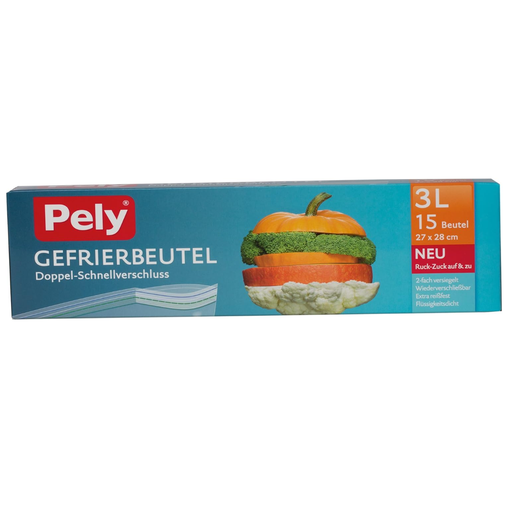
Why this product suits this profile: According to pely’s product information, the 3-litre bag with a double closure is designed for larger quantities, soups, stocks and marinades.
The double sealing track addresses the risk of liquids escaping through a single closure that has not been sealed completely.
15 bags, 3-litre capacity, double closure and labelling area according to the product description.
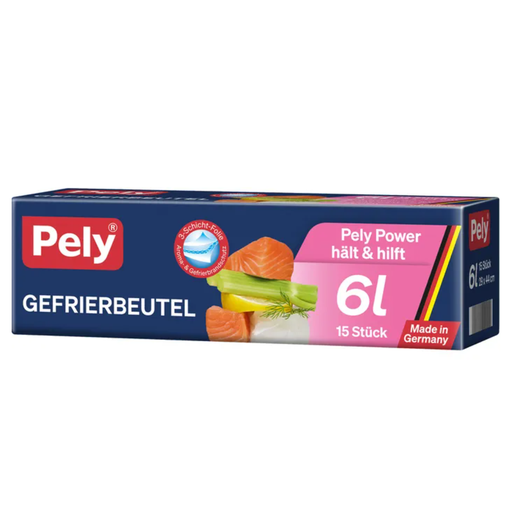
Why this product suits this profile: According to pely’s product information, the 6-litre format, measuring 29 × 44 cm, is intended for large quantities of food and bulky items.
The large dimensions are stated clearly, helping to prevent unsuitable purchases caused by bags that are too small for joints or harvest supplies.
15 bags per pack, 6-litre volume, three-layer film and suitability down to -40 °C according to the supplier’s information.
We have put together a complete, regularly updated list of products that fully meet these strict selection criteria and the safety regulations applicable in the EU.
Do not fill the bag right to the top. Leave some room so that the contents can expand as they freeze. For liquids, it is advisable to keep the bag upright until the contents are completely frozen. Remove excess air without stretching the film too much, and label the bag with its contents and the date.
Sharp bones or frozen edges can damage the film. When vacuum-packing food, the vacuum bags for food must be suitable for the vacuum sealer being used. Reusable silicone bags should be cleaned according to the manufacturer’s instructions after each use and dried completely.
The possible storage time depends on the food, temperature, packaging quality and amount of air remaining in the bag. For better organisation, note down the contents and freezing date. You can find guidance on recommended storage times, for example, from consumer advice centres or on food packaging.
Yes, provided the manufacturer states that they are suitable for this use and the closure is sealed correctly. For soups, sauces and marinades, leak-proof freezer bags with a double closure or a sturdy safety seal are practical choices. When freezing, the bag should stand in a bowl and should not be overfilled.
Freezer bags are usually sealed by hand and are suitable for everyday portioning. Vacuum bags generally require a compatible vacuum sealer and are designed for packaging with reduced air. Before buying, check the dimensions, material and compatibility with your appliance.