Families with a large bean harvest
If you regularly freeze large quantities in one go, consider the freezing capacity for each batch as well as having enough usable space.


First, check whether your existing four-star freezer compartment has enough space for the portions of beans you plan to freeze. For occasional batches, an additional appliance isn’t automatically worthwhile. If you regularly stock up, an upright freezer with drawers or a chest freezer with baskets could be a good fit. Compare the usable capacity, freezing capacity in kg/24 h, annual energy consumption and the dimensions of the specific model. Blanching prepares beans for freezing, but it doesn’t replace cooking them thoroughly before eating.
If you regularly freeze large quantities in one go, consider the freezing capacity for each batch as well as having enough usable space.
If you take out individual portions of beans as you need them, look for an interior layout that makes it easy to organise different foods.
If you only freeze occasional portions, check whether a suitable freezer compartment you already have will be enough before planning for another appliance.
A good fit if: you only freeze beans occasionally and have enough space for the new portions.
The trade-off: you won’t need another appliance, but you’ll need to check the available space and whether the compartment is suitable for freezing.
A good fit if: you regularly take out individual family portions and want to organise your supplies in drawers.
The trade-off: usable capacity and features vary by model; an appliance that’s too large could use more electricity than necessary.
A good fit if: you want to store larger quantities of beans alongside other foods and have room for a lid that opens upwards.
The trade-off: baskets rather than drawers affect how you organise your food; make sure the footprint and access suit the space where you’ll put it.
For home-frozen beans, the Federal Centre for Nutrition recommends using a four-star compartment suitable for freezing. For longer storage, keep portions at −18 °C or below.
| What to consider | What to look for | Who it matters to |
|---|---|---|
| Space and freezing capacity | Compare the available space, usable capacity in litres and freezing capacity in kg/24 h with the quantity you plan to freeze at once. | If I freeze a large batch of beans in one go, I need enough room for the portions and a suitable freezing capacity. Around 36% of consumers prioritise this combination. |
| Taking out portions | Check the layout and dimensions of the drawers or baskets, as well as the space available for your preferred freezer containers. | If you take out individual, labelled family portions as you need them, you’ll want to find them without a lengthy search. That’s why around 29% of consumers prioritise a well-organised interior. |
| Energy consumption | Compare the EU energy label, kWh/year and usable capacity across suitably sized models; calculate your own costs using your electricity tariff. | If an appliance runs between batches of beans, annual energy consumption matters to me as well as storage space. Around 21% of consumers put running costs first. |
| Where to put it | Check the appliance dimensions and the space needed to open it. If it’s going in a cold room, check that the specific model is approved for the ambient temperature. | If you can only use a cramped or cold space, you’ll need to take the dimensions and permitted ambient temperature into account. Around 14% of consumers prioritise where they’ll put the appliance. |
A large appliance gives you plenty of storage, but could use more electricity than necessary if you don’t need all that space. The German consumer advice centre recommends choosing a size that suits the amount you actually store.
Estimate how many portions you usually store at once, then compare usable capacity and kWh/year.
Litres tell you how much storage space there is; kg/24 h is the stated freezing capacity. Both figures matter when freezing a large batch of fresh beans.
Check both figures for the specific model and plan for the quantity you’ll be freezing at once.
For the AEG AHB531D1LW, the manufacturer describes LowFrost as reducing ice build-up; it isn’t the same as NoFrost. The Siemens GS51NAWCV is specifically listed as having NoFrost.
Compare the defrosting technology of the specific model rather than assuming similarly named features are the same.
Blanching green beans for three minutes prepares them for freezing, but it doesn’t replace cooking them thoroughly before eating. The Federal Institute for Risk Assessment warns that raw beans contain phasin.
Cook the beans thoroughly before serving them to your family. As a rule of thumb, the Federal Institute for Risk Assessment recommends boiling fresh pulses for at least 30 minutes.
The GS51NAWCV is a freestanding upright freezer for larger supplies that you use regularly.
The FH15E6W5 is a chest freezer with a 141 l capacity and basket storage.
The CF200CWN is a freestanding chest freezer with a 198 l capacity.
The AHB531D1LW is a larger chest freezer with a 308 l capacity and three baskets.
The model range includes freestanding upright freezers in various sizes, including the FNd 4234 Plus.
This selection includes fridge-freezers and separate upright freezers for households looking to freeze and store portions of beans in an organised way.
 No image available
Could suit households looking to combine their fridge and freezer needs in one appliance; check how much of the total capacity is available as freezer space.
Total capacity: 333 l. Total No Frost. Energy class C.
 No image available
For households looking for a separate upright freezer; check whether the stated capacity suits the portions of beans you usually store.
Capacity: 161 l. No-Frost. Energy class C.
 No image available
Could suit smaller supplies if you’re looking for a separate freezer with drawers.
Capacity: 85 l. Three drawers. Four-star freezer compartment.
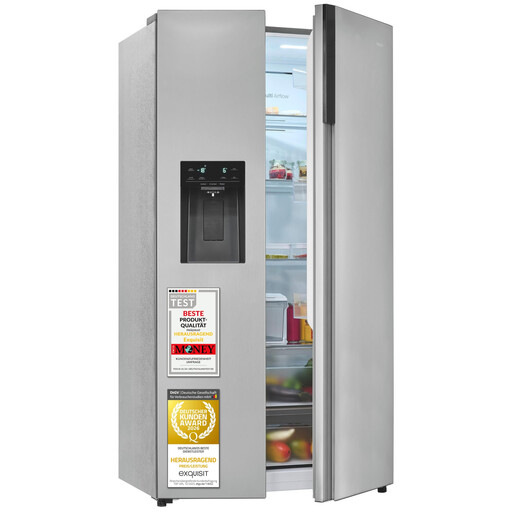 No image available
For households looking for fridge and freezer sections in a side-by-side appliance; check the stated freezer capacity as a proportion of the total.
Total capacity: 528 l. No Frost.
 No image available
Could suit larger supplies if you’re looking for a separate upright freezer with several compartments.
Capacity: 204 l. NoFrost. Energy class E.
Not necessarily. If your existing four-star compartment has enough free space, it may be all you need. If you regularly freeze larger quantities, the German consumer advice centre recommends considering a separate upright freezer or chest freezer.
No. The Federal Centre for Nutrition describes blanching for three minutes as preparation for freezing. The Federal Institute for Risk Assessment warns that raw beans contain phasin, so brief blanching doesn’t replace cooking them thoroughly before eating. As a rule of thumb for fresh pulses, the Institute recommends boiling them for at least 30 minutes.
After blanching, cool the beans in iced water and pack them with as little air as possible in suitable freezer bags or containers. Label them with the contents, quantity and date. If possible, don’t place new, unfrozen portions directly on top of food that’s already frozen. The Federal Centre for Nutrition recommends keeping home-frozen vegetables frozen until you’re ready to prepare them; beans must be cooked thoroughly before eating.
For appliances of a suitable size, compare the kWh/year figures on the EU energy label. To estimate your own costs, multiply the figure by your electricity tariff in €/kWh. Your statutory rights against the seller are separate from any voluntary guarantee. If a product is faulty, repair or replacement may be available in the first instance.
The EU energy label must be visible when covered new refrigeration and freezing appliances are sold online. Under § 17 ElektroG, retailers that meet the conditions set out there must accept a corresponding old appliance free of charge when you buy a new one. For home delivery, the collection service provided for must also be free. Check the arrangements with the seller before delivery.