
Lieferung heute & morgen

Qualitätsgarantie

Willkommens-Angebote freischalten: KOSTENLOSE Lieferung | Bis zu 80 % RABATT | Kostenlose 30-Tage-JoyPlus-Testphase
App herunterladen
A new freezer is an investment intended to make daily life easier for years to come. However, the market is flooded with technical jargon, new energy labels, and marketing promises that complicate the selection process. All too often, impulse buys lead to unexpectedly high electricity bills, disruptive operating noise, or the constant hassle of manual defrosting.
As your Joybuy Product Recommendation Officer, I'm here to help you avoid these pitfalls. We'll focus on the facts that truly matter, so you can find an appliance that precisely fits your needs without overpaying for superfluous features.
Before we dive into the key features, let's look at the three most common mistakes that can lead to buyer's remorse.
To make the right choice, you should focus on three core aspects. These are the primary determinants of everyday usability and long-term operating costs.
The first decision concerns the basic design. Both types have specific advantages and disadvantages:
As a rule of thumb for usable capacity:
Manual defrosting is one of the most disliked household chores. Modern technologies can significantly reduce or completely eliminate this effort.
Operating an energy-efficient freezer saves money and protects the environment. Pay attention to the annual consumption in kWh indicated on the energy label. Multiply this value by your electricity rate (e.g., €0.30/kWh) to calculate the annual operating costs.
The noise level is specified in decibels (dB). Here is a guide:
Here are some models that represent a considered choice for different user profiles, based on objective criteria.

Why This Fits Their Persona: Ideal for singles, couples, or as a secondary unit in an office. With 60 litres of capacity, this mini freezer offers enough space for the essentials without taking up much room. The three compartments allow for structured storage.
This model offers a clear 4-star freezing performance and mechanical temperature control. Instead of vague promises, it delivers solid, fundamental features for compact needs.
Compact Dimensions: Fits under standard countertops. Reversible Door Hinge: The door can be hinged on the left or right, making placement easier.
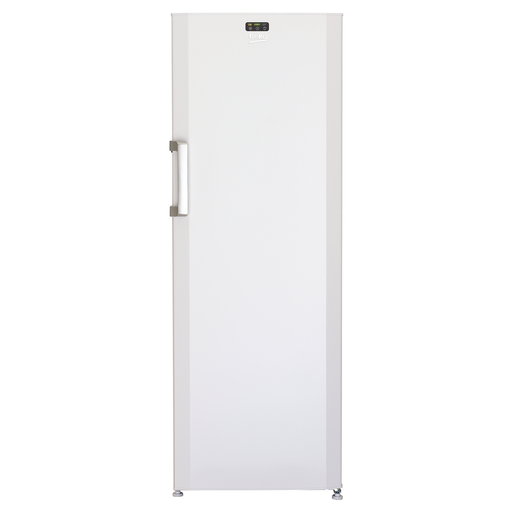
Why This Fits Their Persona: With 244 litres of usable capacity, this Beko freezer is ideal for families who buy in bulk or store produce from their own garden. The combination of drawers and flap compartments ensures everything stays organised.
It solves the placement problem: according to the manufacturer, it is suitable for operation in unheated rooms down to -15°C, directly addressing the climate class pitfall. Its operating noise is clearly specified at 36 dB.
MinFrost Technology: Significantly reduces ice build-up and minimises defrosting effort. Temperature Alarm: Warns of an undesirable temperature rise, thus protecting the frozen goods.

Why This Fits Their Persona: For users who value state-of-the-art technology, high efficiency, and maximum flexibility. With 301 litres, it offers enormous space and can even be converted into a refrigerator if needed.
Its Class C energy efficiency rating is an objectively strong value that goes beyond vague promises of savings. The Total No-Frost technology completely eliminates defrosting, ensuring maximum convenience.
Instaswitch Function: The appliance can be flexibly used as either a freezer or a refrigerator. Very Quiet Operation: At approx. 36-37 dB, it is also an excellent choice for open-plan kitchens.
We have compiled a complete, up-to-date list of products that fully meet these strict selection criteria and German safety regulations.
As a general guideline, you can plan for 50 to 80 litres of usable capacity per person in your household. If you regularly buy in bulk, do a lot of meal prep, or freeze a large garden harvest, you should calculate with 100 to 130 litres per person instead.
No-Frost technology is a circulation system that reduces the humidity inside the freezer and directs it outwards. This prevents ice from forming on the interior walls or on the frozen food itself. The biggest advantage is that manual defrosting of the appliance is no longer necessary. Furthermore, energy consumption remains consistently low because there is no insulating layer of ice to impede cooling performance.
The perception of loudness is subjective, but decibel values provide an objective comparison. It is fair to call a freezer quiet at values below 40 dB. Models rated at 38 dB or less are considered very quiet and are barely audible in a normal living environment. Appliances around 35 dB are whisper-quiet and ideal for open-plan kitchens or studio apartments.