
Lieferung heute & morgen

Qualitätsgarantie

Willkommens-Angebote freischalten: KOSTENLOSE Lieferung | Bis zu 80 % RABATT | Kostenlose 30-Tage-JoyPlus-Testphase
App herunterladen
A freezer gives you extra space for frozen food, supplies and food you’ve frozen yourself. The right style depends largely on the space available, the size of your household and how convenient you want it to be to use. A freezer that’s too small can quickly leave you short of space, while an oversized model uses more electricity than necessary and takes up valuable floor space.
Before you buy, it’s also worth looking out for a few common marketing pitfalls. Claims such as ‘quiet’, ‘fast freezing’ or ‘maintenance-free’ are only useful when backed up by specific measurements and technical details.
A freezer with 160 litres of usable capacity needs more than just the stated appliance width. You also need to allow for clearance from walls, the door opening and ventilation. With a chest freezer, you’ll also need to leave enough space in front of the appliance to open the lid fully.
So, check:
A No Frost freezer reduces ice build-up using a fan-assisted cooling system. This can make manual defrosting much less of a chore. However, you’ll still need to clean the interior, door seal and ventilation openings regularly. Low Frost and manual systems still need to be defrosted occasionally.
The dB(A) rating matters in flats, open-plan kitchens, offices and holiday homes. A model rated at 36 to 40 dB may suit many living spaces, but how noisy it seems also depends on the flooring, distance from the wall and compressor cycles.
For running costs, the most important figure is the stated annual energy consumption in kWh. The EU energy efficiency rating from A to G is useful for comparing models, but it’s still worth checking the specific kWh figure.
As a rough guide, choose your capacity based on how you’ll use the freezer:
A freestanding freezer with drawers usually makes it easier to see what you have than a deep, undivided compartment. Check the number, height and transparency of the drawers. Shallow compartments are handy for smaller packs, while larger containers need more interior height.
A 4-star freezer compartment is an important technical feature for storing frozen food long term. The freezing capacity, measured in kilograms per 24 hours, tells you how much fresh food the appliance can freeze during that time.
A freezer with a fast-freeze function temporarily lowers the temperature further. This is particularly useful when adding a larger quantity of fresh food. Check whether the function switches off automatically or needs to be turned off manually.
A freezer with a reversible door is easier to fit into a kitchen, cellar or utility room. With a chest freezer, the direction and clearance needed to open the lid are the main considerations.
If you’re keeping the freezer in a garage or an unheated room, check the permitted ambient temperature. Some models are specifically designed to work in colder rooms, but this isn’t a given with every freezer. Appliances should also be placed in a dry, level spot with adequate ventilation.

Why this product suits you: This compact freestanding model offers 60 litres of usable capacity, making it suitable for singles, small households, offices or as an extra freezer alongside your existing fridge.
Three separate compartments make it easier to organise your food and stop small packs getting lost at the back. The reversible door is handy when space is tight.
60 litres of usable capacity, 4-star freezing performance, three temperature settings and a stated freezing temperature of down to -24 °C.
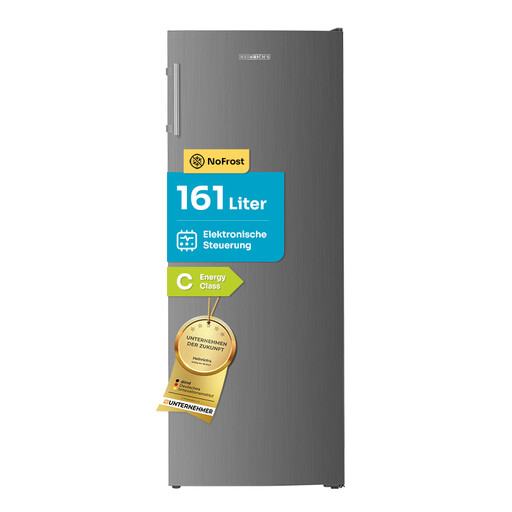
Why this product suits you: This model combines 161 litres of storage with No Frost, several drawers and an electronic display. It’s a good fit for households looking to keep supplies organised and cut down on defrosting.
No Frost helps prevent ice build-up, while three freezer drawers and two compartments make it easier to find food without stacking it haphazardly.
161 litres of usable capacity, energy efficiency class C, a fast-freeze function down to -22 °C and a reversible door.

Why this product suits you: This chest freezer is designed for families, bulk buyers and anyone using a cellar, garage or utility room who needs plenty of capacity.
Two baskets, a counterbalanced lid and the Multi-Zone function make access and flexible use easier, so you’re less likely to lose track of food stored at the bottom.
198 litres of capacity, energy efficiency class C, a super-freeze function and operation at ambient temperatures down to -15 °C according to the product details.
We’ve put together a complete, regularly updated list of products that meet these strict selection criteria and fully comply with the safety regulations in force in the EU.
A 30 to 60-litre mini freezer may be enough for one person. Couples and small families often find that around 100 to 160 litres works well. For larger quantities, shared use or regular batch cooking, a model with 190 litres or more, or a chest freezer, may be a better choice. What matters is the usable capacity, not just the external dimensions.
Annual running costs depend on the stated energy consumption in kWh, your electricity tariff, the room temperature and how you use the appliance. For a rough estimate, multiply the annual consumption in kWh by your price per kWh. An appliance that’s correctly set to the right temperature and well stocked will generally be easier to budget for than one that’s frequently opened or overloaded.
There’s no guaranteed lifespan. It depends on factors such as the compressor, door seal, location, maintenance and operating conditions. Regular cleaning, keeping ventilation openings clear and avoiding unnecessary door openings can help keep it running well. When choosing a model, also check the warranty terms, availability of spare parts and the manufacturer’s guidance.