
Lieferung heute & morgen

Qualitätsgarantie

Willkommens-Angebote freischalten: KOSTENLOSE Lieferung | Bis zu 80 % RABATT | Kostenlose 30-Tage-JoyPlus-Testphase
App herunterladen
An additional freezer creates more space for provisions, frozen meals and larger shops. The range extends from compact mini freezers to large upright models with a usable capacity of over 200 litres. However, not every model is suitable for every household or installation location.
Typical buying mistakes arise from three points:
A freestanding freezer can be installed flexibly in the kitchen, utility room, cellar or office. Its upright design often provides drawers and compartments, making it easy to organise food clearly. A table-top freezer or mini freezer with around 30 to 100 litres is suitable for smaller homes.
A chest freezer makes use of space across its width and often offers a spacious interior for larger packages. Smaller items may, however, end up stacked on top of one another. Baskets and clear organisation are therefore particularly important.
For families or households that buy provisions in bulk, a 200-litre freezer can be a sensible choice. Before buying, however, you should check the door width, floor space, ceiling height and transport route. For example, a 204-litre upright model may be around 170 centimetres tall.
Net capacity is more relevant for comparison than gross capacity. Drawers, baskets and interior walls reduce the space that is actually available. You should also check:
A reversible door makes it easier to adapt the appliance to kitchen units or narrow spaces. With a chest freezer, on the other hand, there must be enough space above the appliance to open the lid.
A freezer with NoFrost removes moist air in a controlled manner, thereby reducing ice formation inside the appliance. This makes cleaning easier and prevents drawers from becoming difficult to open because of frost. Models with MinFrost or manual defrosting can also be suitable, but depending on how they are used, they require regular maintenance.
A fast-freezing function lowers the temperature further for a limited period when larger quantities of fresh food are being stored. Pay attention to the stated freezing capacity in kilograms per 24 hours and do not exceed it. The function should be switched off again after freezing, in accordance with the operating instructions.
EU energy efficiency classes range from A to G. A class E appliance is not automatically equally economical for every household. Always compare annual consumption in kWh together with the capacity.
A quiet freezer producing around 37 to 40 dB may be suitable for open-plan kitchens, studio flats or offices. For cellars and garages, the climate class and permitted ambient temperature range are also important. A model that, according to the manufacturer, can operate at an ambient temperature of −15 °C is generally more flexible for cold, unheated rooms. Nevertheless, the specific installation must comply with the operating instructions.
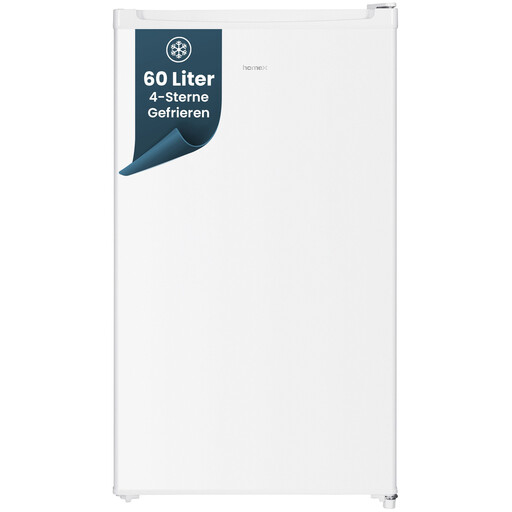
Why this product suits the profile: With 60 litres of usable capacity, a height of 85 centimetres and mechanical temperature control, this appliance is suitable for single occupants, couples or use as a second appliance.
The two transparent drawers and an additional compartment make sorting easier, while the reversible door allows more flexible installation.
4-star freezer compartment, 2.8 kg freezing capacity per 24 hours, 40 dB and energy efficiency class E.
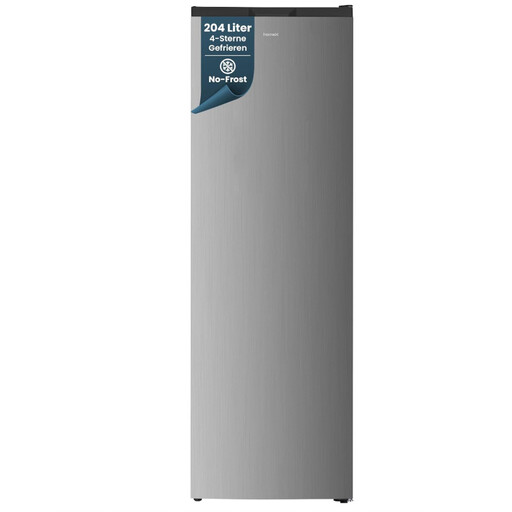
Why this product suits the profile: Its large capacity and NoFrost features make it appealing to families and house shares that regularly buy provisions in bulk.
The six storage areas help keep everything organised, NoFrost reduces ice formation and the reversible door can be adapted to the room.
204 litres of net capacity, 39 dB, energy efficiency class E, NoFrost and Super-Frost function.

Why this product suits the profile: The chest freezer offers plenty of storage space for larger packs and, according to the product details, can be used in unheated rooms down to −15 °C.
Two baskets prevent completely disorganised storage. The lid stay keeps the lid open in different positions, making loading easier.
198 litres of usable capacity, energy efficiency class C, 126 kWh annual consumption, 13 kg freezing capacity per 24 hours and Multi-Zone function.

Why this product suits the profile: This compact appliance can switch between cooling and freezing modes. With 95 litres of capacity, it fits into many smaller homes, garages or utility spaces.
The removable basket makes it easier to access smaller items. A drain allows controlled water drainage during manual defrosting.
38 dB, seven-level thermostat, 165 kWh annual consumption and switchable cooling or freezing mode.
We have compiled a complete, regularly updated list of products that fully meet these strict selection criteria and the safety regulations applicable in the EU.
Place the freezer on a level, dry and adequately ventilated surface. Do not cover the ventilation grilles. Maintain the clearance between the appliance and the wall specified in the instructions. After transport, the appliance must stand upright for several hours before it is connected, depending on the manufacturer’s instructions.
For a garage or cellar, room temperature is not the only consideration. Humidity, major temperature fluctuations and a lack of frost protection can also cause problems. You should therefore check the climate class and the expressly approved ambient temperature. In the event of a power cut, keep the door closed so that the cold is retained for as long as possible.
Around 60 to 100 litres may be enough for single occupants or couples. Families that regularly buy provisions in bulk often choose between 150 and 250 litres. Your shopping habits, available space and preferred level of organisation are the key factors.
Running costs depend on annual consumption in kWh and your electricity tariff. Example calculation: an appliance with annual consumption of 200 kWh would cost around 70 euros per year to run at an assumed unit price of 0,35 euros per kWh. The actual amount may vary.
A fixed service life cannot be guaranteed. It depends, among other things, on usage, location, ventilation, door seal and maintenance. Regular cleaning, loading the appliance correctly and keeping the ventilation openings clear can help support reliable operation.