
Lieferung heute & morgen

Qualitätsgarantie

Willkommens-Angebote freischalten: KOSTENLOSE Lieferung | Bis zu 80 % RABATT | Kostenlose 30-Tage-JoyPlus-Testphase
App herunterladen
A freezer can provide extra storage, free up space in your fridge and make it easier to freeze food in portions. However, when buying a freezer, capacity and a low price are not the only factors that matter. Some appliances require more floor space than expected, while others create extra work because they need to be defrosted manually.
Three issues are particularly common causes of unsuitable purchases:
For single people or limited additional storage, a small freezer with a capacity of around 30 to 95 litres is often sufficient. A countertop freezer or compact freestanding model can often be placed beneath a worktop or in a small kitchen.
For couples and smaller families, around 120 to 200 litres is often a suitable capacity range. If you regularly buy larger quantities, batch-cook or store seasonal food, you may want to consider a large freezer with a capacity of around 200 litres or more. Models of approximately 280 to 400 litres do, however, require enough room and a suitable route for delivery and installation.
A freestanding freezer can be positioned flexibly, but should not be placed directly next to heat sources or without adequate ventilation. A chest freezer offers plenty of usable storage space across its width, but is less convenient when sorting through its contents. Transparent drawers or flap compartments are more practical for food you use frequently.
A freezer with a 4-star compartment is designed for the long-term storage of frozen food. The star rating indicates the temperature class that can be reached, not necessarily the energy efficiency or the quality of the interior layout.
You should also check the freezing capacity in kilograms per 24 hours. If you often freeze fresh food, a fast-freeze function can be useful. It temporarily lowers the temperature further so that new food freezes more quickly. The function should only be used according to the operating instructions and should not be left on permanently.
For households that rarely have time to defrost an appliance, No Frost is a practical feature. You should still check the information on noise levels, annual consumption and the interior layout.
A freezer for the garage must be suitable for the ambient temperatures found there. The climate class and permitted minimum temperature are more important than general claims about flexible positioning. Some of the appliances listed here are specified as suitable for use in unheated rooms down to -15 °C. This information only applies under the relevant manufacturer’s conditions.
You should also measure the following before buying:
A low noise level of around 34 to 41 dB may be important in open-plan living areas, offices or holiday homes. However, this figure describes airborne noise emissions under specified conditions and does not cover every possible operating phase.
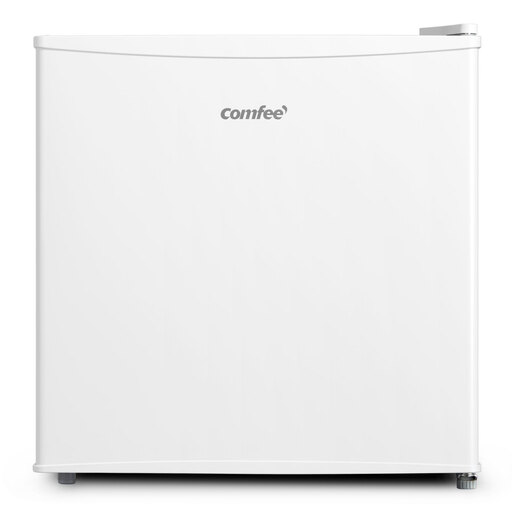
Why this product suits this profile: This compact appliance is suitable for single people, offices, holiday homes or as additional storage where floor space is limited. It takes up very little room and has a reversible door.
With a capacity of 31 litres, there is less risk of buying an oversized appliance for a small amount of storage. Annual consumption is stated as 147 kWh.
4-star compartment, freezing capacity of up to 2 kg per 24 hours, adjustable feet and an operating noise level of 41 dB.

Why this product suits this profile: This freestanding model combines a large usable capacity with No Frost, Fast Freeze and a sensor display. It is suitable for families and households that regularly buy food in bulk.
The product details specify 286 litres of usable capacity, 34 dB and energy efficiency class D. This makes it easier to compare the space required, noise level and consumption before buying.
No Frost, freezing capacity of 17 kg per 24 hours, five drawers and suitability for unheated rooms down to -15 °C according to the product information.

Why this product suits this profile: This chest freezer is designed for households with larger stocks of food, frequent freezing and a suitable location in the cellar or utility room.
The WinterProof specification down to -15 °C is designed for installation in cool rooms. You should check the climate conditions, available floor space and access beforehand.
Energy efficiency class D, annual consumption of 146 kWh, 39 dB, fast-freeze functions and switchable Multi-Zone.
We have put together a complete, regularly updated list of products that fully meet these strict selection criteria and the safety regulations applicable in the EU.
When comparing an energy-efficient freezer, compare its annual consumption in kWh with your own electricity tariff. Energy efficiency class D or E provides a guide on the EU scale from A to G, but is not a direct indication of running costs. An appliance with an Eco mode, a good door seal and the right capacity may be more practical in everyday use than an oversized model with unused interior space.
Make sure the appliance is level, keep the ventilation openings clear and allow hot food to cool down first. With manual-defrost models, ice should not be removed using sharp objects. With a freezer with a fast-freeze function, activation is generally only needed for larger quantities of fresh food, in accordance with the operating instructions.
In addition to the external dimensions, you need to allow for ventilation clearances and room to open the door. Also check that the appliance will fit through doors, staircases and corridors.
The service life depends on usage, maintenance, location, the door seal and the compressor. It would not be reliable to give one general figure for every model. Regular cleaning, unobstructed ventilation and avoiding unnecessarily long periods with the door open all help to ensure trouble-free operation.
Annual electricity costs are calculated by multiplying the stated annual consumption in kWh by your electricity price. Before buying, therefore, compare not only the energy efficiency class, but also consumption, usable capacity and how much of the appliance you will actually use.