
Lieferung heute & morgen

Qualitätsgarantie

Willkommens-Angebote freischalten: KOSTENLOSE Lieferung | Bis zu 80 % RABATT | Kostenlose 30-Tage-JoyPlus-Testphase
App herunterladen
Anyone looking to buy a freezer often compares capacity and price first. However, that only tells part of the story: a model may offer plenty of storage space on paper, yet be impractical in everyday use because of unsuitable dimensions, excessive ice build-up or a lack of warning functions. For households, families, flatshares and anyone storing provisions, several technical specifications need to be considered together.
The advertised litre capacity does not always reflect the genuinely usable interior space. Drawers, baskets and technical components reduce the available capacity. Therefore, pay attention to the net capacity. A freezer with 177 litres of usable space may be more practical in everyday use than a larger model with an inconvenient interior layout.
A freezer with NoFrost prevents manual ice build-up through air circulation and defrosting technology. This makes maintenance easier, but depending on the model, it may also mean a higher noise level or different energy consumption. For models without NoFrost, Low Frost or MinFrost are practical alternatives, as they reduce ice formation but do not eliminate the need for regular defrosting entirely.
A freezer for the garage must be suitable for the ambient temperatures expected there. Check the stated climate class and permitted temperature range. According to the manufacturer’s specifications, some models in the selection can be operated in unheated rooms down to -15 °C. This does not automatically apply to every appliance.
A freestanding freezer makes use of vertical space and usually has drawers or flaps. This makes it easier to organise meals, meat, vegetables and baked goods. A small freezer with a capacity of around 85 to 100 litres is suitable for individuals, couples, offices or as an additional appliance.
A chest freezer opens from the top and retains comparatively more cold air inside when opened. However, accessing food stored at the bottom is less straightforward. If you want to buy a chest freezer, measure the floor space, lid opening and clearance above the appliance. Models of around 100 litres often fit into small utility rooms, while large chest freezers require considerably more floor space.
A 200-litre freezer should have several separate compartments or drawers so that the interior does not become an awkward stack that is difficult to access. In a chest freezer, removable baskets help to organise smaller packs.
The EU energy label rates appliances on a scale from A to G. The energy efficiency class E is represented by several available models. For running costs, the stated annual energy consumption in kWh is also important. Multiply this figure by your electricity tariff to get a rough annual estimate.
Also pay attention to:
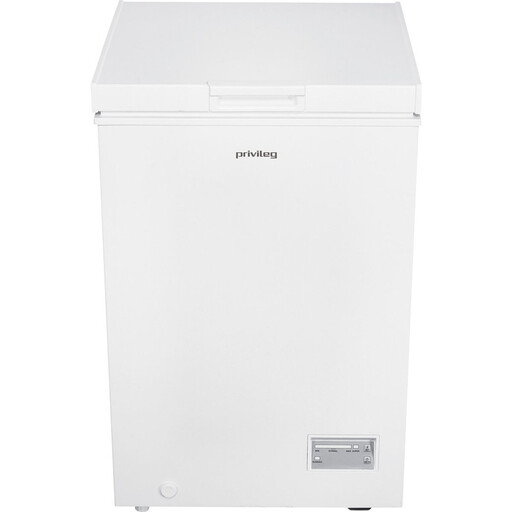
Why this product suits the profile: This compact chest freezer offers 98 litres of usable capacity, two baskets and a footprint of around 55 × 54 cm. This makes it suitable for small households or as additional freezer space.
The stated usable capacity, baskets and visual temperature alarm make the available space and important warnings easy to understand.
Super-freezing function, a freezing capacity of 6 kg per 24 hours and a noise level of 40 dB(A).
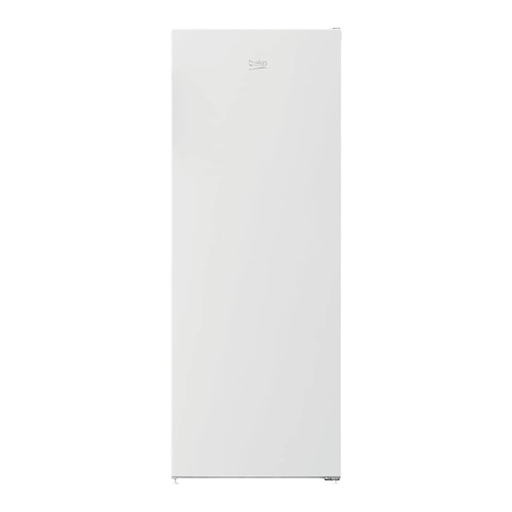
Why this product suits the profile: Three drawers and two compartments organise the interior. NoFrost, the fast-freezing function and the reversible door hinge are designed for regular household use.
NoFrost technology reduces the need for manual maintenance, while the temperature alarm helps address the risk of unnoticed temperature increases.
177 litres of usable capacity, 40 dB and, according to the product details, suitability for unheated rooms down to -15 °C.
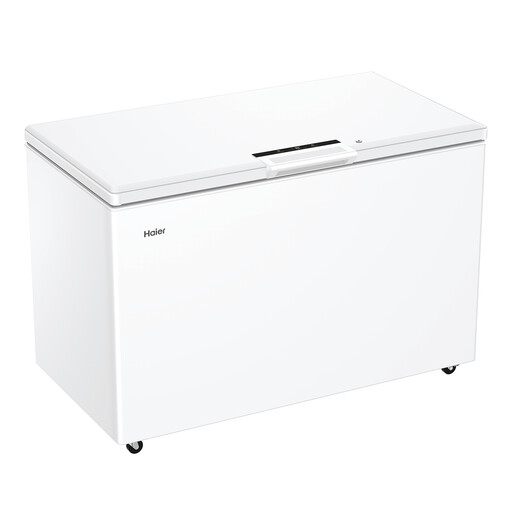
Why this product suits the profile: The spacious interior is aimed at families and households that store provisions, bulk packs or seasonal food. Three baskets support basic organisation.
The dimensions, three baskets and LED interior lighting help make the large storage space practical to plan and easy to access.
418 litres, Low Frost, fast-freezing function, 39 dB and wheels for positioning.

Why this product suits the profile: The chest freezer can also be used as a fridge thanks to its Multi-Zone function. According to the product details, WinterProof supports operation in unheated rooms down to -15 °C.
The stated temperature range and electronic controls make it easier to choose this model for a cellar, utility room or garage.
198 litres, energy efficiency class C, annual consumption of 126 kWh according to the product details and a freezing capacity of 13 kg per 24 hours.
We have compiled a complete, regularly updated list of products that fully meet these strict selection criteria and the safety regulations applicable in the EU.
Measure more than just the footprint: check doors, staircases, corridors and the clearance needed to open the appliance. For a freezer with a reversible door hinge, check whether the conversion can be carried out yourself according to the instructions or whether it requires a qualified professional.
After delivery, the appliance should remain upright for several hours before being connected, depending on its transport position. The manufacturer’s precise instructions are decisive. Before filling it, allow the appliance to cool to the intended temperature and keep the ventilation openings clear.
This depends on how often you shop and how much food you store. For one person or a small amount of additional storage, 85 to 100 litres may be sufficient. Families or households that regularly prepare meals in advance often choose 140 to 200 litres. A large freezer or chest freezer from around 400 litres is particularly useful for extensive food storage.
NoFrost can reduce maintenance because manual defrosting is no longer necessary. Whether the technology is worthwhile depends on how intensively the appliance is used, its purchase price, noise level and annual energy consumption. If you only defrost occasionally, a Low Frost or MinFrost model may be perfectly adequate.
For a rough calculation, multiply the stated annual consumption in kilowatt-hours by your electricity price per kilowatt-hour. Actual consumption depends on factors including room temperature, how full the appliance is, where it is installed, how often the door is opened and the condition of the door seal.