
Lieferung heute & morgen

Qualitätsgarantie

Willkommens-Angebote freischalten: KOSTENLOSE Lieferung | Bis zu 80 % RABATT | Kostenlose 30-Tage-JoyPlus-Testphase
App herunterladen
Freezer bags are part of the basic equipment in many British households. They allow you to portion meat, vegetables and leftovers, make meal prep easier and keep your freezer organised. However, a low price does not automatically mean you are getting the right solution. Capacity, film thickness, closure type and intended use are the key factors.
A 1L freezer bag can offer different amounts of space for flat or bulky food, depending on its shape. That is why the dimensions are just as important as the capacity when choosing a bag. A bag measuring 16 × 25 cm is better suited to portions and leftovers, while a 4L freezer bag measuring 25 × 38 cm can also hold larger loaves of bread, roasts or poultry.
Not every bag with a zip closure is equally suitable for liquids. For soups, marinades or sauces, a double closure, a broad base and a sturdy edge are useful features. A simple knot can work, but it is harder to manage and more prone to leaks when the film is thin.
Reusable freezer bags made from silicone or composite materials can be useful for certain applications. However, their service life depends on cleaning, drying and the food placed inside them. Sharp bones, hard frozen food and harsh cleaning products can damage the material. For frequent portioning, a pack of single-use bags may be more straightforward.
Do not fill the bags right up to the closure. Liquids expand when frozen. Leaving some space at the top reduces pressure on the sealed seams and closure.
Multi-layer films can offer greater tear resistance than very thin single-layer films. The pely freezer bags in this selection are specified as having a three-layer film. Several models are rated as flexible down to -40 °C. This information should always be checked against the product details and is not a substitute for filling the bag correctly.
Clear material information is important for food contact. BPA-free freezer bags can be a suitable choice when this is expressly stated on the product page or packaging. The pely models mentioned here are specified as being made from BPA-free material. A labelling panel makes it easier to note the contents and freezing date, helping you use up older supplies first.
A clip or knot is simple and suitable for dry, compact food. A freezer bag with a zip closure can be opened and resealed more quickly. For liquids and marinated foods, a freezer bag with a double closure can provide additional security. Even so, the bag should be frozen upright in a bowl until the contents have solidified.
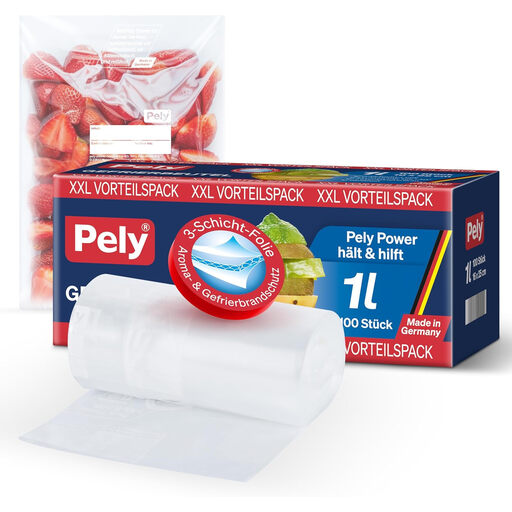
Why this product suits this profile: The pack of 100 is designed for regular portioning at home, for families and for meal prep. Measuring 16 × 25 cm, it is suitable for many everyday portions.
The specified three-layer, BPA-free film and labelling panel make the material and organisation easy to understand.
100 bags per pack, 1-litre capacity and made in Germany according to the product details.
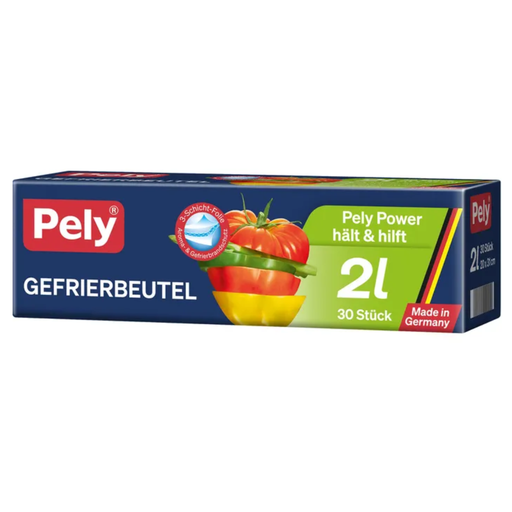
Why this product suits this profile: With a 2-litre capacity and dimensions of 20 × 31 cm, these bags offer a well-balanced size for family portions, baked goods and prepared meals.
The precise dimensions mean that suitability for everyday use is not judged by the litre capacity alone.
Three-layer BPA-free film, labelling panel and specified flexibility down to -40 °C.
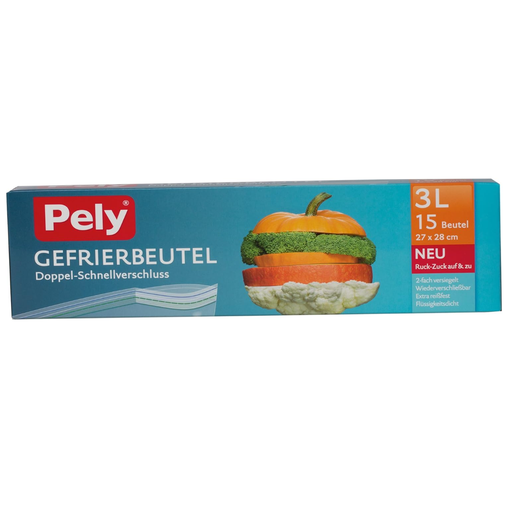
Why this product suits this profile: A 3-litre bag with a double closure is particularly practical for soups, stocks, marinades and larger meal-prep quantities.
The two closure tracks address the typical weak point of simple closures when holding liquid contents.
3-litre capacity, 15 bags per pack and a specified double closure.
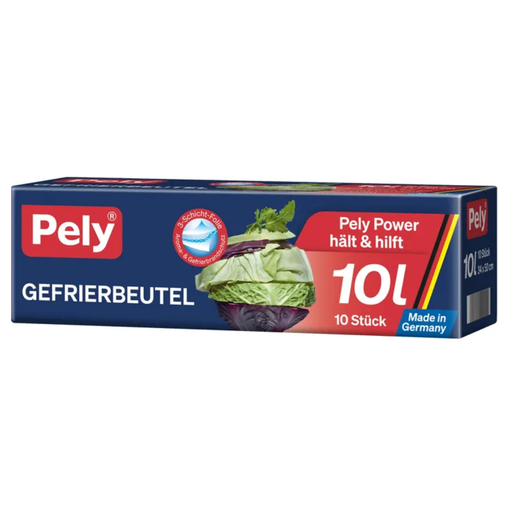
Why this product suits this profile: Measuring 34 × 50 cm and with a capacity of 10 litres, these bags are designed for bulky food and larger quantities of provisions.
The large dimensions are clearly stated, reducing the risk of forcing bulky food into bags that are too small.
10-litre capacity, three-layer PE film, BPA-free material and 10 bags per pack.
We have put together a complete, regularly updated list of products that fully meet these strict selection criteria and the safety regulations applicable in the EU.
Reusable freezer bags should be cleaned with a mild detergent after every use and dried completely. For composite bags, always follow the relevant manufacturer’s instructions regarding temperature, dishwasher use, microwaving and heating. Being suitable for freezing does not automatically mean that a bag is suitable for cooking or reheating.
For individual portions, berries or leftovers, a 1L freezer bag is often sufficient. For family-sized portions or several ingredients, 2 to 3 litres are more practical. The right choice depends on the shape, fill height and dimensions of the bag.
Food should be packaged with as little air as possible, sealed securely and labelled with the date. Multi-layer film can improve protection, but it does not replace proper storage. The freezer should remain consistently cold and should not be left open unnecessarily long.
A correctly closed zip closure can work reliably for many solid and liquid foods. For soups or marinades, freezer bags with a double closure provide an additional sealing track. For safety, liquid contents should always be frozen upright and preferably in a bowl.